
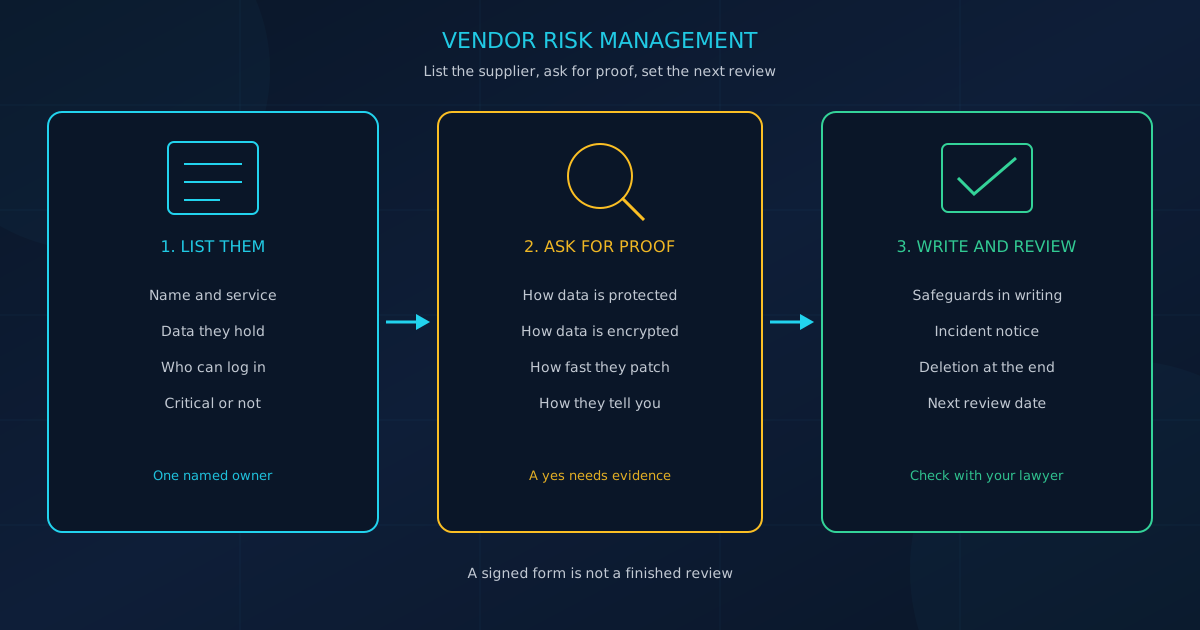
Vendor risk management is the work of checking an IT or software supplier before that supplier holds your data or can reach your systems, and of checking again after you sign. In October 2024, NIST Special Publication 1305 described cybersecurity supply chain risk management as "a systematic process for managing exposure to cybersecurity risk throughout supply chains and developing appropriate response strategies, policies, processes, and procedures." Small and mid-sized businesses in Canada and the United States can use the same sequence for payroll, file storage, and email administration.
As our note on third-party vendor risk puts it: "When you share data with a vendor or grant them access to your systems, their security posture becomes relevant to yours."
What is vendor risk management?
Vendor risk management is a named owner, a supplier list, and a repeatable check of anyone who holds data or has access. On February 26, 2024, NIST published Cybersecurity Framework 2.0 and placed that work in the Govern function. GV.SC-06 says: "Planning and due diligence are performed to reduce risks before entering into formal supplier or other third-party relationships." NIST's Small Business Cybersecurity Corner, updated August 24, 2026, describes the same job as identifying, assessing, and mitigating supply-chain risk.
16 CFR 314.2, revised as of January 1, 2025, defines a service provider as "any person or entity that receives, maintains, processes, or otherwise is permitted access to customer information through its provision of services directly to a financial institution that is subject to this part." The record to keep is what that supplier can touch, what it agreed to, and the next review date.
Who has to vet IT and software suppliers?
Some businesses must oversee suppliers because a rule says so. Under 16 CFR 314.4(f), a covered financial institution shall select and retain service providers capable of maintaining appropriate safeguards, require those safeguards by contract, and periodically assess them. Massachusetts 201 CMR 17.03 requires persons who own or license personal information about a resident of the Commonwealth to oversee third-party service providers. PIPEDA principle 4.1.3 requires comparable protection when personal information goes to a third party for processing.
Whether the FTC rule applies is a legal question. Our guide to a written information security program says the definition includes tax preparers, mortgage brokers, and automobile dealerships that lease vehicles on a nonoperating basis for longer than 90 days. Mass.gov posts 201 CMR 17.00 as an unofficial version and says it is not an official statement of the regulations. Its scope section says the provisions apply to all persons that own or license personal information about a resident of the Commonwealth.
PIPEDA Schedule 1, current to October 29, 2026, states: "An organization is responsible for personal information in its possession or custody, including information that has been transferred to a third party for processing. The organization shall use contractual or other means to provide a comparable level of protection while the information is being processed by a third party." The Office of the Privacy Commissioner is accepting comments until December 4, 2026, on its guidance on assessing third-party service providers. That guidance says organizations should assess a third party's privacy practices before using, or entering into an agreement to obtain, a prospective provider's services.
This article is general information, not legal advice and not a contract. Before you decide whether 16 CFR Part 314 or 201 CMR 17.00 applies, and before you send any clause, check with your lawyer.
What should vendor risk management check before you sign?
Before you sign, write down what the supplier will hold, who can reach it, and what evidence you will keep. In March 2025, the Canadian Centre for Cyber Security said in ITSAP.00.070 that the first step is to know your vendors who have access to your data and support your critical business functions. The note says you cannot look at all vendors with the same approach, and it says to inventory third parties and classify them by criticality.
Start from an IT asset inventory, which that guide calls the working list of hardware, software, cloud accounts, and the data those things hold. It also quotes NIST CSF 2.0 subcategory ID.AM-04: "Inventories of services provided by suppliers are maintained."
ITSAP.00.070 gives these questions for IT service providers and vendors. Keep the answers in the file:
- "How do you protect customer data?"
- "How do you encrypt data?"
- "Where do you store customer information, in the cloud, onsite, on a PC?"
- "Do you share information with third-party contractors?"
- "How do you ensure software is up to date and how do you address known vulnerabilities?"
- "How long do you retain information and how do you destroy it?"
- "What is your disaster recovery strategy?"
- "Will you inform me if there has been a cyber event? If so, how quickly?"
A yes without a document is not evidence. CISA's Vendor Supply Chain Risk Management Template says: "They will aid in mitigating (not eliminating) risk." Our guide to vendor security questionnaires quotes that same limit.
For cloud suppliers, Baseline Cyber Security Controls V1.2, section 3.10, states: "Organizations should require that all their cloud service providers share an AICPA SSAE 18 SOC 3 report that states that they achieved Trust Service Principles compliance. If a provider cannot provide this certification, the organization should consider alternative providers." Our SOC 2 guide says a small business typically needs a SOC 2 report when enterprise customers or partners request one during vendor security reviews, and that SOC 2 is an attestation report, not a certification.
How do you put supplier safeguards in the contract?
A contract turns a sales promise into a duty the supplier has agreed to. Section 314.4(f)(2) requires covered firms to require service providers "by contract to implement and maintain such safeguards." Massachusetts 201 CMR 17.03(2)(f) requires third-party service providers "by contract to implement and maintain such appropriate security measures for personal information." PIPEDA principle 4.1.3 allows "contractual or other means." NIST CSF 2.0 subcategory GV.SC-05 puts cybersecurity supply-chain requirements into contracts and other agreements.
The FTC's Start with Security guide says: "Insist that appropriate security standards are part of your contracts." Its Protecting Personal Information guide says: "Insist that your service providers notify you of any security incidents they experience, even if the incidents may not have led to an actual compromise of your data." ITSAP.00.070 says to add clauses for basic supply-chain risks and to stipulate that vendors notify you within a specified time frame about incidents and vulnerabilities.
Hosting does not move the whole duty off your books. Our patch management guide quotes ITSM.10.096 (effective August 5, 2022): even with cloud or managed services, "your organization is still legally responsible and accountable for securing its data." The same guide says to ensure "patch management requirements and emergency patching and updating are included in your service agreements."
Ask your lawyer to cover five points in the supplier's paper: safeguards for the data or access you are giving, subcontractors named in writing, incident notice that names who is called and how quickly, patching in the service agreement, and return or deletion of data at the end, including cloud and subcontractor copies. The OPC guidance says to confirm subcontractor identities and those end-of-service steps.
How deep should a small-business supplier review go?
Match the file to the harm that supplier can cause. NIST SP 1305 (October 2024) says to set criticality criteria using, for example, the importance of the supplier's products or services, the sensitivity of data it processes or stores, and its degree of access to your systems. 16 CFR 314.3(a) says a covered program must be appropriate to "your size and complexity, the nature and scope of your activities, and the sensitivity of any customer information at issue."
Write down which depth you used:
- One row. No system access and no customer, employee, or financial data. ITSAP.00.070 says a non-critical service provider has a lower impact than a supplier of essential components.
- Short file. Ordinary business records, or access without personal information or administrator rights. Keep the answers and send the contract points to your lawyer.
- Full week. Personal information, payments, email, or administrator access to systems, backups, or identities. For cloud in this tier, ask for the section 3.10 SOC 3 report.
NIST SP 1305 says to keep a record of all suppliers, prioritized based on the criticality criteria.
What does a one-week supplier review look like?
One critical supplier can be reviewed in a week when one person owns the file. NIST SP 1305 (October 2024) says to identify one or more roles responsible and accountable for planning, resourcing, and executing this work, and to keep suppliers prioritized by criticality. These seven steps are a practical sequence, not a regulatory timetable, and they do not replace a lawyer's review of the contract.
- Name the owner. Write the legal name, the service, the data, and every login. If you cannot name the data, do not sign.
- Score criticality with the three SP 1305 examples: importance, sensitivity, and access. If any one is high, use the full week.
- Send the ITSAP.00.070 questions above and ask for short written answers.
- Match answers to evidence, including the section 3.10 SOC 3 report for a cloud provider.
- Mark the contract for safeguards, subcontractors, notice, patching, and deletion, then send it to your lawyer.
- Decide in writing: use, use with limits, or do not use. The OPC guidance says to ensure that additional functionalities can be disabled if they are not required or are outside the scope of your needs.
- File a next date. 16 CFR 314.4(f)(3) says to assess service providers "based on the risk they present and the continued adequacy of their safeguards," and it states no number of days. ITSAP.00.070 says to re-evaluate regularly.
Copy this outline into the file: name, service, date, owner, data, access, depth, answers, evidence, signed contract points, the decision, and the next review date.
Cyber Unit's cybersecurity services include a security assessment with a third-party risk review. The page states: "We analyze your entire IT environment (systems, applications, access controls, and third-party risks)."
What mistakes make vendor risk management fail?
The usual failure is a form nobody follows after the signature. The FTC's Start with Security guide says: "Take reasonable steps to select providers able to implement appropriate security measures and monitor that they're meeting your requirements." NIST CSF 2.0 subcategory GV.SC-07 says supplier risks are monitored over the course of the relationship. A copied questionnaire, with no owner and no later look, does not meet either point.
- The template is never used. A sales answer is filed and never compared with the access the supplier has.
- Nobody owns the list. NIST SP 1305 says to name a role that is responsible and accountable.
- The review stops at signing. GV.SC-07 and 16 CFR 314.4(f)(3) both continue past the contract date.
- A familiar brand is skipped. ITSAP.00.070 says that even if your organization has top-notch security, a vulnerable partner in your supply chain is a risk to everyone in the chain.
If you want a plain starting point for the controls those suppliers touch, take the free cybersecurity assessment. A cyber security assessment helps you understand where your business stands. This free 5-minute version covers 22 security areas and runs entirely in your browser, with no signup required.
This article is intended for general informational purposes only and does not constitute professional security, legal, or compliance advice. The obligations and recommendations described are drawn from the Code of Federal Regulations revised as of January 1, 2025 (16 CFR 314.2, 314.3, and 314.4), the FTC's Start with Security guide and Protecting Personal Information guide, the unofficial Mass.gov text of 201 CMR 17.00, PIPEDA Schedule 1 as posted on the Justice Laws site (current to October 29, 2026), OPC guidance on assessing third-party service providers (open for comment until December 4, 2026), NIST Cybersecurity Framework 2.0 (February 26, 2024), NIST Special Publication 1305 (October 2024), NIST's Small Business Cybersecurity Corner supply-chain page (updated August 24, 2026), and Canadian Centre for Cyber Security publications ITSAP.00.070 (March 2025) and Baseline Cyber Security Controls for Small and Medium Organizations V1.2, as of the date of publication, and they may change. Completing a supplier review does not by itself make an organization secure or determine that any statute applies. Organizations should consult a lawyer before deciding which rules apply and before sending contract language, and should consult qualified cybersecurity professionals before relying on a supplier's answers.