
Vendor security questionnaires are the forms a customer sends before it will trust your company with a contract or with its data. On April 12, 2021, the U.S. Cybersecurity and Infrastructure Security Agency (CISA) published a Vendor Supply Chain Risk Management (SCRM) Template that it describes as "a set of questions regarding an ICT supplier/provider's implementation and application of industry standards and best practices." ICT means information and communications technology. NIST Special Publication 800-161 Revision 1 (May 2022, with updates as of November 1, 2024) says an enterprise may use "due diligence questionnaires for the initial screening and collection of evidence from potential suppliers."
CISA's template says those questions "will aid in mitigating (not eliminating) risk." A careful answer does not make a business secure, and it does not guarantee the sale. This guide is for owners at small and mid-sized businesses in Canada and the United States.
What is a vendor security questionnaire?
A vendor security questionnaire is the list of security questions a customer uses to screen a supplier before buying. CISA's April 3, 2023 fact sheet defines the supplier as an SMB business owner, operator, or executive who "aims to win a contract where ICT supply chain security is of concern to the prospective client." NIST SP 800-161 Revision 1, updated November 1, 2024, says enterprises should not treat "the initial C-SCRM due diligence risk assessment as exhaustive."
Customers send the form because your security becomes their problem once they share data or grant access. Our article on third-party vendor risk states: "When you share data with a vendor or grant them access to your systems, their security posture becomes relevant to yours."
CISA's April 3, 2023 fact sheet says the questions apply when the small business is the buyer, the integrator, or the supplier. The spreadsheet page states: "This spreadsheet is a voluntary tool. CISA is not collecting any information." A form from your customer is different: that customer keeps what you send.
What do vendor security questionnaires ask?
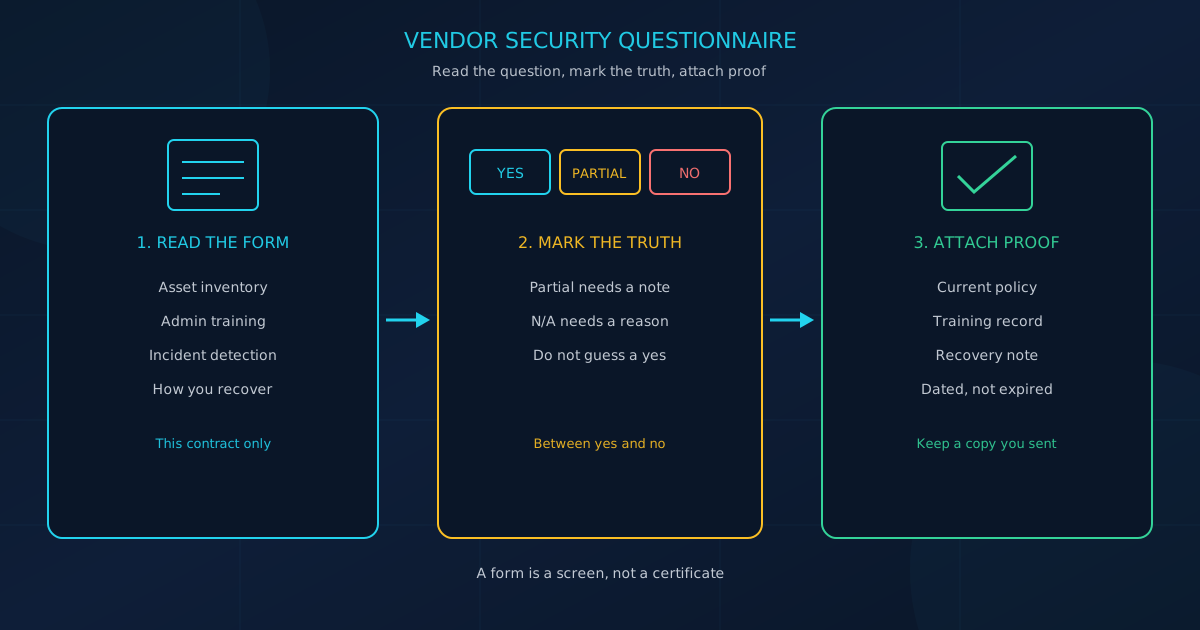
CISA's April 3, 2023 fact sheet lists questions its small-business spreadsheet records as Yes, No, or Partial. They include whether you analyze vulnerabilities to find a root cause, whether management approves an asset inventory, whether people with admin rights must take cybersecurity training, whether incident detection steps are written down, and whether you can recover full function after a major cybersecurity incident. In March 2025, the Canadian Centre for Cyber Security published a shorter list aimed at the same conversation.
The Cyber Centre's ITSAP.00.070 (March 2025) gives sample questions an organization should ask its providers:
- "How do you protect customer data?"
- "How do you encrypt data?"
- "How do you ensure software is up to date and how do you address known vulnerabilities?"
- "What is your disaster recovery strategy?"
- "Will you inform me if there has been a cyber event? If so, how quickly?"
The same note says to consider "using third-party assessments to assess critical suppliers." A questionnaire is not a certificate. Our guide to SOC 2 for small business says a small business typically needs a SOC 2 report when enterprise customers or partners request one during vendor security reviews. It also says: "A detailed questionnaire response can demonstrate your security posture without requiring an independent audit."
How should you answer yes, no, or partial?
Answer the control you actually run. CISA's April 2021 template says to respond to each Yes or No question "as relevant to the offering." If a question does not apply, answer N/A and "provide a supporting statement of applicability." The April 3, 2023 fact sheet says answers "might rest somewhere between yes and no," and the spreadsheet records Yes, No, or Partial.
Use the honest middle when the control is incomplete:
- Yes means the control is in place for the product or service this customer is buying, and you can attach something that shows it.
- Partial means it covers only some systems, sites, or people. CISA's spreadsheet has a column to explain a Partial answer. Use it. Name what is covered and what is not.
- No means you do not do it. A no is safer than a yes you cannot support. The template is a screen, not a score you have to ace.
- Alternate is allowed "if a particular supply chain risk can be addressed in alternative ways and not directly through compliance with a standard or framework."
- N/A needs the short statement CISA asks for, explaining why the question does not apply to this offering.
Do not use the shortcut unless you meet it. The April 2021 template says: "If you can provide affirmative responses to the questions below AND supporting, non-expired documentation, you may skip ALL remaining questions." One of those questions is: "Do you have controls fully aligned to NIST SP 800-161, Supply Chain Risk Management Practices for Federal Information Systems and Organization?" The next line asks you to "provide proof of the scope of controls implemented and how controls were validated." NIST's own title for that publication is Cybersecurity Supply Chain Risk Management Practices for Systems and Organizations. Full alignment is a high bar. If you cannot attach current proof, answer the rest of the form.
What documents should you attach?
Attach documents that match the answers, and keep them current. CISA's April 2021 template says: "Please attach supporting documents to the completed questionnaire." The skip rule on that page requires "supporting, non-expired documentation." NIST SP 800-161 Revision 1 describes these questionnaires as a way to collect evidence, not as a finished verdict.
Match the file to the question. You do not need a novel:
- Information security or privacy policy. CISA asks whether company-wide information security policies are in place. A written information security program is, in our guide's words, "a documented plan describing how your business protects customer data."
- Asset list. CISA asks whether management approves an asset management program that is regularly maintained. A current list of the systems this customer would rely on is the relevant extract.
- Training record for administrators. CISA asks whether cybersecurity training is required for people with administrative rights. A completion record for those people is enough. A slide deck with no attendance list is not.
- Incident detection and recovery notes. CISA asks for documented incident detection practices and for a way to recover full functionality, including an integrity check, after a major incident. Our article on incident response planning says: "Organizations that have thought through their response in advance tend to navigate these situations more effectively than those making it up as they go."
- The copy you sent last time. Question 1.1 asks whether you previously provided supply chain risk information to this organization and, if yes, for an updated revision covering material changes.
When the folder is empty, do not invent the documents in the answer box. Cyber Unit's cybersecurity assessment "includes structured interviews with your team, a hands-on review of 22 security areas, a written report documenting observations and recommendations, and a findings walkthrough with our analysts." The service page states: "The report is designed for leadership, boards, and cyber insurers."
What do insurer questionnaires ask?
An insurer's questionnaire asks for controls, not a slogan. The Insurance Bureau of Canada's Cyber Savvy Canada page says its assessment "offers some questions that cyber insurers may ask you." Those questions cover a written information security plan, a cyber incident response plan, a disaster recovery or business continuity plan, and whether employee training is tracked and documented.
On that page, one recovery-plan choice is a plan "reviewed and tested within the past 12-months." The page also says the assessment covers "the cyber security protocols that most cyber insurers want you to have." It does not publish one form used by every carrier. Our guide to what carriers ask at renewal says: "The core controls are the same on both sides of the border." It adds that if an incident reveals a control was missing or not enforced, "the carrier has grounds to dispute the claim."
What should you check before you send the answers?
Name one owner, mark partial answers in writing, and attach documents that have not expired. CISA's April 2021 template says: "We recommend designating one primary POC from your organization" to collect and compile the responses. POC means point of contact. The August 2025 edition of CISA's small-business guide says the 2021 content "remains current and valid," including the point that answers might rest between yes and no.
- Give one person the pen. That person can ask finance, IT, and operations for facts. The form should not be forwarded to whoever is free on a Friday.
- Read every question against this contract. A control that exists for one product may not exist for the service this customer is buying. CISA says to answer as relevant to the offering.
- Write Partial and N/A in plain words. State the gap. Do not hide it in an attachment the reviewer will not open.
- Check dates. The skip rule asks for non-expired documentation. If a policy or a training record has no date, fix that before you rely on it.
- Save what you sent. The next form may ask what changed. Question 1.1 is easier to answer from a copy than from memory.
If the same forms keep arriving and nobody can answer them, that is a leadership gap, not a formatting problem. Our guide to a virtual CISO for small business lists "receiving security questionnaires from customers or insurers you cannot answer" as a common trigger for that kind of help.
NIST says the initial due diligence assessment is not exhaustive. CISA says the questions help mitigate risk and do not eliminate it. Send the true answer, with the documents behind it, and treat the gaps as work. Do not treat a submitted form as proof the business is secure.
If you want a plain starting point before the next form arrives, take the free cybersecurity assessment. A cyber security assessment helps you understand where your business stands. This free 5-minute version covers 22 security areas and runs entirely in your browser, with no signup required.
This article is intended for general informational purposes only and does not constitute professional security, legal, or compliance advice. The questionnaire practices described are drawn from CISA's April 2021 Vendor SCRM Template, CISA's April 3, 2023 fact sheet, CISA's August 2025 small-business guide, NIST SP 800-161 Revision 1 as updated November 1, 2024, the Canadian Centre for Cyber Security's March 2025 ITSAP.00.070, and the Insurance Bureau of Canada's Cyber Savvy Canada assessment, as of the date of publication, and may change. Answering a questionnaire does not by itself make an organization secure or guarantee a contract or an insurance policy. Organizations should consult qualified cybersecurity professionals before sending answers or documents to a customer or insurer.