
Patch management is a written cadence for finding a fix, ranking how fast it matters, installing it, and keeping proof it landed. On June 10, 2026, the U.S. Cybersecurity and Infrastructure Security Agency (CISA) revoked Binding Operational Directive (BOD) 22-01. BOD 26-04 supersedes it. The Known Exploited Vulnerabilities (KEV) catalog, which CISA established in 2021 under BOD 22-01, is still the public list of flaws CISA says have been exploited in the wild. For a small or mid-sized business in Canada or the United States, the practical question is which clock you will follow, and how you will show the work.
CISA's June 10, 2026 bulletin says BOD 26-04 "is issued for federal agency compliance" and that its approach offers "practical tools for any organization." The Canadian Centre for Cyber Security publishes separate recommended timeframes. This article lines those public clocks up so an owner can pick a cadence and keep the evidence.
What should a patch management cadence include?
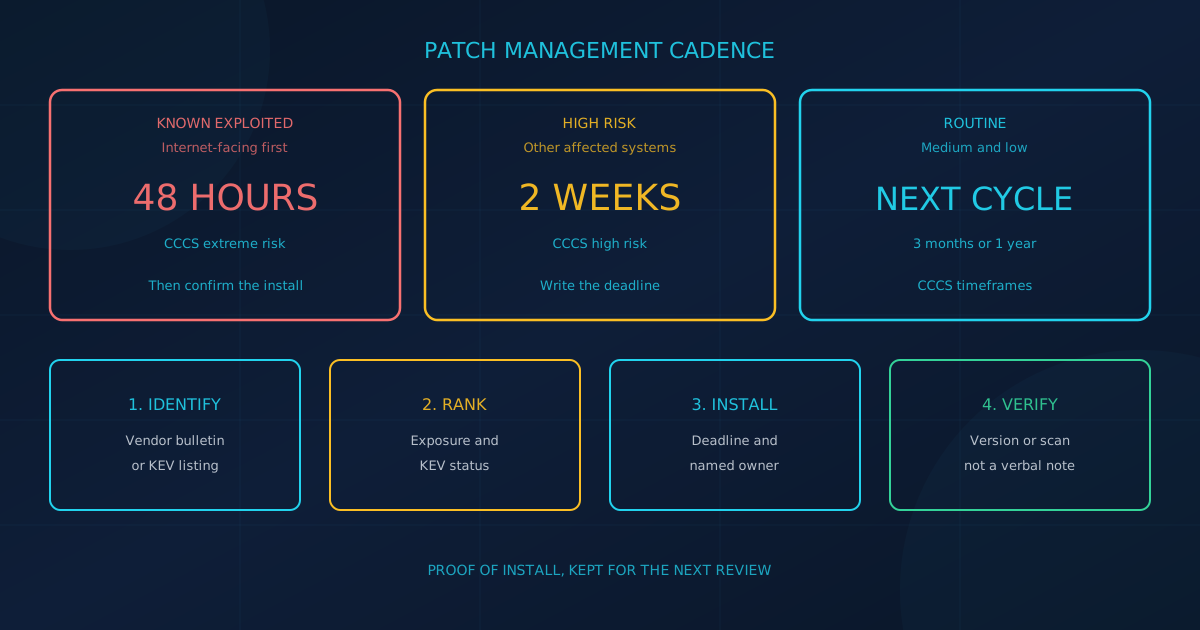
NIST Special Publication 800-40 Revision 4 (April 2022) defines enterprise patch management as "the process of identifying, prioritizing, acquiring, installing, and verifying the installation of patches, updates, and upgrades throughout an organization." The Cyber Centre's ITSM.10.096 (effective August 5, 2022) describes patch management as the strategy and process for acquiring, validating, testing, and installing patches and upgrades. A practical cadence adds a deadline and a named owner to each step.
NIST calls patching preventive maintenance and "a cost of doing business." ITSM.10.096 lists the operating steps: identify that a patch exists, test it when possible, review what else the install needs, install it, and verify it applied.
Write those steps once, with a name next to each one. If a managed provider does the install, the owner still needs the deadline and the proof. A patch SLA is the part of an IT contract that sets deadlines for installing security fixes and requires proof that they were installed.
What happened to BOD 22-01's two-week rule?
On June 10, 2026, CISA stated: "This Directive has been revoked. It is superseded by BOD 26-04." The November 3, 2021 text required remediation "within 6 months for vulnerabilities with a Common Vulnerabilities and Exposures (CVE) ID assigned prior to 2021 and within two weeks for all other vulnerabilities." BOD 26-04 says it "supersedes and hereby revokes" BOD 22-01. Those defaults are no longer the federal rule.
BOD 26-04 replaces the single default with four questions: Is the asset publicly exposed? Is the flaw on the KEV catalog? Can an adversary automate every step of the exploit? Does exploitation give partial control or total control? The directive says days are calendar days. The federal clock starts at the earlier of two events: CISA adds the flaw to the catalog, or the agency identifies it on an asset and updates the federal dashboard. Where the timeline includes forensic triage, the directive says the agency must finish remediation or mitigation "within the timeline (three days)" and check whether the system is compromised.
Two rows on the catalog page, as listed on November 16, 2026, show that due dates are not one number. CVE-2026-123039 was added on November 13, 2026, with a due date of November 16, 2026, and forensic triage required. CVE-2026-125350, a Chromium flaw, was added on November 10, 2026, with a due date of November 24, 2026, and forensic triage not required.
Which flaws should a small business patch first?
The KEV catalog page says organizations should use the catalog "as an input to their vulnerability management prioritization framework." The BOD 22-01 FAQ, still published on the revoked directive, says known exploited vulnerabilities "should be the top priority for remediation." That FAQ lists three criteria: "a CVE ID", "clear remediation guidance", and "reliable evidence of exploitation in the wild." BOD 26-04 states that the criteria for inclusion "remain unchanged."
The same FAQ says it does not recommend exclusive use of the catalog as the only criterion, and that CVSS scoring can still be part of vulnerability management. For a small business, a workable order is:
- On the KEV catalog, and reachable from the internet. Treat this as the first queue. CISA's bulletin calls known exploited vulnerabilities "a frequent attack vector." Our article on a managed firewall notes that the catalog tracks vulnerabilities that are actively being used in attacks, and that edge devices appear frequently.
- On the KEV catalog, but inside the network. Still ahead of a high score that nobody is exploiting. The BOD 22-01 FAQ says attackers "do not rely only on" vulnerabilities rated critical.
- Everything else, by the risk in your environment. A flaw in software you do not run is not your emergency. A flaw in the application that takes payments is.
Unsupported software never enters that queue, because there is no vendor fix. Our article on Windows 11 24H2 says to treat an OS-build inventory as a monthly routine, alongside patch management.
What timelines does the Cyber Centre recommend?
ITSM.10.096 (effective August 5, 2022) recommends four timeframes after you assess risk in your own environment: extreme within 48 hours, high within two weeks, medium at the next major update or within three months, and low at the next major update or within one year. It says: "This policy should establish a timeframe for applying corrective actions to vulnerabilities." These are recommendations, separate from CISA's federal deadlines.
The same document says to test on a group from each part of the business. "If the test group does not report any fault within 48 hours of testing, then the patch can be deployed to the rest of the organization." That window is as long as the extreme-risk recommendation, so write down which one you follow for a KEV-listed internet-facing system. The publication also says: "Workarounds are not a permanent solution." Once a patch is available, "you should apply it as soon as possible."
For a smaller team, the Cyber Centre's Baseline Cyber Security Controls for Small and Medium Organizations (V1.2) gives a simpler default. BC.2.1 says: "Organizations should enable automatic patching for all software and hardware OR establish full vulnerability and patch management solutions." Our explainer of the CCCS baseline controls lists BC.2 as "Automatically patch operating systems and applications."
A cadence many small businesses can write on one page, using those two publications and the KEV list as the sort order:
- Extreme: internet-facing, or listed on the KEV catalog. Aim for 48 hours, per ITSM.10.096. If you cannot install the fix, remove the system from the internet and record who approved that, and the date the exception expires.
- High: within two weeks.
- Medium: the next major update, or within three months.
- Low: the next major update, or within one year.
- No vendor update left: BC.2.2 says: "Organizations should conduct risk assessment activities as to whether to replace any software and hardware that are not capable of automatic updates. If the organization chooses to keep such devices, they should have a business process to ensure regular manual updates."
How do you prove a patch was installed?
NIST SP 800-40 Rev. 4 (April 2022) says a deployment can be verified "to ensure that it has been installed successfully and taken effect," and that monitoring can confirm the patch "is still installed." ITSM.10.096 says administrators "should audit it to measure the success rate and ensure that it is effective." A version number or a scan is evidence. A note that says patched is not.
NIST also says monitoring can confirm the patch "has not been uninstalled" and that "an unpatched version of the software has not been restored from a backup." Keep a short record for each exception and each emergency install:
- The CVE ID or the vendor bulletin, and the date you learned about it.
- Which systems were in scope, and whether each one faces the internet.
- The deadline you set, and the date the fix was actually installed.
- How you checked: a version report, a scan, or a screenshot of the vendor console.
- If you did not install it: the workaround, the person who approved the delay, and the date that approval ends.
Our comparison of vulnerability scans and penetration tests says a regular scan is the simplest way to show that patching is actually working. Our guide to evaluating a managed IT provider says monthly or quarterly reporting on patching status, detected threats, ticket resolution times, and open vulnerabilities is standard practice. Ask for the patching lines in that report, not a new dashboard.
What should you ask your provider this month?
ITSM.10.096 (August 5, 2022) says that even with cloud or managed services, "your organization is still legally responsible and accountable for securing its data." It also says to ensure "patch management requirements and emergency patching and updating are included in your service agreements." In a software-as-a-service model, you still cover systems that "fall out of the scope of the contract." Four questions make that split visible:
- Which of our systems do you patch, and which does someone else patch?
- What is the written deadline for a KEV-listed flaw on an internet-facing system?
- When a fix cannot go in, who approves the exception, and when does it expire?
- What will I receive each month that shows the fix is still installed?
If the list is longer than your team can run, Cyber Unit's vulnerability management is one of the cybersecurity services on that page. The page says the service automatically patches operating systems and third-party applications, and it lists automated OS patching, third-party app updates, patch scheduling, and update monitoring.
If you want a first read on whether updates are actually happening, this free 5-minute version covers 22 security areas and runs entirely in your browser, with no signup required.
This article is intended for general informational purposes only and does not constitute professional security, legal, or compliance advice. Timelines and criteria are drawn from CISA BOD 22-01 (revoked June 10, 2026), BOD 26-04 (June 10, 2026), the Known Exploited Vulnerabilities catalog as listed on November 16, 2026, CISA's June 10, 2026 bulletin, NIST Special Publication 800-40 Revision 4 (April 2022), and Canadian Centre for Cyber Security publications ITSM.10.096 (effective August 5, 2022) and the Baseline Cyber Security Controls for Small and Medium Organizations V1.2. Directives cited here bind federal civilian agencies, not private businesses. Recommended timeframes are not a promise of any particular security outcome. Organizations should consult qualified cybersecurity professionals before changing patching processes.