
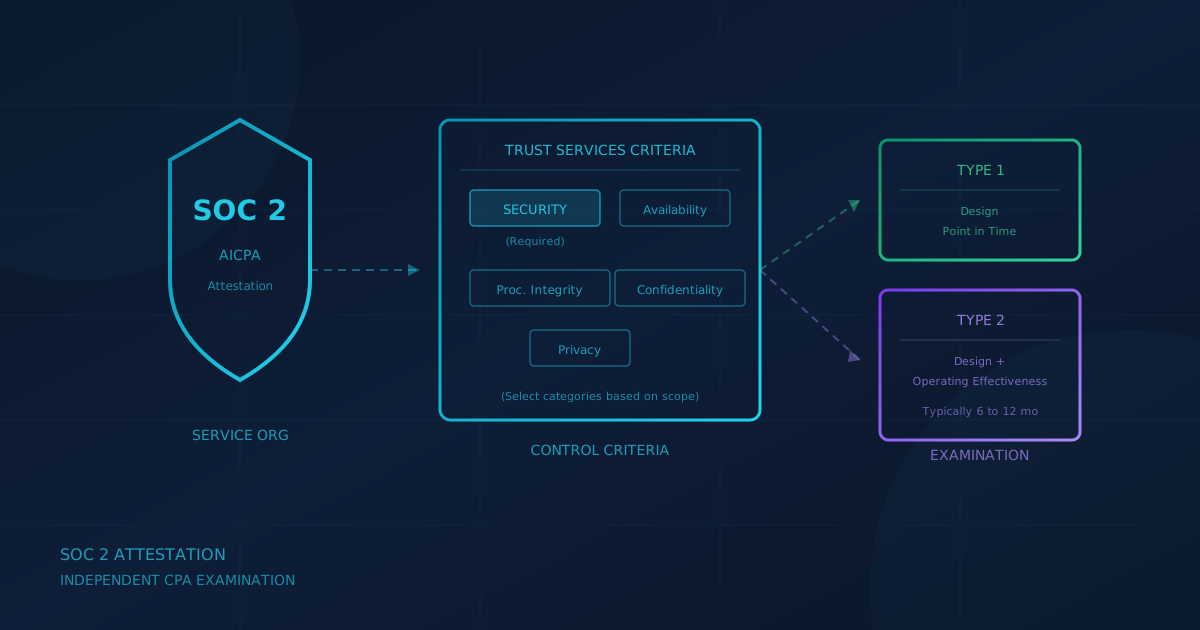
SOC 2 for small business becomes relevant when enterprise customers ask for proof that your controls meet a recognized standard. According to an October 28, 2026 AICPA news release, SOC 2 "is an examination performed by a licensed, independent CPA under the AICPA Attestation Standards" that evaluates controls relevant to security, availability, processing integrity, confidentiality, or privacy. The same release announces a proposed update to the Trust Services Criteria; if approved, the 2027 update would be effective for engagements beginning on or after December 31, 2027. Until then, the 2017 Trust Services Criteria (with revised points of focus from 2022) remain in effect.
What is a SOC 2 report and who issues it?
A SOC 2 report documents the results of an examination performed by a licensed, independent CPA firm. According to the AICPA's SOC suite resources, the examination uses the Trust Services Criteria as the evaluation framework. The CPA firm reviews your controls, tests evidence, and delivers a report containing their professional opinion on whether those controls were suitably designed and, in a Type 2, operating effectively.
The distinction between attestation and certification matters. As Drata's SOC 2 guide explains, "there is no certificate, no pass/fail grade, and no governing body stamping approval." The AICPA sets the standards but does not grant certifications. What you receive is an auditor's opinion in a report, and the correct claim is that your organization has obtained a SOC 2 report, not that it is "SOC 2 certified."
What are the Trust Services Criteria?
The Trust Services Criteria are the control framework against which SOC 2 examinations are evaluated. According to the AICPA's 2017 Trust Services Criteria (With Revised Points of Focus, 2022), there are five categories: Security, Availability, Processing Integrity, Confidentiality, and Privacy.
As Drata notes, "Security is the only mandatory criterion; the others are optional based on your services and what your customers expect." You select which categories to include based on your service commitments and what your customers require.
Is SOC 2 changing in 2027?
The AICPA is seeking comment on a proposed update to the SOC 2 Trust Services Criteria. According to the October 28, 2026 AICPA news release, comments are due by January 15, 2027. "If approved next year, the proposed 2027 SOC 2 Trust Services Criteria would be effective for engagements beginning on or after Dec. 31, 2027, with early adoption permitted." The proposed updates include "new points of focus" that "address issues such as AI governance, model monitoring, prompt manipulation, data poisoning, transparency of AI-generated outputs, training data management, and the risks associated with automated decision-making."
For now, SOC 2 examinations continue under the 2017 Trust Services Criteria with 2022 revised points of focus. Organizations preparing for their first SOC 2 examination should work with their CPA firm to determine which version will apply to their engagement timeline.
What is the difference between SOC 2 Type 1 and Type 2?
A SOC 2 Type 1 report evaluates whether your controls were suitably designed at a specific point in time. As Drata explains, "A Type 1 report evaluates whether your controls are suitably designed at a specific point in time." The examination captures a snapshot of your control environment on a single date, without testing whether those controls operated consistently.
A SOC 2 Type 2 report goes further, evaluating both design and operating effectiveness over a period. According to Drata, a Type 2 report evaluates whether controls are designed properly and operating effectively over a review period, which Drata puts at typically six to twelve months. The auditor samples evidence from across the observation period and tests whether controls functioned as intended throughout.
As Modus Alliance notes, "Type 1 timelines run roughly 3 to 6 months end-to-end, including readiness work." For Type 2, "The AICPA does not mandate a minimum observation period, but 6 months is the practical floor for a first-year engagement." Modus Alliance adds that annual renewals default to a 12-month period.
How does SOC 2 differ from SOC 1 and SOC 3?
SOC 1, SOC 2, and SOC 3 serve different purposes. SOC 1 reports on controls at a service organization that are likely to be relevant to user entities' internal control over financial reporting. According to the AICPA's SOC 1 resources, these reports are specifically intended for user entities and their auditors evaluating how the service organization affects financial statement audits.
SOC 2 reports on controls relevant to security, availability, processing integrity, confidentiality, or privacy.
SOC 3 covers the same Trust Services Criteria as SOC 2 but produces a general-use report. According to the AICPA's SOC 3 resources, SOC 3 reports "do not provide the same level of detail. Therefore, they are considered general use reports and can be freely distributed."
When does a small business actually need SOC 2?
Most small businesses do not need a SOC 2 report unless someone asks for one. The trigger is typically an enterprise customer, partner, or prospect that requires assurance about your security controls as part of a vendor security review. If you provide software, handle data, or deliver services on behalf of other organizations, and those organizations are subject to their own compliance or risk management requirements, they may ask you for a SOC 2 report before signing a contract.
Common scenarios where SOC 2 becomes relevant:
- An enterprise customer sends a security questionnaire with questions you cannot answer confidently
- A contract requires evidence of an independent security audit or third-party attestation
- Your sales team encounters objections during security reviews that are blocking deals
- An existing customer requests updated assurance as part of their own audit or compliance cycle
If your business does not process, store, or transmit data for other organizations, or if your customers have not asked for this level of assurance, you may not need a SOC 2 report yet. But if you are losing deals or being excluded from RFPs because you cannot demonstrate your controls, it may be time to prepare.
What does SOC 2 readiness look like for a small business?
Preparing for a SOC 2 examination does not mean starting from scratch. Many of the controls auditors test are security fundamentals your business may already have in place. The work is often about documenting what you do, filling gaps, and collecting evidence you can show an auditor.
Common control areas that auditors examine include:
- Access controls: How access is granted, reviewed, and revoked. Are access reviews performed regularly? Is there a documented process for onboarding and offboarding?
- Multi-factor authentication: Is MFA enforced on critical systems, especially for administrative access?
- Change management: How are changes to systems documented, tested, and approved before deployment?
- Vendor management: How do you evaluate and monitor third-party vendors that have access to your systems or data?
- Incident response: Do you have a documented incident response plan?
- Logging and monitoring: Are security events logged, and is someone reviewing them?
- Security policies: Do you have a written information security program that employees are trained on?
The readiness process typically involves a gap assessment against the Trust Services Criteria, remediation of identified gaps, documentation of policies and procedures, and collection of evidence that controls are operating. Many organizations start with a Type 1 examination to validate that controls are designed appropriately, then move to a Type 2 to demonstrate operating effectiveness over time.
How does SOC 2 work for Canadian businesses?
Canadian CPA firms perform SOC 2 engagements under Canadian Standard on Assurance Engagements (CSAE) 3000, the Canadian attestation standard. According to CPA Canada's SOC 2 guide, the guide "is a non-authoritative resource which has been adapted by CPA Canada from the AICPA version to meet Canadian standards." The guide includes "illustrative service auditor's reports, including reporting in accordance with both Canadian and international, or Canadian and U.S. standards."
What are alternatives when SOC 2 is premature?
If your business is not ready for a SOC 2 examination, or if the investment does not match the opportunity, there are other ways to respond to customer security inquiries:
- Complete the customer's security questionnaire: A detailed questionnaire response can demonstrate your security posture without requiring an independent audit.
- Share your security policies: Providing your written information security program, incident response plan, or access control documentation can satisfy customers who want evidence of a security program.
These approaches may not satisfy customers who explicitly require a SOC 2 report, but they can help you respond to security reviews while you prepare for a formal examination.
A question to ask your IT provider
If an enterprise customer asked for a SOC 2 report tomorrow, how would you respond? A useful question to put to your IT lead or managed service provider: "Which of our controls could we show evidence for today if a customer asked for a SOC 2 report?"
If the answer is uncertain, that is where the preparation work begins. Understanding which controls are documented, which are operating consistently, and which have evidence you can produce is the foundation of SOC 2 readiness.
If you are unsure where your business stands on the security controls that underpin a SOC 2 examination, a free cybersecurity assessment can help identify which areas need attention. The assessment takes under 5 minutes, covers 22 security areas, and requires no signup. It is not a SOC 2 readiness assessment, but it can surface gaps in the fundamentals that would need to be addressed before any formal examination.
This article is intended for general informational purposes only and does not constitute professional security, legal, audit, or accounting advice. SOC 2 requirements are based on the AICPA Attestation Standards and Trust Services Criteria as of the date of publication and may change. Cyber Unit is not a CPA firm and does not perform SOC 2 examinations. Organizations should consult a licensed CPA firm and qualified cybersecurity professionals to determine their specific SOC 2 readiness and examination needs.