
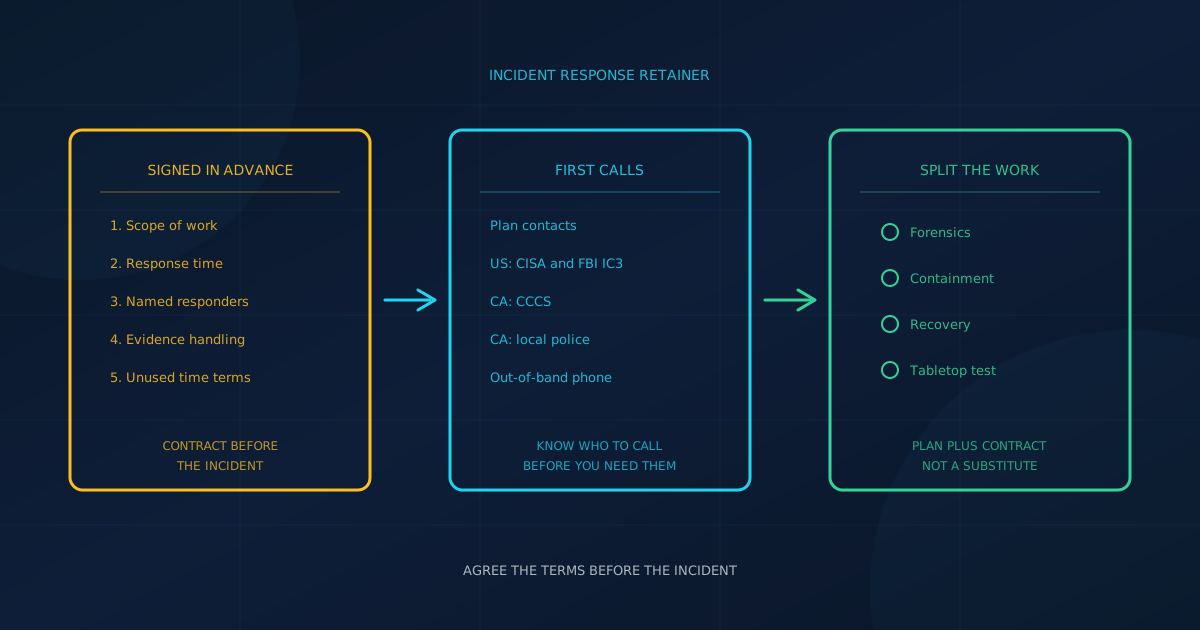
An incident response retainer is a contract with an outside incident response firm, agreed before an incident happens, that sets the terms for help when one occurs. The IANS glossary states that definition. A September 28, 2026 article from Sprintlaw, an Australian law firm, describes the same arrangement: a provider agrees to be on call, or to reserve capability, to help investigate, contain, and respond. A small or mid-sized business in Canada or the United States should read what the contract actually commits the responder to do.
NIST Special Publication 800-61 Revision 3, Incident Response Recommendations and Considerations for Cybersecurity Risk Management: A CSF 2.0 Community Profile, was published in April 2025. It supersedes Rev. 2. The CSRC record dates that earlier guide to August 6, 2012.
What is an incident response retainer?
An incident response retainer is a contract with an outside incident response firm, agreed before an incident happens, that sets the terms for help when one occurs. IANS states that definition. Sprintlaw calls it a contract to be on call, or to reserve capability, to investigate, contain, and respond. NIST SP 800-61 Rev. 3 (April 2025) does not use the word retainer. It says handlers may be on staff, on contract, or available when needed.
NIST says those duties should be defined in the contract, including authority to act. An MSSP may perform detection, response, and recovery. Another firm may be used only for some incidents.
Does a small business need a responder arranged in advance?
Not in every case. NIST SP 800-61 Rev. 3 (April 2025) says many organizations do basic response internally and use third parties for some incidents. ITSAP.40.003 (January 2026) says to decide which actions you do internally and which you outsource. It also says professional services can be retained to assist with incident response initiatives.
NIST says handlers collect evidence, limit damage, find root causes, and restore operations. If no contract covers that, you are hiring during the incident. Sprintlaw says the risk in contracts you already have is overlap and gaps, and NIST says the policy should name who may shut assets down. Our guide to incident response planning before something happens says a ten-page formal plan that no one reads is less valuable than a few key questions and knowing who to call.
Why put the contract in place before an incident?
Sprintlaw says the retainer is meant to reduce delay: you agree the framework in advance instead of negotiating during a breach, so the provider can step in quickly. It also says speed on paper helps only if the contract supports fast action. NIST SP 800-61 Rev. 3 (April 2025) says authority to act should already be in the contract.
ITSM.50.030 (effective October 14, 2020) says a request for an immediate response may sit in a provider's queue while that provider helps other customers. You remain accountable for the response. CISA's #StopRansomware Guide says to follow the notification requirements already in the plan.
What should the written agreement cover?
Write scope, the clock, and evidence rules into the contract. IANS lists guaranteed activation and response times, named responders, limits on substituting them, scope, and what unused hours can be spent on. ITSM.50.030 (effective October 14, 2020) says the agreement should state turnaround times, communication media, escalation, metrics, and penalties for a missed turnaround. Sprintlaw says to check whether a time is guaranteed, conditional, or only a target.
Separate investigation from restoration. NIST says analysis supports forensics and recovery, and that disaster recovery plans may need to start once an incident is declared. Our disaster recovery guide says incident response focuses on detecting, containing, and eradicating an active threat, while disaster recovery restores systems and data after containment.
- Scope, clock, and people. Sprintlaw lists remote or onsite forensic investigation, containment, and preserving evidence, and says scope often varies. A response time may mean only an acknowledgement. IANS says to name responders and to limit substitution.
- Communication, evidence, and unused time. ITSAP.40.003 says to state how, when, and with whom you communicate, including phones or out of band email. CISA says to use out-of-band phone calls and to preserve volatile evidence, or evidence with limited retention, such as system memory and logs. NIST says that data remains evidence even if chain-of-custody steps are not used every time. Sprintlaw says to name who owns the images and to check rollover. IANS says many firms let unused prepaid hours convert to other services if the contract allows it.
How does the agreement fit a cyber insurance policy?
Read the policy before you treat a firm as approved. Sprintlaw says a policy may require approval before certain forensic vendors are engaged, or may only cover panel providers. IANS states: "Most cyber insurers keep a panel of approved response firms with pre-negotiated rates." A Coalition brochure says its incident response services are offered to policyholders as an option via its incident response firm panel.
This is not a statement of what an insurer will pay. Sprintlaw's point is that a preferred provider might not be reimbursable if you sign first. Our guide to the cyber insurance questionnaire at renewal says carriers ask whether the plan names who is called, who decides, and how the insurer's breach team is engaged.
What should you ask a provider before you sign?
Use the questions those pages already pose. ITSM.50.030 (effective October 14, 2020) says to ask the provider's roles, your roles, the guaranteed turnaround for the incidents you named, and the penalty if that time is missed. IANS says to walk through activation and check forensic depth. Sprintlaw says to start with scope, activation, response times, privacy, ownership of outputs, and liability limits.
Then write the answers down: in-scope work, whether the clock is an acknowledgement or forensic work, named people and substitutes, who images systems and who rebuilds them, the out-of-band number and backup, what happens to unused hours, a tabletop at least annually, and any overlap with the policy or the managed-service contract.
How does this agreement fit a plan and a tabletop?
The contract is not the plan. ITSAP.40.003 (January 2026) says the plan is the processes, procedures, and documentation for how you detect, respond, and recover, and that you should test and revise it annually. NIST SP 800-61 Rev. 3 (April 2025) says that once an incident is declared, contact the incident response service provider if appropriate. Exercises, it says, prepare staff and critical service providers. It points to NIST SP 800-84 for tabletops.
Our guide to a cybersecurity tabletop exercise for small business calls it a short, discussion-based meeting that walks through a simulated incident. IANS says to require that rehearsal ahead of an emergency.
Monitoring is a different job from a response engagement. Our comparison of EDR vs MDR says you still need an incident response plan alongside MDR. If monitoring and response should sit with one provider, Cyber Unit's cybersecurity service includes endpoint detection and response (EDR), managed detection and response (MDR), 24/7 Security Operations Center monitoring, and incident response. The incident response section on that page lists rapid threat containment, root cause identification, remediation support, and a post-incident review.
What are the red flags in a response contract?
Missing writing is the warning. Sprintlaw says a common mistake is treating qualified response times as firm promises, and leaving key terms in emails or sales calls. IANS says named responders and substitution limits affect how well help arrives. ITSM.50.030 (effective October 14, 2020) says you remain accountable even when a provider performs steps. If scope, the clock, evidence, and substitution are unstated, do not sign.
- "We respond quickly," with no written time. Our guide to evaluating a provider calls no written SLAs or vague response commitments a disqualifying red flag.
- No owner for forensics, recovery, substitution, or unused time. NIST separates investigation records from the choice to start recovery. IANS says substitution limits and any conversion of prepaid hours belong in the contract. Sprintlaw says to check rollover in writing.
- No exercise, or an unread policy. IANS says to require a tabletop ahead of time and at least annually. Sprintlaw says a policy may require approval before certain forensic vendors are engaged, or may only cover panel providers.
What belongs on a before-you-sign checklist?
Mark these in the copy you will sign, then store one offline. CISA's #StopRansomware Guide says to maintain and exercise an incident response plan and a communications plan, including a hard copy and an offline version. NIST SP 800-61 Rev. 3 (April 2025) says to have ways, in advance, to coordinate with affected parties.
- Parties, term, and how either side ends it (IANS lists that ending rule).
- Separate lines for investigation, containment, and recovery, or explicit exclusions.
- What starts the clock, and whether the first response is an acknowledgement or active work.
- Named responders, a substitution limit, an after-hours path, and a backup contact (ITSAP.40.003).
- Who may see records, and who owns images and the report. NIST limits access to authorized people.
- Unused time is one sentence: convert, roll over, or end.
- Any conflicting policy notice or panel term is written down. That note does not decide a claim.
- A tabletop date is set. ITSAP.40.003 says to revise the plan from the test. Keep paper and offline copies of the plan and the call list.
- A decision maker other than the provider for shutdowns and customer messages. NIST says leadership may hold authority for high-impact steps such as shutting down critical services.
Who do you call first during an incident?
Call the people named in the plan, then the official channel for your country. NIST SP 800-61 Rev. 3 (April 2025) says to coordinate with people who have roles, to notify law enforcement when the plan and management say to, and, if appropriate, to contact the incident response service provider. A provider does not replace a government report, and a government report does not replace the provider.
In the United States, the FBI IC3 says to call 911 or local police in immediate danger. IC3, run by the FBI, is the central hub for reporting cyber-enabled crime. File even if you are unsure it qualifies. For ransomware, CISA says every incident should be reported to the U.S. government. Victims can report to the FBI, CISA, or the U.S. Secret Service, and one report notifies the others. CISA's reporting page also says to consider local law enforcement and appropriate regulatory agencies.
In Canada, the Cyber Centre report page says to contact local police in an emergency. The form covers an individual or an organization, meaning a business in Canada. The RCMP says to use Report Cybercrime and Fraud, built with the Canadian Anti-Fraud Centre, and to contact local police as soon as possible because local police investigate. The Canadian Anti-Fraud Centre says to use that system for fraud and cybercrime, to tell local police if money was lost or an investigation may be required, and to contact the financial institution if money or financial information is involved.
Our first hour after a ransomware attack checklist names, for ransomware, the Canadian Centre for Cyber Security, the Canadian Anti-Fraud Centre, and local police in Canada, and IC3 and CISA in the United States. Take the free cybersecurity assessment. This free 5-minute version covers 22 security areas and runs entirely in your browser, with no signup required.
This article is intended for general informational purposes only and does not constitute professional security, legal, insurance, or compliance advice. Descriptions of retainers, plans, and reporting channels are based on public pages from IANS, Sprintlaw, NIST, CISA, the FBI IC3, the Canadian Centre for Cyber Security, the RCMP, and the Canadian Anti-Fraud Centre as of the date of publication and may change. Organizations should consult qualified cybersecurity, legal, and insurance professionals before signing a contract or relying on a policy.