
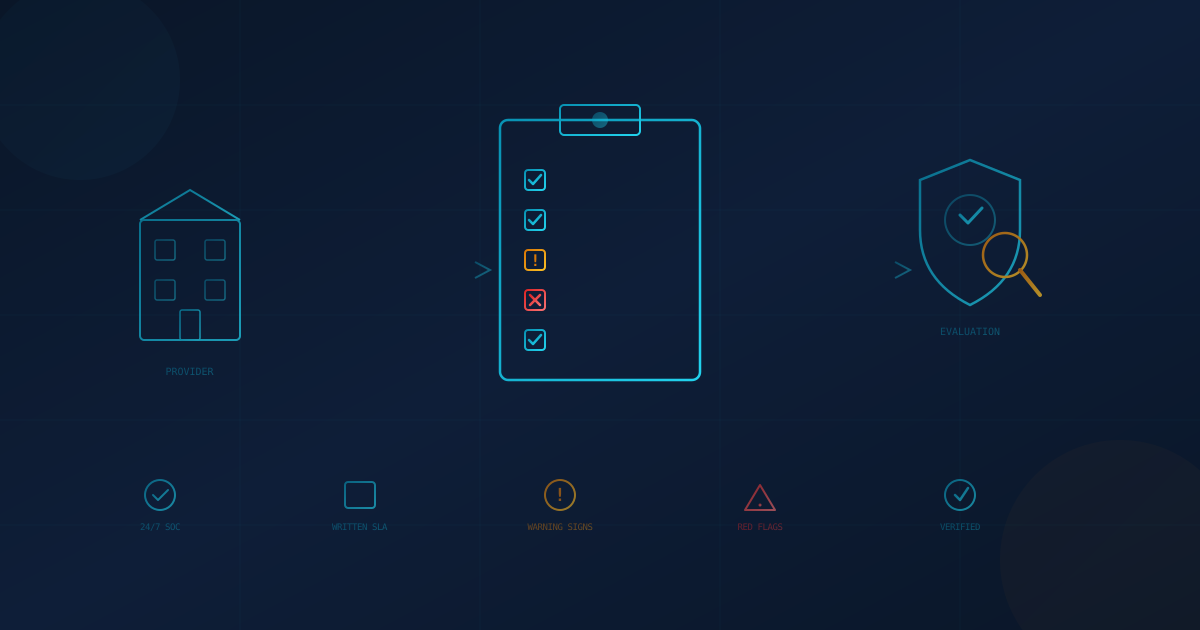
Choosing a managed IT or cybersecurity provider is one of the most consequential decisions a growing business can make. The provider you select will have privileged access to your systems, your data, and your employees' credentials. According to Barracuda's MSP Customer Insight Report 2025, 73% of organizations with up to 2,000 employees already work with an MSP, and that reliance climbs to 96% once you include those actively considering one. Most businesses now outsource IT and security by default. What separates businesses that choose well from those that regret the decision is the rigor of their evaluation process before signing the contract.
This guide is not about finding the cheapest provider or the one with the slickest website. It is about asking the questions that reveal whether a provider is actually equipped to protect your business, and knowing the warning signs that suggest they are not.
What should you evaluate before choosing a managed IT or cybersecurity provider?
Effective evaluation covers four areas: security posture, accountability, operational transparency, and contract terms. A provider that is strong in one area but weak in the others is a risk, because the weakest link determines how the relationship performs under pressure. Before evaluating any specific provider, confirm you understand the distinction between an MSP (manages IT operations), an MSSP (focuses on security monitoring), and an integrated provider that handles both. Our breakdown of MSP vs. MSSP explains which model fits which business profile.
What specific questions should you ask a provider before signing?
The answers to these questions separate providers who manage security as a discipline from those who market it as a feature. Ask them directly, in writing, and compare responses across at least three providers before making a decision.
Security operations and monitoring
- Who is monitoring our environment at 2 a.m. on a Saturday? The answer should name a specific team, facility, or third-party SOC with defined escalation procedures. "Our team responds quickly" is not an answer. A documented 24/7 monitoring commitment is a baseline expectation in 2026, not a premium feature.
- What counts as an incident, and what happens in the first hour after one is detected? A credible provider can walk you through their incident response process in plain language: who gets notified, what containment steps are taken, and when you hear about it. Vague assurances are a warning sign.
- Do you hold any security certifications (SOC 2 Type II, ISO 27001)? Certifications are not guarantees, but they indicate that the provider has submitted their internal controls to third-party audit. If a provider has no certifications and no roadmap to obtain them, ask why.
- How do you secure your own internal systems? Managed service providers are high-value targets. The 2021 Kaseya VSA ransomware attack demonstrated the risk: a single compromise of an MSP tool impacted more than 50 providers and an estimated 800 to 1,500 downstream businesses. CISA has repeatedly warned that attackers treat MSPs as gateways into many client networks. A provider that cannot clearly describe how they protect their own environment is a supply chain risk to yours.
Accountability and reporting
- What are your response time commitments, by severity level, in writing? A provider confident in their performance will show you their SLA document without hesitation. If critical issues do not have a 15 to 30 minute response commitment with continuous work until resolution, that is below industry benchmarks.
- How often will we receive reports on our security posture, and what do they include? Monthly or quarterly reporting on patching status, detected threats, ticket resolution times, and open vulnerabilities is standard practice. A provider that only contacts you when something breaks, or when an invoice is due, is not managing proactively.
- Can you provide references from clients of similar size in a similar industry? A 25-person professional services firm has different needs than a 200-person manufacturer. Ask for references you can actually call, and ask those references directly: "Have you experienced a security incident, and how did the provider handle it?"
Technical capabilities and alignment
- What is included in your baseline offering, and what costs extra? Endpoint detection and response (EDR), email security, automated patching, backup and disaster recovery, and security awareness training are considered essential in the small business cybersecurity baseline. If these are priced as add-ons rather than included, factor the true cost into your comparison.
- Do you understand the regulatory requirements that apply to our business? For Canadian businesses, that may mean PIPEDA or provincial privacy legislation. For US businesses, HIPAA, PCI DSS, or the FTC Safeguards Rule may apply. A provider who cannot speak specifically to your compliance obligations has not worked with businesses like yours.
- How do you handle employee onboarding and offboarding from a security perspective? The offboarding process is where security gaps often appear: former employees retaining access, accounts remaining active for weeks after departure. A provider with a documented identity lifecycle process is operating at a higher standard.
What are the red flags that should disqualify a provider?
Some warning signs are subtle and require careful attention during the sales process. Others are obvious enough that any one of them should end the conversation.
Disqualifying red flags
- No documented onboarding process. If a provider cannot explain what the first 30 to 90 days look like in specific terms, the transition will be chaotic, and security gaps will appear in the handoff.
- Resistance to discussing their own security posture. A provider that deflects, changes the subject, or claims their security practices are proprietary is a provider you cannot trust with privileged access to your environment.
- Security positioned as an upsell. If endpoint protection, email security, and patching are sold as premium features rather than baseline expectations, the provider is treating security as optional revenue rather than core responsibility.
- No written SLAs or vague response commitments. "We respond quickly" is not a service level agreement. If a provider will not put response times in writing, they are not committing to anything you can hold them to.
- Contracts with steep early termination penalties and narrow cancellation windows. A multi-year agreement with punitive exit clauses suggests the provider is optimizing for revenue retention, not service quality. Balanced terms are reasonable; traps are not.
Warning signs that warrant further scrutiny
- One-size-fits-all solutions. If every client gets the exact same package regardless of size, industry, or compliance requirements, the provider is not tailoring their service to your risk profile.
- Slow or evasive responses during the sales process. Responsiveness before you sign predicts responsiveness after. A provider that takes a week to return an email during the courtship phase will not suddenly become responsive once they have your contract.
- No regular business reviews or strategic planning sessions. A provider that does not schedule periodic reviews to discuss your evolving needs is managing tickets, not your business.
- Unable to explain how they would handle a breach at one of their other clients. Supply chain risk is real. A provider who has never considered how a compromise in their environment could affect you has not thought through the threat model.
How should you structure the evaluation process?
Rushing the decision is how businesses end up locked into contracts with providers who looked good on paper. A structured evaluation reduces that risk.
- Assess your current state first. Before talking to providers, understand where you stand. The small business cybersecurity checklist provides a framework for identifying your current gaps. This gives you a baseline for evaluating whether a provider can address your specific needs.
- Document your requirements. Write down what you need: essential services, budget range, compliance obligations, response time expectations, and support hours. If you are weighing a nearby provider against a remote one, our guide on whether a local cybersecurity company still matters covers when on-site support actually helps. Having this in writing prevents scope creep during sales conversations.
- Evaluate at least three providers. Ask each the same questions so you can compare directly. Different answers to the same question reveal differences in capability, transparency, and culture.
- Verify references independently. Do not rely on testimonials on the provider's website. Ask for references you can call, and ask specific questions: response times, how incidents were handled, whether hidden costs appeared after signing.
- Review the contract before the final meeting. Read the termination clause, notice period, data ownership language, and any auto-renewal provisions before you are in the room negotiating. Knowing your actual obligations changes how you sequence the conversation.
What questions should you ask your current provider?
If you already have a managed IT or cybersecurity provider, the same questions apply as a health check. Ask your current provider this week: "Who is monitoring our environment overnight, what counts as an incident, and what happens in the first hour after one is detected?" If the answer is vague, defensive, or shifts to a different topic, that is information about where the relationship actually stands.
Patching deserves its own question. Ask to see the written deadlines for installing security fixes and the report that proves they were met. Our guide to setting a patch SLA explains what to look for, using the FBI's September 2026 breach, which the bureau blamed on a contractor's missed patch.
A provider that can answer these questions clearly and confidently, with specifics rather than reassurances, is operating at a professional standard. A provider that cannot is asking you to trust them without evidence. The distinction matters most when something goes wrong.
One step you can take today
Before evaluating any external provider, get an independent baseline on your own security posture. Our free cybersecurity assessment takes about five minutes and covers 22 areas including endpoint protection, email security, backup, access controls, and vendor risk. Canadian businesses seeking a deeper evaluation can use the Cybersecurity Canada assessment, which aligns with the CCCS baseline framework. The results give you a starting point for conversations with current or prospective providers, and highlight the areas that need attention first.
This article is intended for general informational purposes only and does not constitute professional security, legal, or compliance advice. Recommendations are based on industry best practices and public guidance from CISA, CCCS, and security research as of the date of publication. Organizations should consult qualified cybersecurity professionals before selecting a provider or making operational changes based on this article.