
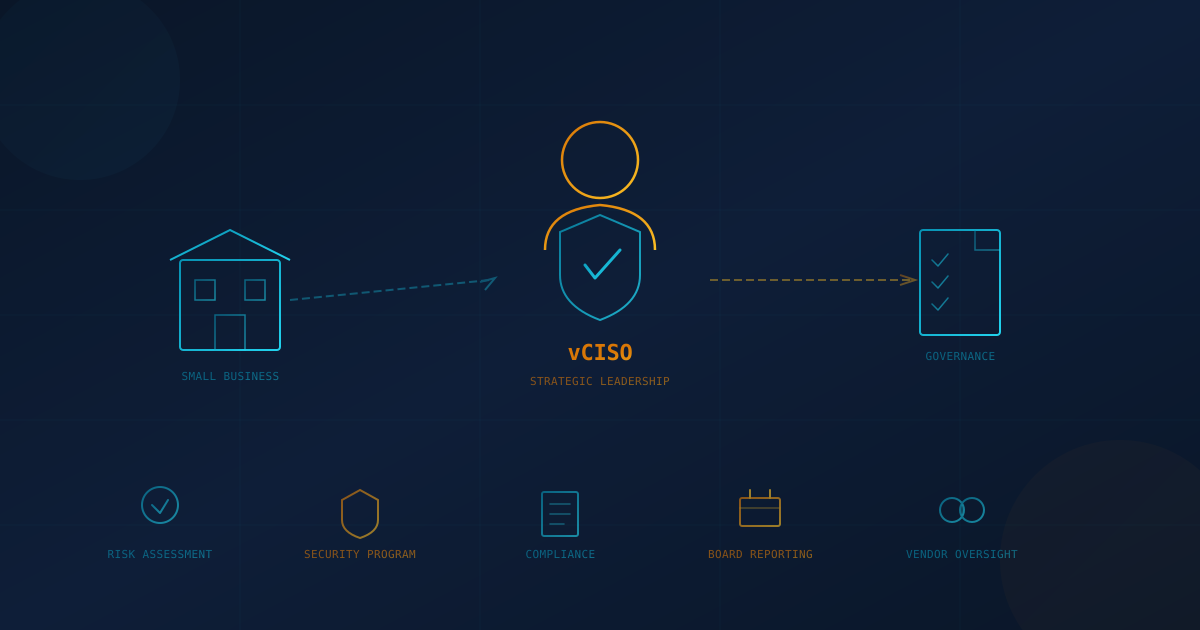
A virtual CISO for small business is an external security executive who provides strategic cybersecurity leadership on a part-time or contract basis. The role fills a gap many growing businesses face: cybersecurity has become a board-level concern, but no one inside the company has the authority, time, or expertise to own it. For businesses subject to compliance requirements, a vCISO can also serve as the designated individual responsible for the security program, a role the FTC Safeguards Rule explicitly allows a service provider to fill. In Canada, PIPEDA does not name a CISO, but it does require an organization to designate someone accountable for privacy compliance.
What does a CISO actually do?
According to the NIST NICE Framework (SP 800-181 Rev 1), the Executive Cybersecurity Leadership work role (OG-WRL-007) is responsible for establishing vision and direction for an organization's cybersecurity operations and resources. It is the NICE work role closest to a CISO, and its task statements include "Develop organizational cybersecurity strategy," "Conduct cybersecurity risk assessments," "Manage cybersecurity budget, staffing, and contracting," and "Advise senior management on organizational cybersecurity efforts."
The NIST Cybersecurity Framework 2.0 reinforces this at the framework level. Under the GOVERN function, subcategory GV.RR-01 states that "organizational leadership is responsible and accountable for cybersecurity risk and fosters a culture that is risk-aware, ethical, and continually improving." Implementation examples include leaders agreeing on their roles in developing, implementing, and assessing the organization's cybersecurity strategy, and directing the CISO to maintain a comprehensive cybersecurity risk strategy and review it at least annually.
CISA's Cyber Guidance for Small Businesses frames this practically for smaller organizations. It assigns the CEO responsibility for establishing a culture of security, selecting and supporting a "Security Program Manager," reviewing and approving the incident response plan, participating in tabletop exercises, and personally driving multi-factor authentication adoption. The underlying message is consistent: cybersecurity is a leadership responsibility, not just a technical one.
Where does regulation allow an outsourced security leader?
The FTC Safeguards Rule (16 CFR Part 314) requires covered financial institutions to designate a "Qualified Individual" responsible for implementing and supervising the information security program. According to Section 314.4(a), the Qualified Individual "may be employed by you, an affiliate, or a service provider." The FTC business guidance clarifies that "the person doesn't need a particular degree or title. What matters is real-world know-how suited to your circumstances."
When outsourcing this role, three conditions apply under the Rule:
- The company must retain responsibility for compliance.
- The company must designate a senior member of its own personnel to direct and oversee the Qualified Individual.
- The company must require the service provider to maintain an information security program that protects the company in accordance with the Rule's requirements.
This is the regulatory basis for a vCISO arrangement. The role can be external, but accountability stays with the business and its senior management. As we covered in written information security program for small business, the FTC Safeguards Rule applies to a broader set of "financial institutions" than the term might suggest, including tax preparers, mortgage brokers, and automobile dealerships that lease vehicles on a nonoperating basis for longer than 90 days.
In Canada, PIPEDA Principle 4.1 (Accountability) requires organizations to "designate an individual or individuals who are accountable for the organization's compliance" with the privacy principles. According to the Office of the Privacy Commissioner, "other individuals within the organization may be delegated to act on behalf of the designated individual(s)." PIPEDA does not name a CISO, and its accountability principle covers privacy compliance rather than the whole security program. The parallel is narrower but useful: someone must be accountable, and parts of the work can be delegated without moving that accountability.
How does a vCISO differ from an MSP, MSSP, or full-time CISO?
The roles solve different problems and frequently work together. As we explored in MSP vs. MSSP: what's the difference and which do you need, an MSP handles day-to-day IT operations (helpdesk, patching, backups, device management), while an MSSP focuses on security operations (24/7 monitoring, threat detection, incident response). Neither typically provides executive-level strategy, governance, or board reporting.
A vCISO provides the leadership layer:
- Strategy and governance: Defining the security program, setting priorities, and aligning security investments with business objectives.
- Risk management: Conducting or overseeing risk assessments, maintaining a risk register, and advising leadership on risk tolerance and treatment.
- Compliance: Ensuring the organization meets regulatory and contractual security requirements, and serving as the designated Qualified Individual where applicable.
- Policy: Developing and maintaining security policies and procedures.
- Reporting: Providing regular reports to leadership or the board on security posture, incidents, and program status.
- Vendor oversight: Evaluating and managing security providers, including the MSP and MSSP.
A full-time CISO performs the same functions as a dedicated employee, with deeper integration and day-to-day availability. A vCISO provides the same strategic layer on a part-time or contract basis, which suits a business whose security program needs an accountable leader but not a full-time executive.
The practical question is not vCISO or MSP: most small businesses need both. The MSP or MSSP handles operations; the vCISO sets direction and holds the operational providers accountable. Without the vCISO layer, security decisions default to whoever happens to be closest to the technology, and strategic questions (what risks matter most, whether compliance requirements are being met, whether the MSP is actually doing what they claim) go unanswered.
What are the signs a business needs a virtual CISO?
A vCISO is not the right answer for every business. If your organization has a single, defined technical problem, a focused consultant may be more appropriate. If you need devices patched and users supported, an MSP handles that. If you need continuous alert monitoring, an MSSP or managed detection and response provider is the fit. The vCISO role is for ongoing judgment, governance, coordination, and accountability.
You may be ready for a vCISO when several of these conditions are true:
- Security questionnaires you cannot answer. Enterprise customers, insurers, or partners are sending detailed security assessments, and you struggle to respond accurately. As we covered in what cyber insurers check before quoting a policy, underwriters now verify specific controls and ask for documentation. A vCISO ensures you can answer those questions truthfully.
- Regulated data with compliance obligations. You hold health records, financial information, payment card data, or other regulated information subject to HIPAA, the FTC Safeguards Rule, PCI DSS, PIPEDA, or similar requirements. Compliance is not optional, and it requires someone accountable.
- A compliance deadline approaching. An audit, certification, or regulatory milestone is coming, and no one is driving the preparation.
- A recent incident or near miss. A ransomware attempt, phishing compromise, or business email fraud exposed gaps in your current approach. You need someone to assess what happened, why, and how to prevent it from recurring.
- Leadership asking for risk reporting. The board, investors, or owners want to understand cyber risk in business terms, and no one can provide that view today.
- Accountability spread across multiple providers. Security work spans an internal team, an MSP, cloud providers, and software vendors, but no one owns the overall picture. Findings from assessments produce lists, but the roadmap repeatedly stalls.
- Rapid growth or change. Adding employees, entering a regulated market, acquiring another business, or changing technology creates complexity that your current approach cannot manage.
The common thread is that cybersecurity has become a leadership responsibility, but no one inside the company is positioned to own it. A vCISO fills that gap without requiring a full-time executive hire.
What should a virtual CISO for small business deliver?
A virtual CISO for small business should leave written outputs, not just advice. The FTC Safeguards Rule (16 CFR 314.4) requires a written risk assessment, a written incident response plan, service provider oversight, and an annual written report to the board or a senior officer, and NIST CSF 2.0 expects leadership to own cybersecurity risk. A good engagement should deliver:
- A documented risk assessment. Written criteria for evaluating risks to customer and business information, with periodic reassessments as operations or threats change.
- A written information security program. Policies, procedures, and safeguards appropriate to the size and complexity of the business, covering access controls, encryption, vendor oversight, training, and incident response.
- A security roadmap. Prioritized remediation steps with clear ownership and timelines, not just a list of findings.
- Regular reporting. Periodic written reports to leadership covering compliance status, risk assessment results, security events, and recommendations. The FTC Safeguards Rule requires the Qualified Individual to report at least annually to the board or a senior officer.
- Vendor oversight. Evaluation of service providers, including the MSP and any security vendors, to ensure they maintain appropriate safeguards. This addresses the third-party risk discussed in our guide to how to evaluate a managed IT and cybersecurity provider.
- An incident response plan. A written plan covering goals, internal processes, roles, communications, remediation, documentation, and post-incident review, as required by the FTC Safeguards Rule and recommended by CISA.
If a vCISO engagement is not producing written deliverables you can point to, it may be advisory in name only. The value is in the documented program, not just the conversations.
What should business leaders take from this?
A virtual CISO is not a product to buy or a box to check. It is a leadership function: someone accountable for setting security strategy, managing risk, ensuring compliance, and reporting to the business. For organizations subject to the FTC Safeguards Rule, that role can legally be filled by a qualified external provider. For organizations under PIPEDA, the accountability principle requires a designated individual accountable for privacy compliance.
Whether your business needs a vCISO depends on your specific circumstances: the data you hold, the regulations that apply, the questions customers and insurers are asking, and whether anyone today can answer the question "who owns our security program?"
A useful question to put to your IT lead or managed service provider this week: "Who is accountable for our security program, and when did they last report on our cyber risk posture to leadership?"
If the answer is unclear, that is the gap a vCISO fills. If you are unsure where your organization stands on the controls and practices that belong in a security program, a free cybersecurity assessment can help identify which areas need attention and whether the gaps require operational support, strategic leadership, or both.
This article is intended for general informational purposes only and does not constitute professional security, legal, or compliance advice. The regulatory requirements described are based on the FTC Safeguards Rule text, FTC business guidance, PIPEDA legislation, OPC guidance, NIST frameworks, and CISA guidance as of the date of publication and may change. Organizations should consult qualified legal and cybersecurity professionals to determine their specific obligations and whether a virtual CISO arrangement is appropriate for their circumstances.