
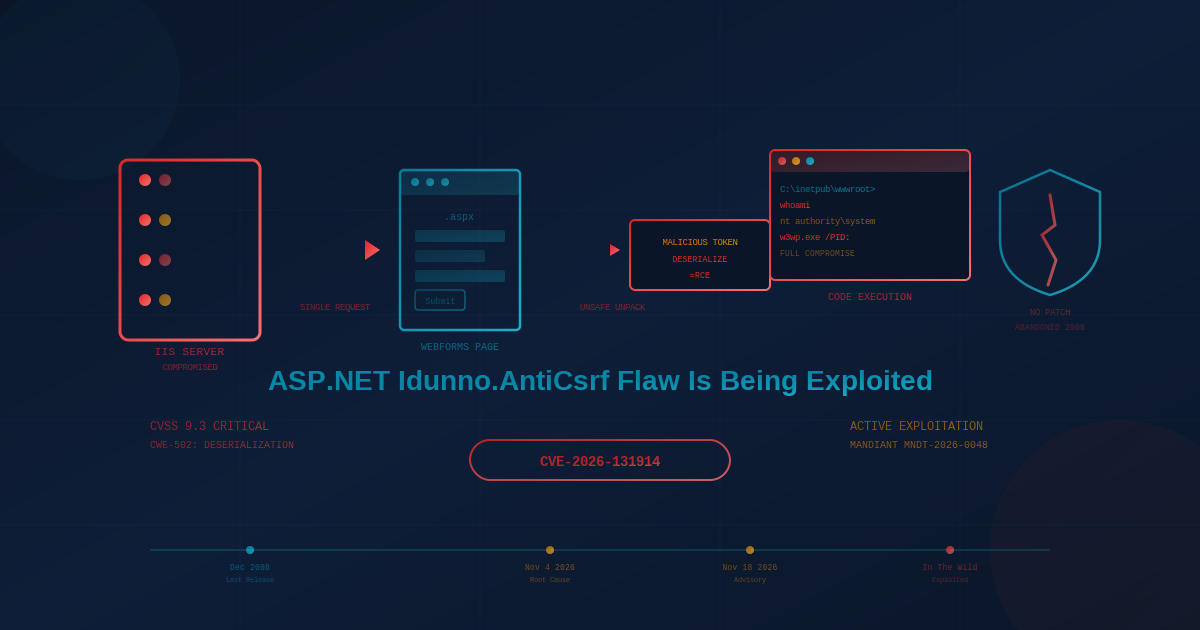
The Idunno.AntiCsrf vulnerability, tracked as CVE-2026-131914, lets an attacker take over a Windows web server with a single web request, and Mandiant's advisory says "active exploitation in the wild has been observed." The flaw sits in a free add-on for older ASP.NET WebForms websites that was last released in December 2008. It scores 9.3 out of 10, and there is no patch coming.
Most businesses do not run this library. The ones that do often do not know it, because it would have been copied into a website years ago by a developer or agency. That makes this a good test of a broader question: do you know what old code is still running on the websites and portals your business depends on, in Canada or the United States?
What is the Idunno.AntiCsrf vulnerability?
Idunno.AntiCsrf is a third-party module, originally published on the now-retired CodePlex site, that added cross-site request forgery (CSRF) protection to ASP.NET WebForms sites. CSRF protection is meant to stop a malicious site from submitting forms on a logged-in user's behalf. According to Mandiant, the module trusts the token it receives and unpacks it without checking that it is genuine, which lets an attacker hide commands inside it.
In plain terms, the safety feature became the way in. Mandiant says an attacker needs no password and no valid token: any .aspx page on an affected site that anonymous visitors can reach, and that has not been opted out of the check, can be used. The attacker's code runs as the IIS worker process (w3wp.exe), which Mandiant describes as "complete compromise of the web application server."
- Affected: Idunno.AntiCsrf.dll version 0.9.1.0 (also called 0.9.1 Beta). The CVE record published by NVD lists "versions through 0.9.1 Beta."
- Severity: CVSS 4.0 score of 9.3, Critical, weakness type CWE-502 (deserialization of untrusted data).
- Fix: none. Mandiant says the project "has no active maintainer or official patch available."
Who found it, and is it really being exploited?
Google Cloud's FLARE team found the flaw during a Mandiant incident response investigation, completed its root-cause analysis on November 4, 2026, and Mandiant published the advisory on November 18. The advisory states that exploitation has been observed in the wild, and The Hacker News reported that Google had nothing further to share about the activity.
Two caveats are worth knowing. Mandiant has not named an attacker or a victim count. And as of November 24, 2026, CISA had not added CVE-2026-131914 to its Known Exploited Vulnerabilities (KEV) catalog, the US government list that many security teams use to set patching priority. Treat the exploitation claim as Mandiant's, from its own incident work. With no patch and no login required, that is reason enough to check.
Why does an abandoned library matter so much?
Abandoned code is a blind spot because no vendor will ever send an update. Your normal patching routine cannot fix it. As our patch management cadence guide puts it, unsupported software never enters the patch queue, because there is no vendor fix. The only remedy is to find it and remove it.
Libraries like this one are also easy to miss in inventories. It is a single DLL file that sits in a website's bin folder and is switched on by a line in the site's Web.config file. Mandiant notes that organizations that recompiled the library will have different file hashes, so a scan for known file fingerprints can miss it. A search by name is more reliable.
The damage can also outlast the fix. GBHackers notes that attackers who gain code execution this way can plant web shells and steal secrets stored in configuration files, including encryption keys and database passwords. Those secrets often let an attacker come back even after the original hole is closed.
Old code on a public website is only found if someone keeps a list of what runs there. Our free assessment takes under 5 minutes and covers website and domain protection, software updates, and 20 other risk areas.
Who is actually at risk?
Only organizations running an ASP.NET WebForms website or web application that includes the Idunno.AntiCsrf module are exposed. This is not a flaw in Microsoft's ASP.NET framework itself. Microsoft's own anti-forgery features are among the replacements Mandiant recommends. Websites that do not run on ASP.NET WebForms, such as typical WordPress or Shopify sites, do not use this module.
The businesses most likely to be running it are those with older custom web applications: a customer portal, an online ordering or quoting tool, an intranet, or a line-of-business app built by an outside developer years ago and rarely touched since. If your website is hosted and maintained by an agency or vendor, the code may be theirs to check, but the risk is still yours.
What should business leaders ask their IT lead or web developer?
Start with one direct question: "Do any of our ASP.NET sites or applications include Idunno.AntiCsrf, and how do you know?" A good answer names the systems that were searched and when. A vague "we should be fine" is not an answer. If no one can list your web applications, that is the first gap to close, and our IT asset inventory guide explains why CISA tells leaders to replace unsupported applications.
Mandiant's advisory gives your technical team a clear checklist:
- Search every ASP.NET site. Look in each Web.config file and bin folder for "Idunno.AntiCsrf" and "AntiCsrfModule."
- Remove the library completely. Delete its entries from Web.config, remove code references to it, and delete Idunno.AntiCsrf.dll from the bin folder.
- Replace the protection. Use a supported anti-forgery control, such as System.Web.Helpers.AntiForgery, Page.ViewStateUserKey with MAC-verified ViewState, or ASP.NET Core's IAntiforgery.
- Review web server logs. Mandiant suggests looking for unusual POST requests to .aspx pages that returned HTTP 302 or 500 with larger than normal request sizes.
- Assume secrets are exposed if you find signs of attack. Rotate every secret stored in Web.config and applicationHost.config, including machine keys, encryption keys, and database passwords, and check the website folders for files nobody recognizes.
Step 4 only works if the logs still exist. If your web server keeps logs for a few days and the module has been running for years, you may not be able to tell whether it was used. Our security logging guide covers how long to keep records and who should review them.
If your business does not have someone in-house who owns its websites, an outside IT or security provider can run this search and log review on your behalf. Agree in writing who is responsible for checking third-party code on each site.
What if the library turns up and you suspect a breach?
Treat a confirmed match on an internet-facing site as a possible incident, not just a cleanup task. Removing the DLL closes the door, but it does not remove anything an attacker already left behind. Decide in advance who you will call and who can approve taking a site offline, as covered in our post on planning your incident response before something happens.
If customer information sits behind the affected application, involve legal counsel early. Breach notification duties vary by province and state, and this article cannot tell you whether yours apply.
The lasting lesson: security add-ons need owners too
Idunno.AntiCsrf was installed to make websites safer. Nearly two decades later, it is the reason some of them can be taken over with one request. Every piece of code on a public website needs an owner who knows it is there, knows whether it is still supported, and has a plan for replacing it when support ends.
This article is intended for general informational purposes only and does not constitute professional security, legal, or compliance advice. Details about CVE-2026-131914 are based on Mandiant advisory MNDT-2026-0048, the CVE record published by NVD, and reporting from The Hacker News and GBHackers as of November 24, 2026, and may change as more information is published. Organizations should consult qualified cybersecurity professionals before acting on any specific indicator of compromise or making operational changes based on this article.