
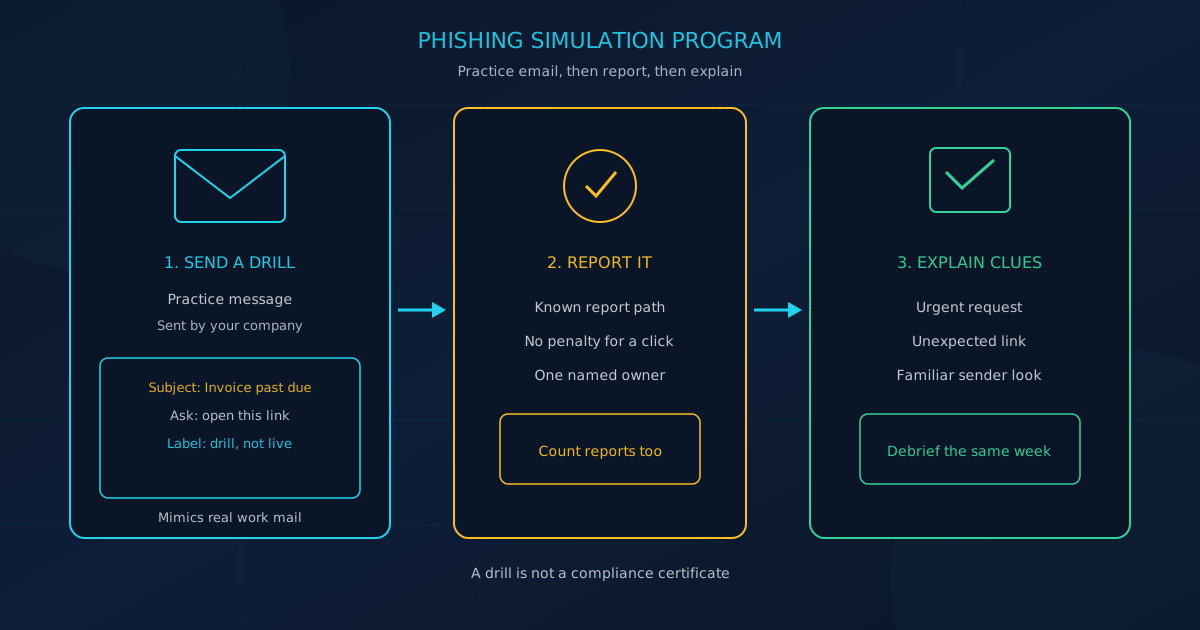
Phishing simulations for small business are practice messages a company sends to its own staff, so people can practice spotting and reporting a fake phish before a real one arrives. In November 2025, the Canadian Centre for Cyber Security's Don't take the bait (ITSAP.00.101) said organizations should conduct internal phishing simulations. The page states: "This will help employees detect and avoid phishing attacks in a safe environment." The FBI Internet Crime Complaint Center's 2024 Internet Crime Report lists Phishing/Spoofing at 193,407 complaints, the highest complaint count among crime types in that report's table. CISA's small-business phishing page, citing that report, says "phishing topped the list of the five most reported cybercrimes, with 193,407 complaints." A simulation is a drill. It does not make a business secure or compliant on its own.
This guide is for owners and operations leaders in Canada and the United States who want a short program people will actually follow. The UK National Cyber Security Centre's Phishing attacks: defending your organisation (version 2.0, reviewed 13 February 2024) says: "Staff within smaller organisations will also find this guidance useful."
What is a phishing simulation?
A phishing simulation is a practice message your organization sends so staff can spot and report a fake phish, with no outside attacker involved. In November 2025, the Canadian Centre for Cyber Security (ITSAP.00.101) said internal simulations help employees detect and avoid phishing attacks in a safe environment. The drill is training, not a legal finding.
CISA's Cybersecurity Awareness Month 2026 toolkit says: "Send out a final message that explains the clues that indicate phishing in each message, so employees can learn from them." That follow-up is part of the drill, not an optional extra.
Why do small businesses run phishing simulations?
Phishing complaints are still high volume, and a once-a-year talk goes stale. The FBI's 2024 Internet Crime Report recorded 193,407 Phishing/Spoofing complaints, the highest crime-type count in that table. CISA's small-business page cites that report and says once-a-year training is not enough. The Cyber Centre's ITSAP.10.093 (September 2024) says training should include "identifying and handling phishing attempts" and "reporting incidents."
The same Cyber Centre note recommends practical exercises "such as learning to spot phishing emails or reviewing incident response processes." A simulation is one way to do that exercise. It still has to match the messages your staff actually receive.
How do you run phishing simulations for small business?
Name one owner, tell people the goal is to report, do not punish a click, and explain the clues after every round. On 13 February 2024 the National Cyber Security Centre's reviewed guidance said: "you should always check with your HR department before undertaking any phishing simulations." CISA's page for state, local, tribal, and territorial government says: "Use phishing simulations that mimic real threats your agency might face." That page also says: "Frequent, realistic testing helps employees build lasting awareness."
A practical round for a small team looks like this:
- Name one owner. CISA's small-business page says: "Designate someone, such as an IT provider or staff lead, to track emerging threats." That person owns the calendar and the follow-up note. The same page says: "Ask them to share updates with your team between trainings."
- Make the report path obvious. CISA tells small businesses: "Make sure employees know to whom and how to report suspicious emails or phishing attempts." The NCSC asks: "Is the process clear, simple and quick to use?"
- Do not punish a click. The NCSC says "punishing people for clicking on emails you've sent starts to resemble entrapment." CISA's government page says: "Make it easy and safe to report suspicious emails and phishing attempts, even if they have inadvertently downloaded malware or shared data." It adds: "A no-blame culture promotes quick action and reduces the chance of widespread damage."
- Match the lure to real work. A fake overdue invoice for the person who pays vendors is more useful than a generic prize note. ITSAP.10.093 says training should be "tailored to your organization's business needs and security requirements."
- Explain the clues the same week. CISA's 2026 toolkit says to send a final message that explains the clues that indicate phishing in each message. Our guide to security awareness training that works for small businesses says employees who click should see an immediate, non-punitive explanation of what they missed.
If nobody on staff can schedule the messages and the follow-up, Cyber Unit's managed security awareness training enrolls the team, schedules campaigns, and runs phishing simulations. The service page states: "Phishing simulations are safe, controlled test emails that mimic real phishing attempts. When an employee clicks a simulated phishing link, they immediately see a learning page explaining what they missed."
What should a phishing simulation program measure?
Count reports, not only clicks. The National Cyber Security Centre says to "focus on how many people reported it," because a metric that only values silence pushes people to stay quiet. CISA's 2026 toolkit, in its awareness-month game, says to "reward those who successfully identify and report the most attempts." Neither source publishes a click-rate target for small businesses. A falling click count with almost no reports is a weak result.
What mistakes should you avoid with phishing simulations?
Punishment, a generic template, and a click-only scoreboard make people stop reporting. The National Cyber Security Centre states: "No training package, including phishing simulations, can teach users to spot every phishing attempt." CISA's government phishing page says a no-blame culture promotes quick action. A copied lure that does not resemble mail your staff receive trains the wrong habit.
- Punishing the person who clicked. Fear of trouble delays reports of real messages. Tell staff, in writing, that a click on a drill is a lesson, not a disciplinary event.
- Tracking clicks alone. The NCSC says to focus on how many people reported it, not only how many clicked. Share the combined result with the owner. Do not post a name-and-shame list.
- Skipping the explanation. CISA's toolkit pairs the practice emails with a message that explains the clues. A drill with no debrief is a pop quiz, not training.
- Treating the drill as the whole defense. The NCSC says: "Having a second factor means that an attacker cannot access an account using just a stolen password." It also recommends "limiting administrator accounts to those who need those privileges." Our article on least privilege for small business states: "Removing admin rights does not prevent phishing or malware, but it limits the blast radius when those controls fail."
How is a phishing simulation different from a tabletop?
A phishing simulation is a message in the inbox. A tabletop is a meeting about what you do after a report. Our guide to a cybersecurity tabletop exercise for small business calls it "a short, discussion-based meeting where your team walks through a simulated incident to find gaps in your response plan before a real attack does." CISA's small-business page points to no-cost tabletop exercises you can adapt so participants understand their roles during an incident.
That follow-up only helps if someone has already thought about it. Our article on incident response planning says: "Organizations that have thought through their response in advance tend to navigate these situations more effectively than those making it up as they go."
What should you check before the next round?
Before the next round, write down who owns the program, when the last practice message went out, and whether staff got an explanation of the clues. The Cyber Centre's November 2025 guidance says to establish protocols for employees to verify and report suspicious communications, and to use multi-factor authentication on systems. If the owner or the report path is unclear, fix those first. A simulation alone does not make the business compliant.
If you want a plain look at training, email, and the controls around them, a free cybersecurity assessment is the next step. A cyber security assessment helps you understand where your business stands. This free 5-minute version covers 22 security areas and runs entirely in your browser, with no signup required.
This article is intended for general informational purposes only and does not constitute professional security, legal, or compliance advice. Guidance summarized here is drawn from the Canadian Centre for Cyber Security, CISA, the UK National Cyber Security Centre, and the FBI Internet Crime Complaint Center's 2024 Internet Crime Report as of the date of publication and may change. A phishing simulation program does not by itself make an organization compliant. Organizations should consult qualified cybersecurity professionals before changing training, reporting, or access practices.