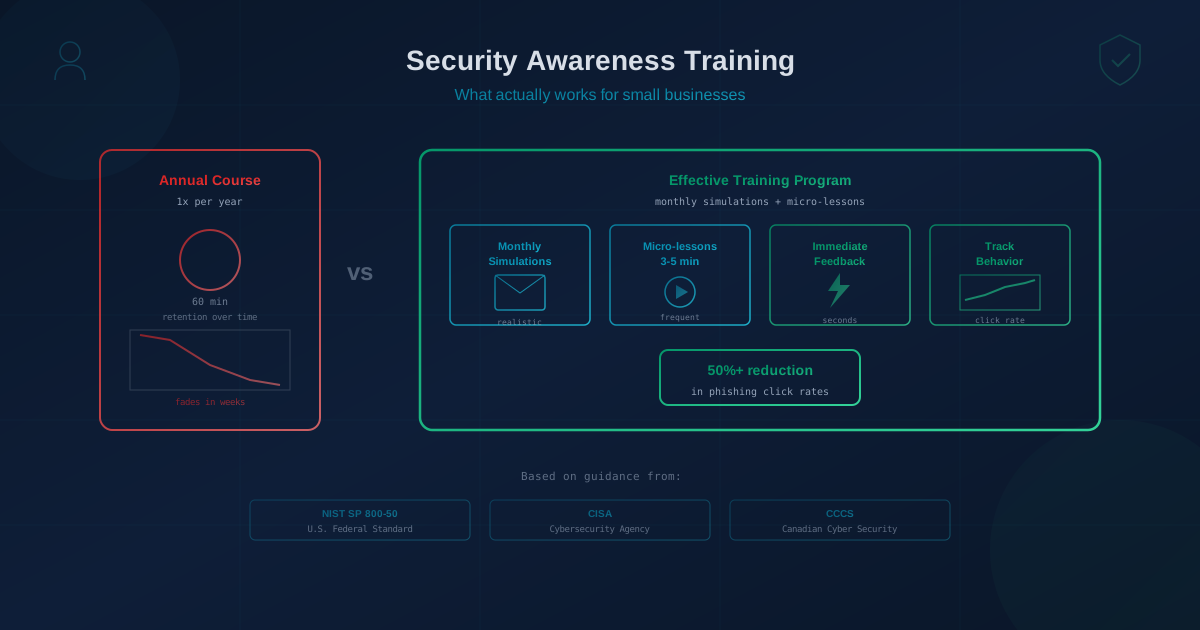
Security awareness training works for small businesses when it combines short, frequent lessons with realistic phishing simulations and immediate feedback. Research from CISA, NIST SP 800-50, and the Canadian Centre for Cyber Security (CCCS) shows that annual one-hour courses have minimal long-term impact on employee behavior. Programs that run monthly simulations, deliver micro-lessons under 5 minutes, and provide feedback within seconds of a click error produce measurable reductions in phishing susceptibility. This article covers what the public research says and how to apply it in a small business without a dedicated security team.
What does the research say about effective security awareness training?
Three public sources provide the clearest guidance: NIST SP 800-50 (the U.S. federal standard for security awareness), CISA's training recommendations, and the Canadian Centre for Cyber Security's guidance for small organizations. The common findings across all three:
- Frequency matters more than length. Short sessions delivered regularly outperform long sessions delivered annually. NIST SP 800-50 recommends "ongoing" training, not annual compliance events. CISA's guidance emphasizes that "security awareness should be a continuous effort."
- Simulations change behavior; lectures do not. Phishing simulations with immediate feedback create a learning moment tied to the employee's actual behavior. The CCCS guidance notes that "hands-on exercises" are more effective than passive content consumption.
- Immediate feedback accelerates learning. When an employee clicks a simulated phish, showing an explanation within seconds produces better retention than sending a follow-up email days later. This is consistent with established learning science on corrective feedback timing.
- Metrics should track behavior, not completion. Completion rates tell you who finished a course, not who changed their behavior. CISA recommends tracking phishing simulation click rates over time and the ratio of reported suspicious emails to actual incidents.
Why do annual courses fail?
Annual security awareness courses became standard because they satisfy compliance checkboxes, not because they change behavior. The problems:
- Forgetting curve. Research on memory retention shows that people forget most new information within days if it is not reinforced. A single annual session cannot overcome this.
- Generic content. Many off-the-shelf courses cover threats employees will never encounter while skipping the specific attack types targeting their industry. A law firm faces different phishing tactics than a construction company.
- No connection to real behavior. Sitting through a slide deck does not simulate the decision an employee makes when a suspicious email arrives at a busy moment. Simulations create that decision point in a controlled way.
- Delayed or absent feedback. Annual courses often test knowledge at the end, but employees who fail rarely receive immediate correction. The gap between mistake and feedback weakens learning.
The CCCS guidance explicitly warns against treating security awareness as "a once-a-year compliance activity" and recommends integrating it into daily operations.
What does effective training look like in practice?
For a small business without a dedicated security team, effective security awareness training has four components:
Monthly phishing simulations
Run at least one simulated phishing campaign per month. The simulation should reflect real-world threats relevant to your industry: fake invoice emails for accounting staff, impersonated executive requests for finance, or credential harvesting pages mimicking tools your team actually uses (Microsoft 365, Google Workspace, etc.). Employees who click should see an immediate, non-punitive explanation of what they missed. Track click rates over time, not just single snapshots. A sustained downward trend indicates behavior change.
Short, frequent micro-lessons
Replace annual hour-long courses with 3 to 5 minute lessons delivered weekly or biweekly. Topics should rotate through core threats: phishing, business email compromise, password hygiene, MFA, suspicious links, and social engineering. Shorter content delivered more often fits into busy schedules and reinforces retention.
Just-in-time reminders
Trigger brief reminders at moments of risk: a warning banner on external emails, a prompt before clicking an unfamiliar link, or a tooltip when downloading an attachment from an unknown sender. These contextual nudges work better than abstract training because they appear at the decision point.
Tracking and accountability
Measure what matters: simulation click rates, time to report suspicious emails, and incident outcomes. Share aggregated (not individual) metrics with leadership so security awareness becomes a business priority, not just an IT checkbox. Avoid punitive approaches that discourage employees from reporting real incidents.
How do you get started without a dedicated security team?
Small businesses often lack the staff to build and run training programs in-house. Options:
- Managed security awareness platforms. Providers like Cyber Unit's Security Awareness Training service (powered by Wizer) handle simulation scheduling, content delivery, and reporting. You define the frequency; the platform runs the campaigns and tracks results.
- Free resources for baseline training. CISA offers free cybersecurity training materials. The Canadian Centre for Cyber Security publishes awareness guidance and posters. These are useful supplements, though they lack the simulation and tracking features of managed platforms.
- Integrate training into IT provider scope. If you work with a managed IT or cybersecurity provider, ask whether security awareness training is included or available as an add-on. Our free cybersecurity assessment covers training gaps as one of the 22 areas evaluated.
What metrics indicate success?
Completion rates alone do not prove behavior change. Track these metrics over time:
- Phishing simulation click rate. Aim for a sustained downward trend, not a single low number. Expect initial click rates of 20% or higher; well-run programs reduce this to under 5% over 12 months.
- Time to report. How quickly do employees report a suspicious email? Faster reporting means faster response if the email is real.
- Report-to-incident ratio. Are employees reporting more suspicious emails than before? A higher ratio of reports to actual incidents indicates increased vigilance.
- Repeat offenders. Track whether the same individuals click simulations repeatedly. Targeted follow-up training (not punishment) may be needed.
Common mistakes to avoid
- Punishing clicks harshly. Threatening discipline for simulation failures discourages employees from reporting real incidents. Non-punitive immediate feedback is more effective.
- Running simulations without training. Simulations alone can frustrate employees if they never receive guidance on what to look for. Pair every simulation campaign with a brief educational follow-up.
- Using only generic templates. Simulations should mimic the specific threats your industry faces. Customize sender names, subject lines, and lures to match real attack patterns.
- Measuring completion instead of behavior. A 100% completion rate means nothing if click rates stay the same. Focus on outcome metrics.
- Stopping after improvement. Phishing tactics evolve. A program that reduced click rates in 2025 may need updates in 2026 as attackers adopt new techniques. Treat training as ongoing, not a project with an end date.
What should a small business do this week?
Start with two steps:
- Assess your current state. Take the free 5-minute cybersecurity assessment to see how your business scores on security training and 21 other areas. The results include prioritized recommendations.
- Run a baseline simulation. If you already have a training platform, run a phishing simulation this month and record the click rate. If you do not, ask your IT provider about adding security awareness training, or contact us about our managed training service.
Security awareness training is not a silver bullet, but it is one of the few defenses that addresses the human layer of risk. The research is clear: short, frequent, simulation-based programs with immediate feedback produce measurable results. Annual compliance courses do not.
This article is intended for general informational purposes only and does not constitute professional security, legal, or compliance advice. Recommendations are based on publicly available guidance from NIST SP 800-50, CISA, and the Canadian Centre for Cyber Security as of the date of publication. Organizations should consult qualified cybersecurity professionals before making operational changes based on this article.