
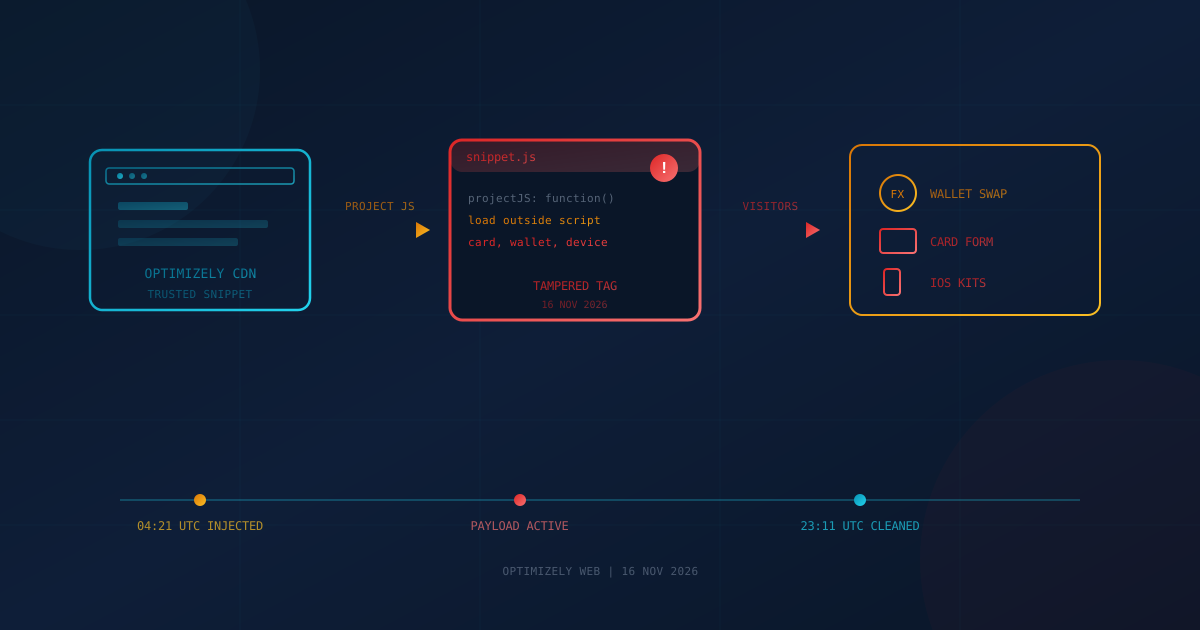
On 16 November 2026, Report URI reported a supply chain attack delivered through Optimizely Web, a tool companies use to test and personalize pages. Scott Helme and his team said they fetched 1,611 Optimizely snippets and found malicious JavaScript in 188 of them, belonging to 178 organizations, and that the real number is likely higher because they could only check snippets they found in time. BleepingComputer and SecurityWeek both reported that research. BleepingComputer said it separately saw the malicious script load, or try to load, on a shorter list of sites.
Report URI said the attacker wrote a loader into Project JavaScript, custom code that runs on every page where the snippet is installed, and left the rest of the file alone. The snippet still came from Optimizely's content delivery network, with Optimizely's certificate. Optimizely's status page, posted at 01:02 UTC on 17 November 2026, says an unauthorized party exploited a vulnerability in Experimentation, that the flaw is fixed, and that the injected code was removed from affected projects. The notice was still marked Monitoring when this article was written.
For a small or mid-sized business in Canada or the United States, the lesson is the tag, not the logo. Testing, analytics, chat, and ad scripts run in the visitor's browser with broad access to the page. If an agency placed one and nobody has listed it since, this is the week to look.
What happened to Optimizely Web on 16 November 2026?
Report URI places the first Optimizely injection at 04:21 UTC on 16 November 2026, on a BBC snippet that had been clean at 02:21 UTC. SecurityWeek reported that same start time. By 21:52 UTC, Report URI said 1 of the 188 infected snippets still held the code. By 23:11 UTC, it said every infected file it was watching was clean, and that those files stayed clean.
BleepingComputer published a statement from Optimizely that the status page does not include. The company told the outlet the vulnerability was in the Experimentation account signup flow, and that it had blocked that path, deployed a fix, removed the injected code, ended active sessions, revoked tokens, reset access for affected accounts, blocked delivery of the code at Cloudflare, and notified affected customers. The 178 figure is Report URI's count of organizations in the snippets it checked. Optimizely has not published its own customer count.
Report URI and BleepingComputer both describe three loaders. The common one added a script tag for an attacker-controlled address, 1688360.cc, which then loaded a file named track.js. A second hid that address in base64, so a text search for the domain misses it. Report URI said Smartsheet's snippet was cleaned and then reinfected with that hidden version. A third carried a full copy of the payload inside the snippet, so blocking the outside address was not enough. SecurityWeek, citing Hudson Rock, made that same point.
Report URI said this was not a poisoned cache. The network served the project file it was given, including copies on a customer's own domain. Optimizely's own site and login page were on the list, and BleepingComputer included Optimizely among the sites where the script appeared.
Report URI also described an earlier wave, from 13 November, through Kissmetrics, StorifyMe, and Minute Media. SecurityWeek reported that Hudson Rock saw the same three services, calling the third minute-ly, and that it is unclear how the code got in. That path is separate from the Optimizely signup-flow bug.
Which organizations did researchers actually name?
A name here means an Optimizely snippet tied to that organization contained the loader. It does not mean the company's own servers were broken into, and it does not mean every page that brand runs was changed. Report URI's opening list is Zoom, the BBC, CNN, Salesforce, GitLab, IKEA, HSBC, Equifax, Air France-KLM, Ledger, and Peacock.
SecurityWeek, citing Report URI, repeats the BBC, CNN, Zoom, GitLab, Salesforce, Equifax, HSBC, and IKEA. Ledger and Peacock are in Report URI's write-up and not in the BleepingComputer or SecurityWeek lists below, so treat those two names as Report URI's identifications.
BleepingComputer did its own check. It said urlscan.io records showed the script loading, or attempting to load, on Zoom, KLM, GitLab, the BBC, Scheels, CNN, American Girl, ManageBuilding, Smartsheet, Stamps.com, and Salesforce. It also listed Fox News, Mutual of Omaha, American Eagle, Air France, Change.org, Optimizely, HSBC Insurance, Bitly, IG, and UNICEF USA. Note the HSBC wording. Report URI listed a set of HSBC country sites. BleepingComputer's independent note says HSBC Insurance. Those are not the same claim, and neither one is "HSBC's entire bank was taken over."
The domain on the row matters. Report URI's IKEA entry is client.home-design.ikea.com, a design subdomain, not a statement that the main retail site was edited. Salesforce properties on Report URI's table include domains such as pardot.com and exacttarget.com. Salesforce told BleepingComputer it was confirming Optimizely scripts were disabled on preview and production as a precaution, and that it would notify customers if it found unauthorized access to their data. That covers Salesforce's sites only.
A few Canadian names are on Report URI's list and not in BleepingComputer's urlscan check: Equifax Canada (my.equifax.ca and www.equifax.ca), CTV News, and Starbucks Canada. Read the domain, then your own tag. Absence from the list is not a clean bill. Report URI said it could not see every snippet, and a different testing vendor would never have appeared there.
What could the malicious script do in a visitor's browser?
Report URI and BleepingComputer both examined the payload and describe the same four jobs: swap cryptocurrency addresses, look for payment card details, collect browser data including cookies and screenshots, and load further code aimed at iPhones and iPads. What a given visitor experienced depended on the device and on what they did on the page. Neither outlet can see how many cards, cookies, or devices actually reached the attacker. Report URI said that directly in its 17 November update.
On cryptocurrency, the script replaced wallet addresses with the attacker's, including text the visitor copied, according to Report URI. BleepingComputer described the same replacement. Both put on-chain receipts at about 7,000 US dollars that evening. Report URI's first tally was about 7,040 US dollars. Both warned that some wallet history predates the campaign, and Report URI said one TRON wallet had been in use since March 2026. That figure is not a finished loss total for the day.
On cards, Report URI said skimming code was added to track.js at 13:43 UTC. It watched forms and certain requests for a card number, an expiry date, and a security code, and it was built to send them to the attacker. Cards typed into the site's own fields were in scope. Cards entered inside a payment company's frame, such as Stripe or Adyen hosted fields, were not. BleepingComputer confirmed the script searched for those three values and tried to send them. No one has published a count of cards received.
On cookies and screenshots, BleepingComputer said the script could collect cookies, the page address, and a screenshot. Report URI tied that collection to an address swap near wallet or payment wording, limited the cookies to ones JavaScript can read, and said the screenshot was made in the browser. That is a capability with a condition. It is not proof that every visitor lost a session.
On phones, Report URI identified the follow-on code as the Coruna and DarkSword exploit kits: Coruna for iOS 13 through 17, DarkSword for iOS 18.x, and a further chain for iOS 26 that it said only fingerprinted the device. The kit's own comments, not an Apple bulletin, treat iOS 18.7.3 and later, and iOS 26.3 and later, as patched. SecurityWeek reported that Hudson Rock linked the infrastructure and had not shown a device taken over. Update anyway.
Why are third-party scripts a supply-chain risk for a normal business website?
A third-party script is code your site tells the visitor's browser to run, written and hosted by someone else. OWASP's guidance on third-party JavaScript calls a compromise of that outside script the greatest risk of marketing and analytics tags, and says the outside code runs with the same kind of power as the page's own script. A/B tests, chat widgets, heatmaps, and tag managers all sit in that category because they are allowed to change the page.
The same trust failure shows up elsewhere. The axios npm compromise altered a JavaScript library so a routine install could pull in malware. The Notepad++ update compromise delivered a tampered installer through an update channel people already trusted. On a website, the cousin is the add-on you did not write. The note on WordPress plugin risk says a site is only as safe as the third-party code it loads. The attacker edits the dependency. Visitors receive the result from a name the site already allowed.
OWASP describes the tag-manager pattern: one snippet on the page, and marketing staff change what it returns without a new release. Project JavaScript is that kind of field. The attacker wrote into it.
Two browser controls help, and they do different jobs. Subresource Integrity lets you pin a hash to a script. Mozilla's documentation says the browser refuses the file if the bytes do not match. That fits a library that should not change. It does not fit a live experimentation snippet, which the vendor rewrites when a test changes. A pinned hash would break the product.
Content Security Policy is the site's instruction to the browser about which JavaScript a document may load. A report-only policy does not block anything. Mozilla says it reports violations so you can see what the site loads before you enforce a rule. The keyword strict-dynamic, on the same page, passes trust from an approved script to scripts that script creates. Mozilla also says that makes the policy less protective, because a trusted script can then pull in something you did not name.
Report URI's crawl of 256 affected hosts is one firm's count, not a second census. It reported 68 with no Content Security Policy, 50 whose policy still allowed the payload and the theft, 17 that blocked the outbound theft while the script ran, and 24 that blocked the payload. Allowing Optimizely's host could not stop code that came from that host. It said strict-dynamic and unsafe-eval let the extra script or the inline copy through, and that limiting where the page may send data stopped some card, cookie, and screenshot theft. That limit did not stop an address swap inside the page.
What should a Canadian or US business check on its website now?
Start with an inventory, not a new product. Ask whoever runs the site for every script the public pages load: A/B testing, analytics, a tag manager, chat, ads, reviews, and embedded video. Write down the host name, the business owner, and who can publish a change. Do this for the marketing site and the checkout. They are often different properties.
If you use Optimizely Web, open Project JavaScript and any custom code on experiments. Look for a script you did not write, including atob, because Report URI documented a version that hid the address. Read the status notice. If you do not use Optimizely, do the same review in the tag manager you do use. The signup-flow bug was specific. Unaudited custom code inside a tag is not.
Then look at access. List users, agency seats, and API tokens. Remove people who have left, and require multi-factor authentication on every account that can publish a tag. Optimizely told BleepingComputer this intrusion used a signup-flow flaw, so that control would not have closed this bug. It is still the right setting on a login that can change what visitors run.
Ask your developer four questions, and expect short answers:
- Is there a Content Security Policy, and is it enforcing or report-only? If there is none, start in report-only mode so you see what a block would break.
- Which scripts are pinned with Subresource Integrity, and which cannot be pinned because the vendor changes them on purpose?
- Where may the page send data? Report URI's partial blocks stopped some card and cookie theft and did not stop an address rewrite inside the page.
- Who is subscribed to status pages for every vendor that injects script, and who reads those emails on a weekend?
If your own forms collect card numbers and an affected snippet was on that page on 16 November, Report URI's advice is to treat cards entered that day as potentially exposed. Hosted payment frames are the exception it described. What you tell customers is a question for counsel. This article is not legal advice. Do not wait on a count of stolen cards. The researchers have said they cannot see that count.
If the snippet on your site was infected, Report URI also said to treat session tokens in cookies that JavaScript can read as exposed, and to rotate them. Your developer can say which cookies script can read. Rotate the ones that grant access, and force a fresh login.
What should staff and customers do after visiting an affected site?
Reading a page and paying on it are not the same exposure. Report URI and BleepingComputer both tell people who visited an affected site on 16 November 2026 to update Apple devices, to check cryptocurrency transfers from that day, and to watch card statements if they typed a card. BleepingComputer also says to watch account activity if you were logged into a sensitive service while the page was open.
On an iPhone or iPad, install the current iOS or iPadOS. Apple's support page says to open Settings, then General, then Software Update, and that keeping the software up to date is one of the most important steps for the device's security. Do not stop at a build number taken from a malware comment. The action both Report URI and BleepingComputer describe is the latest update the device is offered. That same habit is basic mobile security: software updates often contain the patches that close known holes.
If you copied a wallet address from an affected page, or while that tab was open, compare the address you meant to pay with the one that was paid. Report URI said the script could replace an address at copy time. A card typed into the site's own checkout should be watched, and unknown charges should go to the issuer. You do not need a breach letter to dispute a charge that is not yours. If you were logged in, sign out and sign in again.
A company laptop or phone was not "hacked" at the network just because someone opened a news site. The script ran in the browser. Still look if that browser was signed into work email, a password vault, or an admin console. Endpoint detection and response is the software that records what a device does and can isolate it. Ask whoever watches those alerts to look. If nobody watches them after hours, that gap is older than this incident.
When should you call for outside help?
Call when your domain is on Report URI's list, when you find tag code nobody recognizes, or when customers report card fraud or a swapped cryptocurrency payment after using your site on 16 November. Also call if a company device shows sign-ins you cannot explain after someone on staff visited a named site, or if nobody inside the company can answer the inventory questions above.
Decide who picks up before the call feels urgent. The guide to incident response planning before something happens says a short list of who decides and who to call is worth more than a long plan nobody has read. If that monitoring is not in house, Cyber Unit's cybersecurity services include endpoint detection and response with 24/7 monitoring from a security operations center, and incident response to contain an event once it is found.
If you are not sure where the rest of the business stands while you chase tags, the free cybersecurity assessment takes under five minutes and covers 22 areas, including endpoint protection and incident response. It will not inventory your Optimizely projects. It will show which of those neighboring controls are thin before you brief the web team.
What should owners remember after the Optimizely Web cleanup?
Optimizely says the injected code is gone from affected projects, and Report URI said the files it was watching were clean by 23:11 UTC on 16 November. Removing the file does not rewind a card number, a swapped wallet address, or a session cookie that already left the browser.
SecurityWeek quoted Scott Helme on the point that lasts: a website can be compromised through a third-party dependency without its own code or infrastructure ever being breached. Know which scripts you load, who can change them, and what the browser may do next.
This article is intended for general informational purposes only and does not constitute professional security, legal, or compliance advice. Details about the Optimizely Web incident are based on public reporting from Report URI, BleepingComputer, SecurityWeek, and Optimizely's status notice as of the date of publication and may evolve as the investigation continues. Organizations should consult qualified cybersecurity professionals before acting on any specific indicator of compromise or making operational changes based on this article.