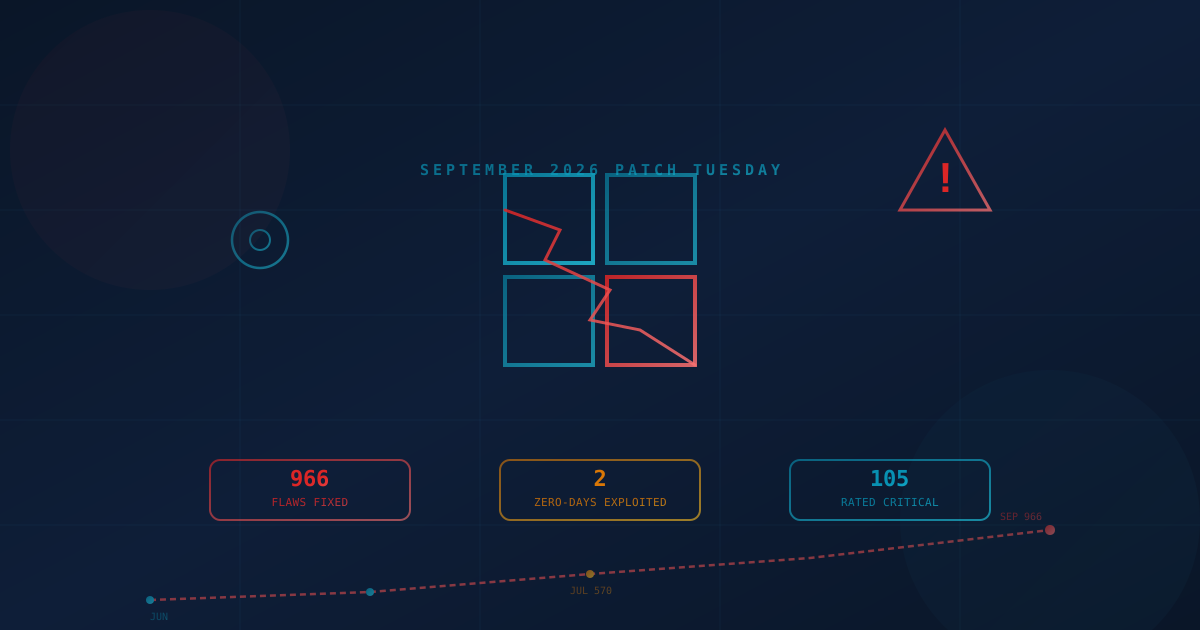
On September 8, 2026, Microsoft shipped fixes for 966 vulnerabilities — the largest Patch Tuesday in the program's history, breaking the previous record of 570 set just two months earlier in July. Two of the 966 were zero-days already under active attack: CVE-2026-81963, an elevation-of-privilege flaw in the Windows Update Stack, and CVE-2026-85880, a heap-based buffer overflow in Windows ALPC that lets an attacker escape a sandbox and reach SYSTEM. (A "zero-day" is a flaw attackers are exploiting before, or as, a patch becomes available.)
The headline count itself is contested at the margins — Microsoft's own tally is 966, some trackers count 964 or 973 depending on how re-published and third-party CVEs are folded in — but every count agrees on the shape of the story: this is not a spike, it is the second record in three months.
This post covers what actually needs attention in the 966, why the number keeps climbing month over month, why that is as much a story about how Windows is built as it is about Microsoft, and what a small or mid-sized business actually needs to change in response.
What Was in the September 2026 Patch Tuesday?
Microsoft's September update addressed 966 vulnerabilities, of which 105 were rated Critical — 81 remote code execution, 20 elevation of privilege, 2 information disclosure, and 1 security feature bypass. That total does not include roughly 204 additional flaws Microsoft had already patched earlier in the month across Azure AI Language, Azure Cosmos DB, Copilot Studio, Entra ID, Microsoft Edge, Microsoft Fabric, and Power Automate — meaning the real September total, across all of Microsoft's products, is closer to 1,170.
Two flaws matter more than the other 964 combined, because attackers were already using them:
- CVE-2026-81963 — Windows Update Stack elevation of privilege. Actively exploited. The bug is a "link following" flaw: the Update Stack fails to properly validate a file path before acting on it, which lets an attacker who already has a foothold escalate straight to SYSTEM — the highest privilege level on a Windows machine. Microsoft credits Romain Deperne of Airbus Helicopters and its own Threat Intelligence Center with the find. CVSS 7.8.
- CVE-2026-85880 — Windows ALPC elevation of privilege. Actively exploited. Advanced Local Procedure Call (ALPC) is a low-level Windows communication mechanism; this is a heap-based buffer overflow in it. An attacker running low-privilege code inside a sandboxed AppContainer can use the bug to break out of that sandbox and reach SYSTEM, with no user interaction required. CVSS 7.8, and it reaches back as far as Windows 10 version 1607 and Windows Server 2012.
Notice what these two have in common: neither is a browser-click, email-attachment kind of bug. Both are privilege-escalation flaws that only matter after an attacker is already on the machine — through phishing, a stolen credential, or a tool like the one we cover in our piece on rogue remote-access software spreading between machines. That is the pattern worth remembering: the "second half" of an attack, where a foothold turns into full control, is where this month's urgency lives.
Why 966 Is the New Baseline, Not an Outlier
Every large Patch Tuesday in 2026 has been followed by a larger one. June set a record at 206. July nearly tripled it to 570. September nearly doubled July's count again. We covered the mechanism behind that curve in detail in our piece on July's record-breaking update: Microsoft built an AI-driven scanning system, internally called MDASH, that reads its own source code and finds real, exploitable bugs at a pace no human review team can match. September is that system running for another two months.
The number that matters isn't 966. It's the slope of the line through June, July, and September. Microsoft has told customers directly to expect larger monthly updates and more frequent out-of-band, emergency patches going forward — in other words, 966 is not a bad month, it is closer to what "normal" now looks like. Treating each record as a one-off event, rather than the new operating baseline, is the single biggest planning mistake a business can make right now.
The Fundamental Problem: Windows Was Never Built for This
Microsoft's AI-assisted discovery is finding real bugs faster. But it is finding them in a codebase that was never designed to survive this kind of scrutiny. Windows carries roughly four decades of accumulated code, and Microsoft's own backward-compatibility promise — that software written for Windows XP should still run on Windows 11 — means old, weakly-validated code paths rarely get deleted. They get wrapped, extended, and carried forward.
That is the actual root cause behind this month's two zero-days. The Update Stack and ALPC are not new features; they are foundational plumbing that has existed for most of Windows' history, written under threat models that predate widespread remote exploitation. AI-driven fuzzing and static analysis are now systematically excavating that plumbing, module by module, and finding what was always there. The bug count is rising not because Windows is getting worse — it is rising because we finally have a tool that can see how much technical debt was already present.
This creates a structural tension Microsoft cannot fully engineer its way out of: the same backward compatibility that makes Windows usable in a 20-year-old accounting office is the reason a 2026 AI scanner can still find kernel-adjacent bugs in code written before most current employees were born.
This Is Not Just a Microsoft Problem
The same AI-driven discovery curve is playing out across the industry, which is the clearest evidence this is structural rather than a Microsoft-specific failure. Adobe moved from monthly to twice-monthly security bulletins. Cisco shifted to risk-based, twice-monthly disclosures with consolidated "umbrella" advisories. Mozilla has shipped near-weekly since its AI-assisted Firefox pipeline went live, including 423 Firefox fixes in a single month. And Google, as we covered in our look at Chrome's sixth actively exploited zero-day of 2026, is now resolving CVE counts in the hundreds per release cycle.
Every major software vendor that has turned AI loose on its own codebase is finding the same thing: decades of legacy code contain far more latent bugs than annual audits ever surfaced. Windows just has the largest, oldest, most widely deployed codebase of the group, so its number is the biggest. The underlying dynamic — AI collapsing the cost of finding a bug, in any large enough codebase — is universal, and it was reinforced again in our coverage of a frontier AI model finding 500-plus unknown flaws in open-source software.
What This Means for Small and Mid-Sized Businesses
For an SMB with no dedicated security staff, a 966-item patch list is not a to-do list — it is noise unless someone triages it. That triage gap is where the real risk sits, and it hits smaller organizations harder than enterprises for a specific reason: most SMBs still patch on a manual, monthly, "whenever IT gets to it" cycle, because that used to be adequate. It no longer is.
- The exploited flaws need a days-not-weeks SLA. If your business (or your MSP) is still batching all patches into a single monthly maintenance window, actively exploited zero-days like this month's two sit unpatched for weeks by design.
- Nobody can manually triage 966 items every month, forever. This is now a recurring, permanent operational task, not an occasional emergency. Without automation, it either doesn't get done consistently, or it consumes disproportionate IT time every single month.
- Fragmented environments make triage worse. A business with unmanaged laptops, a mix of personal and company devices, and no central inventory cannot even answer "which of our machines are affected" quickly enough to matter.
What Actually Needs to Happen: Automated Patching and Centralization
There is no version of this problem that a manual, monthly process solves going forward. Two changes matter more than any others.
1. Automate patch deployment wherever it's safe
For endpoints, browsers, and most desktop applications, the fastest and safest patch is the one that installs itself without waiting on a human to click "update." Automated patch deployment closes the exposure window from weeks to hours for the majority of a fleet. Reserve manual, tested rollouts for servers, domain controllers, and identity infrastructure — the systems where a bad update can cause an outage, not just an inconvenience. We cover the mechanics of this discipline in our guides on patch management fundamentals and managing software updates at scale.
2. Centralize visibility and control
Automated patching only works if there is one place that knows every device that needs it. A centralized endpoint management platform — whether run in-house or through a managed provider — gives you a single inventory, a single patch-compliance view, and the ability to push an emergency fix to every machine within hours instead of hoping each employee updates on their own. Without centralization, "we patch automatically" quietly becomes "we patch automatically on the machines we remembered to enroll."
Centralization comes with its own governance requirement, though: the same remote-management tooling that pushes patches to every endpoint is also a high-value target if it isn't locked down and monitored. We go deeper on that trade-off, including how attackers are already abusing legitimate remote-access software, in our companion piece on why remote-management tools keep showing up in real incidents.
- Patch the two exploited CVEs this week. Confirm CVE-2026-81963 and CVE-2026-85880 are applied fleet-wide, not just "scheduled."
- Set a written, risk-based patch SLA — for example, actively exploited flaws within 72 hours, other Critical items within 7 days — and measure your actual performance against it monthly.
- Turn on automatic updates for every endpoint and browser where a failed update won't cause an outage.
- Get a single centralized inventory of every device, managed or not, so "which machines need this patch" has a fast answer.
- Assign ownership. Someone — internal IT or your MSP — needs to own triaging each Patch Tuesday and reporting compliance, not just installing patches when time allows.
- Baseline where you actually stand. Our free quick security assessment takes about five minutes and flags whether your patching, identity, and backup posture can keep pace with a monthly cadence this size.
The Durable Lesson
Microsoft will likely break the 966 record again before the year is out, and so will several other major vendors. The number itself is not the emergency. The emergency is any organization still running a manual, monthly patch process built for a world of 100-fix months, now facing 966. AI has permanently lowered the cost of finding software flaws — for Microsoft's own defenders first, and eventually for attackers too. The businesses that come through this era calmly are the ones that stopped treating patching as a periodic chore and started treating it as an automated, centralized, continuously measured system.
This article is intended for general informational purposes only and does not constitute professional security, legal, or compliance advice. Details about Microsoft's September 2026 Patch Tuesday and the CVEs referenced are based on public reporting and vendor disclosures as of the date of publication and may evolve as investigations continue. Organizations should consult qualified cybersecurity professionals before acting on any specific indicator of compromise or making operational changes based on this article.