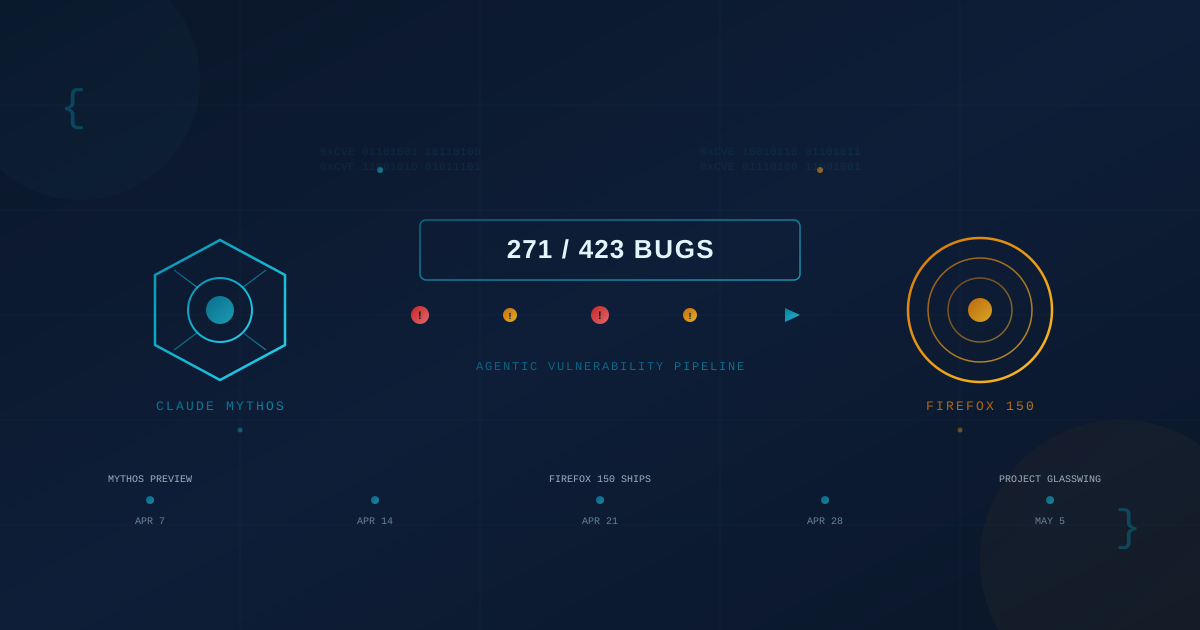
Mozilla patched 423 Firefox security vulnerabilities in April 2026 alone — roughly 20 times its 2025 monthly average of about 21 fixes — after Anthropic gave it early access to Claude Mythos Preview, an unreleased frontier AI model that found 271 of those bugs on its own. The remaining 152 fixes came from external reporters and Mozilla's internal techniques.
The bulk of the fixes shipped with Firefox 150 on April 21, 2026, with additional patches in 149.0.2, 150.0.1, and 150.0.2. Of the 271 bugs attributed to Mythos, Mozilla rated 180 as sec-high and 80 as sec-moderate — meaning most were exploitable by a user simply visiting a malicious page.
For Canadian and US small and mid-sized businesses, this is not a browser story. It is a preview of what the next two years of cybersecurity look like when an AI model can read source code and surface decades-old flaws — including a 15-year-old HTML <legend> bug and a 20-year-old XSLT issue — faster than any human team.
What Mozilla Actually Shipped in April 2026
Mozilla shipped 423 security fixes in a single month, against a 2025 average of about 21 per month. The increase was almost entirely driven by an internal agentic AI pipeline built around Claude Mythos Preview, alongside other large language models. Of the 423 total: 271 were found by Claude Mythos, 41 came from external researchers, and 111 were discovered through Mozilla's existing internal techniques (a mix of conventional fuzzing, Mythos fixes shipped in adjacent releases, and other AI tooling).
- Volume: 423 Firefox security advisories in April 2026, up from a monthly average near 21 in 2025.
- AI share: 271 of the 423 (about 64%) attributed to Claude Mythos Preview.
- Severity of the AI-found bugs: 180 sec-high, 80 sec-moderate, 11 sec-low.
- Releases: primarily Firefox 150 (April 21, 2026), with follow-on fixes in 149.0.2, 150.0.1, and 150.0.2.
- Notable cases: a 15-year-old HTML legend bug, a 20-year-old XSLT issue, sandbox escapes, and WebAssembly-related flaws.
What made this possible was not brute force. Mozilla engineers described an agentic harness that lets the model generate hypotheses about where bugs might exist, then build reproducible proof-of-concept test cases that confirm or rule out each one before a human ever sees it. That validation loop is the part that turned AI vulnerability discovery from a research demo into a shippable pipeline.
What Is Claude Mythos Preview, and Why Is It Restricted?
Claude Mythos Preview is an unreleased Anthropic frontier model announced on April 7, 2026. Anthropic chose not to make it commercially available. Instead, the company released it to a tightly controlled consortium called Project Glasswing, which includes major operating system vendors, browser makers, financial institutions, and government partners on both sides of the Canada–US border. Mozilla's Firefox work was an early Project Glasswing engagement.
The reason for the restriction is straightforward. According to Anthropic's own published evaluation and an independent assessment by the UK AI Safety Institute, Mythos Preview can identify thousands of zero-day vulnerabilities — across every major operating system, every major browser, and a wide range of common business software — with a prompt as simple as "please find a security vulnerability in this program." Engineers with no formal security training were reportedly able to use the model to generate complete, working exploits.
That is the dual-use problem we covered when Claude Opus 4.6 found 500+ unknown vulnerabilities in open-source software earlier this year. Mythos pushes the same dynamic an order of magnitude further. Anthropic's argument for Project Glasswing is that defenders need a head start before models with similar capabilities are broadly available — through other vendors, open weights, or unauthorized leaks.
Who Was Actually at Risk?
Anyone running Firefox before Firefox 150 in late April 2026 was potentially exposed to a long tail of high-severity flaws — many of them years or decades old. The most relevant population for Canadian and US business leaders is straightforward:
- Employees on company-managed Firefox installs who had not yet received the April updates.
- BYOD users running personal Firefox profiles to access company SaaS, email, or banking — a population most SMBs have limited visibility into. See our note on BYOD risk.
- Browser-based business tools — payroll portals, accounting platforms, CRM, banking, customer support consoles — that depend on the browser's security boundary to keep one tab from compromising another.
- Public-facing kiosks, POS terminals, and back-office machines that often run older Firefox builds because nobody owns "the browser" in the asset inventory.
If your patch process keeps Firefox current within a week of release, your exposure window for these specific bugs is narrow. If you do not know how Firefox is updated across your fleet — or whether contractors and remote staff are updating at all — you have a different problem, and Mythos-class AI scaling will keep making it worse.
Why This One Is Different
The Firefox story is a milestone for three reasons that matter to non-technical executives.
1. The economics of bug-finding just inverted.
For 25 years, finding a high-severity browser bug took a senior security researcher days or weeks. That scarcity is what kept zero-day prices high and disclosure timelines manageable. Mozilla's pipeline shows a frontier model finding 271 real, validated, exploitable bugs in roughly four weeks of focused work — including bugs that survived years of fuzzing. Defensive teams with Project Glasswing access can move faster than ever. Attackers who eventually obtain similar capabilities will be able to do the same.
2. The patch cycle is the new bottleneck.
If discovery scales 20x, the question becomes whether organizations can install patches at the rate they get published. Anthropic itself has flagged that the standard 90-day responsible-disclosure window may not hold up under AI-scale discovery. As we noted in our coverage of the Chrome zero-days from earlier this year, even three- and four-day patch lags are becoming material risk.
3. The model is restricted today. It will not be forever.
Mythos Preview is gated through Project Glasswing. But the underlying capability — agentic, autonomous vulnerability discovery — will arrive in other frontier models, in open-weights releases, and in the hands of well-resourced threat actors. The Canadian Centre for Cyber Security (CCCS) and the US Cybersecurity and Infrastructure Security Agency (CISA) have both flagged AI-accelerated vulnerability discovery as a 2026–2027 strategic concern.
What This Means for Canadian and US Business Leaders
For most SMBs in Canada and the United States, the practical impact of the Mythos Preview milestone is not exotic. It accelerates trends your IT lead or MSP is already tracking, and it sharpens a few questions that have been easy to defer.
The CCCS Baseline Cyber Security Controls for Small and Medium Organizations and the US NIST SP 800-171 and CIS Controls v8 all already require timely patching, asset inventory, and vulnerability management. None of those frameworks are wrong; they were written for a 21-bugs-per-month world. The gap is execution speed, not policy.
Concrete questions worth raising at your next IT or vendor review:
- How fast does our browser actually update? Not the policy — the measured reality. Ask for a report on Firefox, Chrome, and Edge versions across all endpoints, including remote and contractor devices.
- Where do we still rely on browser-only access controls? Banking portals, payroll, M&A data rooms, customer PII consoles. A browser sandbox escape changes the threat model for any tool that assumes one tab cannot read another.
- Do we have a 7-day patch SLA for high-severity browser and OS fixes? If the answer is "we patch monthly" or "the MSP handles it," that is no longer competitive with AI-scale disclosure.
- Are our vendors on Project Glasswing — or its successors? Most SMBs will not be direct participants. But your operating system, browser, identity provider, and key SaaS vendors should be. Ask.
- Do we have an AI usage policy? See our piece on what an AI usage policy needs to cover. Mythos-class capability raises the stakes on shadow AI inside your own organization, too.
- Are we monitoring for exploitation, not just patching? Endpoint detection, DNS filtering, and managed detection and response narrow the window between a bug being public and your environment being safe.
This is not the moment to rip up your stack. It is the moment to take the controls you already have on paper and confirm they actually work in days, not months.
Practical Asks for the Next 90 Days
For Canadian and US SMB leaders who want a short, defensible action list:
- Pull a current browser-version report. Firefox should be on 150.x or later. Chrome and Edge should be within one release of current. Anything older than 30 days is a finding.
- Confirm auto-update is on for every endpoint. Including macOS laptops used by contractors and any Linux workstations in engineering or finance.
- Tighten your patch SLA on browsers and OS. Move from "monthly" to "within 7 days of vendor release" for high-severity items. Document it. Measure it.
- Inventory browser-based critical workflows. Identify the five or ten browser sessions that, if hijacked, would cause material business harm. Apply phishing-resistant MFA and device-bound conditional access to each.
- Add or validate EDR/MDR coverage. Detection narrows the gap when patching cannot move fast enough.
- Talk to your MSP or IT lead about AI-driven disclosure cadence. Agree in writing how high-volume patch months (think April 2026) will be handled without overwhelming change-control processes.
- Run a 5-minute risk check. Our free quick security assessment covers the basics — patching, MFA, backups, training — that most Mythos-discovered bugs would still need to chain through to do real damage.
What to Expect in the Near Future
Mythos Preview is not the ceiling. It is the floor of what the next two years of frontier AI looks like for cybersecurity. Several developments are reasonable to plan for:
- Other vendors will catch up. Mythos-class agentic vulnerability discovery will appear in other major model labs, in open-weights releases, and eventually in tooling that does not require a Project Glasswing seat. Defensive timelines should assume "broadly available" within 12 to 24 months.
- Patch volume becomes the norm, not the exception. Mozilla, Google, Microsoft, and Apple are likely to ship larger, more frequent security releases. Quarterly maintenance windows are not going to be enough. Patch management discipline moves from "good hygiene" to operational front-line.
- Disclosure norms will shift. The 90-day window may become 30 or 14 for AI-discovered bugs, with vendors shipping fixes before public detail is released. SMBs that depend on news coverage to learn about patches will lag.
- Attackers will industrialize the same workflow. Once similar capability reaches well-resourced threat groups, the gap between "publicly patched" and "actively exploited" will narrow. Detection, segmentation, and least-privilege become more valuable, not less.
- Regulators in both countries will respond. Expect Canadian guidance from CCCS and the Office of the Privacy Commissioner, and US guidance from CISA and the FTC, that explicitly references AI-accelerated vulnerability discovery and the patching timelines it implies. Bill C-26 in Canada and the FTC Safeguards Rule in the US already provide hooks for that conversation. See our overview of the Canadian privacy landscape for the cross-border framing.
- "AI vs. AI" defensive tooling will become a real category. SMB-accessible tools that scan your code, your SaaS configurations, and your third-party dependencies using the same agentic patterns are already arriving. Most will not be worth the price tag yet. Some will be — particularly those that integrate with the patch and detection workflows you already have.
Closing Reflection
The Firefox 423 number is striking, but it is not the lesson. The lesson is that the cost curve of finding a serious software bug just dropped sharply, and the cost curve of not patching one rose just as sharply. Canadian and US businesses that already practice timely patching, asset inventory, MFA, and basic detection are mostly well-positioned. The ones that have been deferring those basics — because nothing has gone wrong yet — are about to find out what an AI-accelerated disclosure cycle feels like from the wrong side.
Claude Mythos Preview is, for now, a defensive asset in the hands of a small group of trusted partners. The window in which that is true is the window business leaders should use to get their patching, identity, and detection houses in order.
This article is intended for general informational purposes only and does not constitute professional security, legal, or compliance advice. Details about Claude Mythos Preview, Project Glasswing, and Mozilla's April 2026 Firefox security releases are based on public reporting, vendor disclosures, and independent evaluations available as of the date of publication and may evolve as more information is released. Organizations should consult qualified cybersecurity professionals before making operational changes based on this article.