
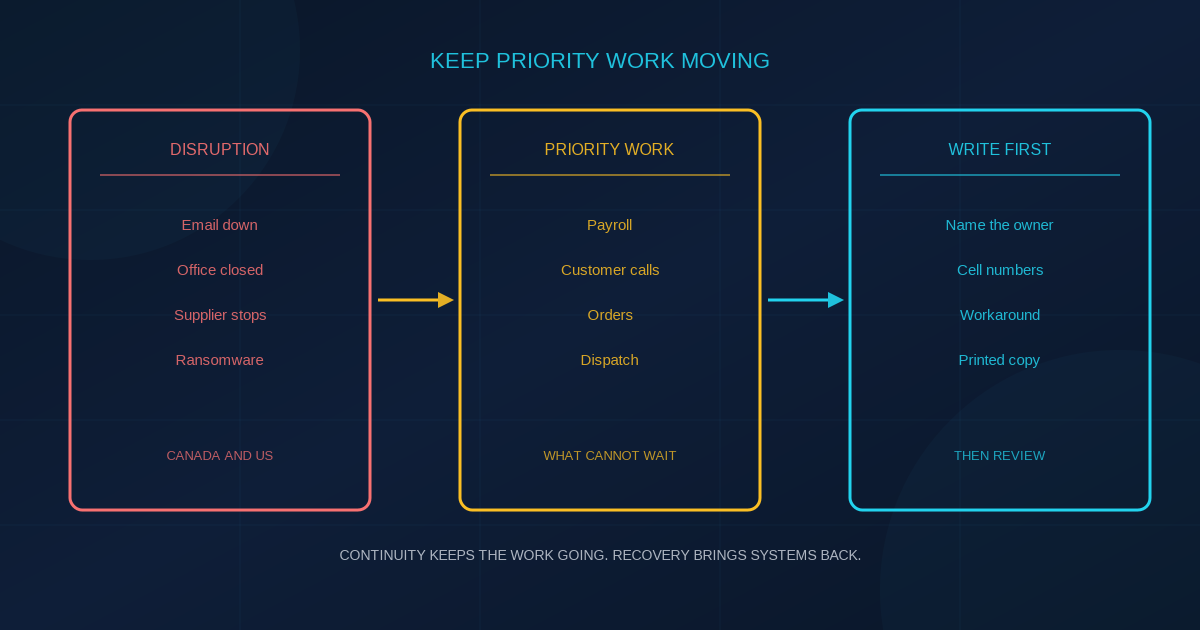
A business continuity plan is the document that says how priority work continues when a system, a site, or a supplier stops. The NIST Computer Security Resource Center glossary, citing NIST SP 800-34 Rev. 1 (published May 2010 and updated November 11, 2010), defines a business continuity plan as "The documentation of a predetermined set of instructions or procedures that describe how an organization's mission/business processes will be sustained during and after a significant disruption." The Canadian Centre for Cyber Security, on its January 2026 page for ITSAP.10.005, says an organization needs one "to resume its most critical business operations quickly."
In Canada and the United States, the first pages name who is in charge, which work cannot wait, and how that work gets done without the usual tools. This is general information, not legal advice. If a law or a contract requires a written plan, talk to your lawyer about the scope.
What is a business continuity plan?
A business continuity plan is a written set of steps for keeping priority work going during and after a disruption. The NIST glossary, citing NIST SP 800-34 Rev. 1 (May 2010, updated November 11, 2010), defines it as predetermined instructions for sustaining mission or business processes. The Cyber Centre's January 2026 page says these plans outline the main assets, roles, responsibilities, and processes required to minimize disruptions and keep critical business functions running until your operations can be fully restored.
How is a business continuity plan different from disaster recovery?
A business continuity plan keeps priority work moving. A disaster recovery plan brings systems back. In NIST SP 800-34 Rev. 1 (May 2010), the business continuity plan "focuses on sustaining an organization's mission/business processes during and after a disruption," while a disaster recovery plan is "an information system-focused plan designed to restore operability of the target system, application, or computer facility infrastructure at an alternate site after an emergency." The Cyber Centre's January 2026 page draws the same split.
Our disaster recovery plan guide says both incident response and disaster recovery are part of business continuity, but the timing differs: incident response happens during the event while disaster recovery happens after containment. NIST section 2.2.6 is narrower still: the disaster recovery plan "only addresses information system disruptions that require relocation." Get Cyber Safe describes an incident response plan as "the processes and procedures to follow to detect, respond and recover from a cyber incident." Keep that recover work in the incident plan.
Who should write a business continuity plan in Canada and the United States?
Write one if a stopped system would stall payroll, customer work, or orders, in Canada or the United States. The Cyber Centre's January 2026 guidance says an organization will need a business continuity plan after a cyber incident or a natural disaster. Ready.gov, last updated May 27, 2026, says preparedness plans should include "communications planning, IT support and recovery, and continuity plans," and lists "power outages and equipment failure."
You do not need a security department to start. CISA's Security Planning Workbook, dated September 2023, says "security expertise is not required to complete this workbook" and that the workbook "is flexible and scalable to suit any type of business or organization." NIST says nongovernment organizations typically use business continuity plans rather than continuity of operations plans. The Cyber Centre lists resilience among its reasons, not one statute for every firm, and it names ransomware, data theft, distributed denial of service attacks, and account compromises.
What should a small business write down first?
Write the decisions you will not have time to invent on the day. CISA's September 2023 workbook says an effective plan should identify key personnel and guide the organization to restore essential functions after an incident. It asks how you will sustain the most essential business functions, maintain lines of communication, protect critical information, records, and IT systems, and ensure employee, staff, and member safety. The Cyber Centre's January 2026 best-practice list starts with the same decisions.
- One owner and a deputy. ITSAP.10.005 says to create a response team and assign a team leader. CISA says to list key staff and their roles during recovery, including who decides if the owner is away.
- The work that cannot wait, and how long it can pause. The Cyber Centre says a business impact analysis separates critical and non-critical operations, and defines recovery time objective as "the planned time and level of service needed to meet the system owner's minimum expectations." A Dallas accounting firm might tolerate a day without tax software. A Calgary contractor might tolerate an hour without dispatch. Our cloud-outage guide says a business continuity plan for a cloud outage answers three questions: who makes decisions, which work continues without the system, and when you escalate.
- How you will talk if email is down. CISA says the plan may include work and personal cell numbers and other electronic means. Keep a copy of those numbers outside the mailbox. NIST says a crisis communications plan "typically designates specific individuals as the only authority for answering questions from or providing information to the public."
- A workaround and a place to work. The Ready.gov template says to document all forms and resource requirements for all manual workarounds. ITSAP.10.005 says to identify an alternate work site and an employee relocation plan, which for many firms is home, a truck, or a second office.
- Outside calls, and a pointer to the other plans. The Cyber Centre says to list alternate suppliers and to establish an IT recovery plan rather than bury those steps here. Our incident response planning guide asks which systems are most critical to your operations and whether you can operate manually for any period of time.
How do you draft a business continuity plan in one week?
A small team can draft a first version in five working days if it writes only the priority functions. The Cyber Centre's January 2026 lifecycle has five moves: initiate, analyze, develop and implement, communicate, then test and validate. CISA's September 2023 workbook says the process of creating a security plan should not be rushed and that users should work at their own pace.
- Day 1: name the owner and a deputy. The Cyber Centre says to tell senior management the intent and the expected outcomes, then have the owner sign the first page.
- Day 2: mark what must happen on a normal Monday, what can wait a day, and what can wait a week. NIST says a plan "may also be scoped to address only the functions deemed to be priorities."
- Day 3: write cell numbers outside email, plus one staff message and one customer message. Name the only person who may send the customer version.
- Day 4: for each priority job, write the steps without the main system, the forms required, and where people will sit. If a job cannot be done manually, name who you call.
- Day 5: name where the incident plan and the disaster recovery plan are stored. The Cyber Centre says to keep this plan "in a secure location that is known to your response team and available in a disaster or incident." The Ready.gov template says a copy should be reachable "if company servers are down," and it calls for printed copies.
The next Monday, spend an hour on one scenario. The Cyber Centre says seminars, tabletop exercises, and live simulations show weak points. Get Cyber Safe lists four ways to test an incident response plan: a checklist read-through, a walkthrough, a simulation, and a backup-system test. Our guide to a cybersecurity tabletop exercise calls that session a short, discussion-based meeting where your team walks through a simulated incident to find gaps in your response plan before a real attack does. Our article on backup assumptions that fail says the single most important question about any backup system is when it was last tested: not when someone checked that the job ran, but when someone actually restored data and confirmed it worked.
A continuity plan is only as useful as the backups, incident steps, and security habits behind it. Our free assessment takes under 5 minutes and covers backups, incident response, and 20 other risk areas.
How long should a small-business continuity plan be?
Long enough that a deputy can run the priority work without calling you, and short enough that they will. NIST SP 800-34 Rev. 1 (May 2010) says a business continuity plan may be scoped to priority functions only. CISA's September 2023 workbook says the process "is unique to organizations of differing sizes, industries, and capabilities." The Cyber Centre says this plan covers only the most critical operations, and that other plans handle the rest of detection, response, and full recovery.
A few critical jobs at one site can fit on a few pages. Add an alternate place when work cannot move, and one alternate supplier for each single point of failure. If the priority jobs are still unclear, move restore steps to the disaster recovery plan.
What mistakes leave a continuity plan unused?
The failures are ordinary, and both Canadian and US sources point at them. The Cyber Centre says the plan has to be tested, reviewed, and updated regularly because risks, priorities, and operations change. CISA's September 2023 workbook says an effective plan identifies key personnel and how they communicate.
- A template was copied and never followed. If the workaround line on a Ready.gov-style template is blank, you do not have a workaround.
- Nobody owns it, or it was never reviewed. The Cyber Centre's first step is to assign a team leader. The Ready.gov template includes a schedule, triggers, and assignments for periodic review. Update the plan when a deputy or a critical tool changes.
- The only copy sits on the system that failed. Keep a printed copy with the deputy. A backup schedule is not a plan for how the front desk works this afternoon.
What belongs on a one-page continuity outline?
Use this outline as the first draft, then add a page only where a priority job needs the extra steps. It follows CISA's September 2023 questions and the Cyber Centre's January 2026 develop-and-implement list: an owner, the critical operations, communications, workarounds, suppliers, and a copy the team can reach when the usual systems are down. Check each line before you call the plan done.
- Business name, plan owner, deputy, and the date of the next review.
- Priority jobs, in order, with how long each can pause. State that this page is not the incident plan or the restore plan.
- Who decides to activate the plan, and who speaks to staff and to customers.
- Call list with cell numbers, kept outside email: owner, deputy, IT, payroll, bank, and the key supplier.
- Workaround for each priority job: steps, forms, and where people work.
- One alternate supplier or tool for each single point of failure.
- Where the incident response plan and the disaster recovery plan are stored.
- Where this plan is stored: a printed copy, the deputy's copy, and a copy that does not sit on the office server.
- The last date someone walked through a scenario, and the one fix made afterward.
This article is intended for general informational purposes only and does not constitute professional security, legal, or compliance advice. Descriptions of business continuity, disaster recovery, and incident response are based on NIST SP 800-34 Rev. 1, the NIST glossary, the Canadian Centre for Cyber Security's ITSAP.10.005, CISA's September 2023 Security Planning Workbook, Ready.gov, and the Get Cyber Safe Guide for Small Businesses as of the date of publication and may change. Organizations should consult qualified legal and cybersecurity professionals before relying on a plan to meet a contractual or regulatory duty.