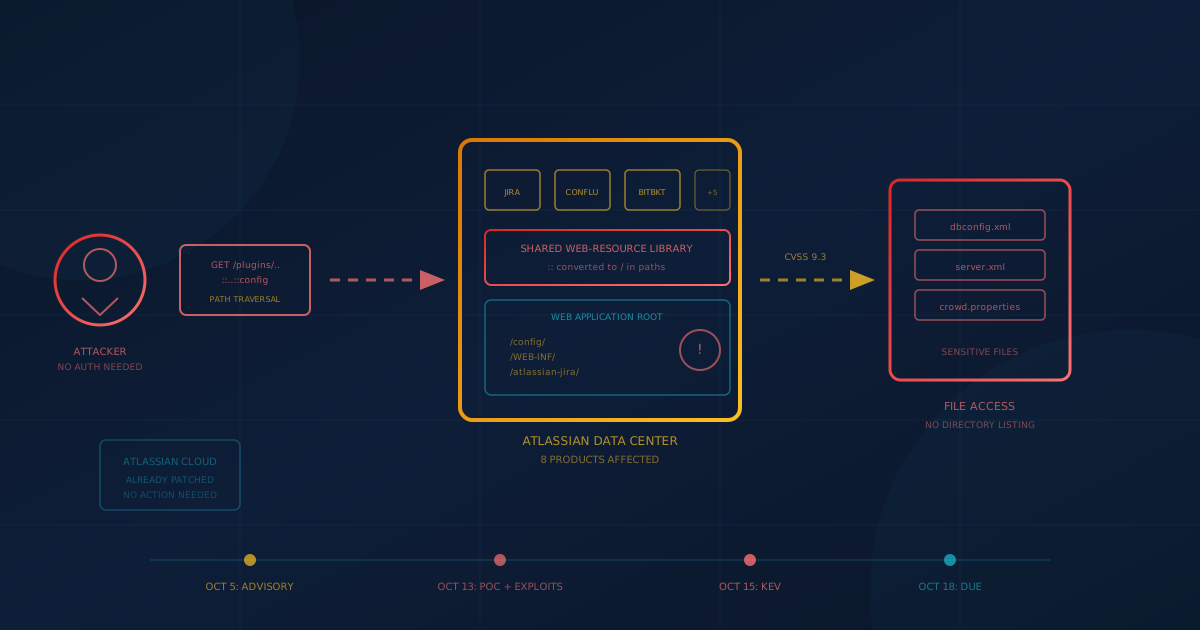
CISA is warning organizations to patch a critical vulnerability in self-hosted Atlassian products immediately. CVE-2026-21589 is an arbitrary file access flaw affecting Jira, Confluence, Bitbucket, and five other Atlassian Data Center products. Attackers are already exploiting it in the wild. CISA added it to the Known Exploited Vulnerabilities (KEV) catalog on October 15, 2026, with a federal remediation deadline of October 18. Atlassian Cloud customers are not affected; the company patched Cloud infrastructure and found no evidence of exploitation there.
For small and mid-sized businesses in Canada and the United States that run self-hosted Atlassian software, this is a patch-now situation. The flaw requires no login to exploit, proof-of-concept code is public, and honeypots are already logging exploitation attempts.
What Is CVE-2026-21589?
CVE-2026-21589 is an arbitrary file access vulnerability that lets an unauthenticated attacker read specific files from the web application root directory if they know the exact file name and path. Atlassian's security advisory, released October 5, 2026, rates the flaw Critical with a CVSS 4.0 score of 9.3.
Key facts from the advisory and the KEV catalog entry:
- Attack method: An attacker sends a crafted HTTP request that exploits path traversal in a shared web-resource library. No login is required.
- Impact: Access to specific files in the web application root. In some configurations, sensitive files such as configuration data may be exposed.
- Limitation: The flaw does not allow directory listing or enumeration. The attacker must already know the exact file path they want to read.
- Severity: CVSS 9.3 (CVSS:4.0/AV:N/AC:L/AT:N/PR:N/UI:N/VC:H/VI:N/VA:N/SC:H/SI:H/SA:H). CWE-552: Files or Directories Accessible to External Parties.
- KEV listing: CISA added CVE-2026-21589 on October 15, 2026, with a federal remediation due date of October 18.
- Ransomware: Unknown. The KEV catalog does not indicate known use in ransomware campaigns.
- Forensic triage: Yes. Under BOD 26-04, federal agencies must check whether the system was compromised before patching.
Which Atlassian Products Are Affected?
All versions of the following self-hosted products are affected, according to Atlassian's advisory:
- Bitbucket Data Center
- Confluence Data Center
- Jira Service Management Data Center
- Jira Software Data Center
- Bamboo Data Center
- Crowd Data Center
- Crucible
- Fisheye
Atlassian Cloud products (Jira Cloud, Confluence Cloud, Bitbucket Cloud, and others) are not affected. Atlassian says it patched Cloud infrastructure and its investigation found no evidence of exploitation in Cloud environments. Cloud customers do not need to take action.
What Are the Fixed Versions?
Atlassian recommends patching to the following fixed versions, or the latest version available:
- Bitbucket Data Center: 9.4.26, 10.2.8, or 10.5.1
- Confluence Data Center: 9.2.26 or 10.2.19
- Jira Service Management Data Center: 5.12.40, 10.3.26, or 11.3.12
- Jira Software Data Center: 9.12.40, 10.3.26, or 11.3.12
- Bamboo Data Center: 10.2.24 or 12.1.12
- Crowd Data Center: 6.3.7, 7.0.3, 7.1.7, or 7.2.4
- Crucible: 4.9.15
- Fisheye: 4.9.15
If you cannot patch immediately, Atlassian provides temporary mitigations. The most effective is removing the instance from the internet until a patch can be applied. If that is not possible, the advisory describes three options: a WAF or proxy rule blocking path traversal patterns, a Tomcat RewriteValve configuration for Confluence, Jira, Bamboo, and Crowd, or a URL rewrite rule for Bitbucket. See the Atlassian advisory for exact configuration details.
How Fast Is Exploitation Happening?
Exploitation began within hours of public proof-of-concept code. According to BleepingComputer, offensive security firm watchTowr published a technical report and proof-of-concept on October 13, showing how the flaw could be exploited to gain administrator-level access to Jira, Confluence, and Bitbucket in certain Crowd-integrated deployments.
Within two hours, Previdian's honeypot network began observing exploitation attempts. Previdian's Ryan Dewhurst told BleepingComputer that a Nuclei scanning template was also released, lowering the bar for automated scanning. The company observed attempts from multiple IP addresses and expects exploitation activity to increase significantly in the coming days.
The pattern matches what we have seen with other critical vulnerabilities this year. Our analysis of the shrinking CVE-to-exploit window found that median time from disclosure to working exploit has dropped to roughly 10 hours in 2026. CVE-2026-21589 is another example of that compressed timeline in action.
Why Does the Root Cause Matter?
WatchTowr's technical report explains that the vulnerability stems from a shared web-resource library used across all affected Atlassian products. The library converts double colons (::) into forward slashes (/), which allows attackers to construct path traversal requests through plugin resource endpoints. Because the library is shared, a single flaw creates exposure across eight product families.
This is a reminder that shared components can multiply risk. A vulnerability in one library becomes a vulnerability in every product that uses it. For SMBs running multiple Atlassian products, the practical implication is that you may need to patch several systems, not just one.
What Should SMB Leaders Ask Their IT Provider?
If an MSP or IT provider manages your Atlassian infrastructure, these are the questions to ask this week:
- Do we run any self-hosted Atlassian Data Center products? If yes, which ones, and which versions?
- Are any of these instances reachable from the internet? Internet-facing instances are at highest risk.
- Have we applied the October 5 patches? If not, when will they be installed?
- If we cannot patch today, are the temporary mitigations in place? The WAF rule, RewriteValve config, or URL rewrite rule blocks the specific traversal pattern.
- Have we checked for signs of compromise? BOD 26-04 requires forensic triage for federal agencies, but any organization should review access logs for traversal patterns before assuming no exploitation occurred.
For guidance on how fast patches should land and what evidence to request from your IT provider, see our guide on setting a patch SLA. CISA's BOD 26-04, which binds federal civilian agencies, sets a three-day deadline for the most critical known exploited vulnerabilities on publicly exposed systems. That directive does not apply to private businesses, but it is a useful benchmark for internet-facing infrastructure.
How Do I Check If We Were Compromised?
Atlassian's advisory states that the company cannot confirm whether individual customer instances have been affected. It recommends engaging your local security team to check all affected instances for evidence of compromise.
The advisory provides guidance for reviewing access logs:
- URL-decode each access-log request line (up to two decoding passes), then check for ".." immediately adjacent to "/", "\", or "::".
- Alternatively, search raw log lines using the regex pattern Atlassian provides in the advisory.
If you find matching entries, treat the system as potentially compromised. That means forensic investigation before restoring service, credential resets for accounts with access to the system, and review of any data that may have been exposed.
The Pattern With Self-Hosted Enterprise Software
CVE-2026-21589 joins a string of actively exploited vulnerabilities in self-hosted enterprise products this month. The Ivanti Connect Secure zero-day hit remote-access VPNs. The Cisco Secure Email Gateway flaw compromised email security appliances. The October Patch Tuesday included an actively exploited Windows Shell bypass.
The common thread is that self-hosted software sits on infrastructure you control, which means patching is your responsibility, not the vendor's. Cloud-hosted versions of the same products often get patched automatically, as Atlassian did in this case. For SMBs that still run self-hosted instances, the operational burden of rapid patching is higher, and the consequences of delay are immediate.
What Should You Take Away?
If your organization runs self-hosted Atlassian Data Center products, confirm today that patches have been applied or mitigations are in place. The flaw is being actively exploited, proof-of-concept code is public, and CISA has set a federal deadline of October 18. Do not wait for your next scheduled maintenance window.
If you rely on Atlassian Cloud, you are not affected. Atlassian patched Cloud infrastructure and found no evidence of exploitation.
If you are not sure how your organization's overall security posture compares, start with our free quick security assessment. It takes about five minutes and covers 22 security areas, including patching practices and internet-facing exposure.
This article is intended for general informational purposes only and does not constitute professional security, legal, or compliance advice. Details about CVE-2026-21589 are based on public disclosures from Atlassian, CISA, BleepingComputer, and security researchers as of October 16, 2026. Information about exploitation and patching may evolve as the investigation continues. Organizations should consult qualified cybersecurity professionals before acting on specific indicators of compromise or making operational changes based on this article.