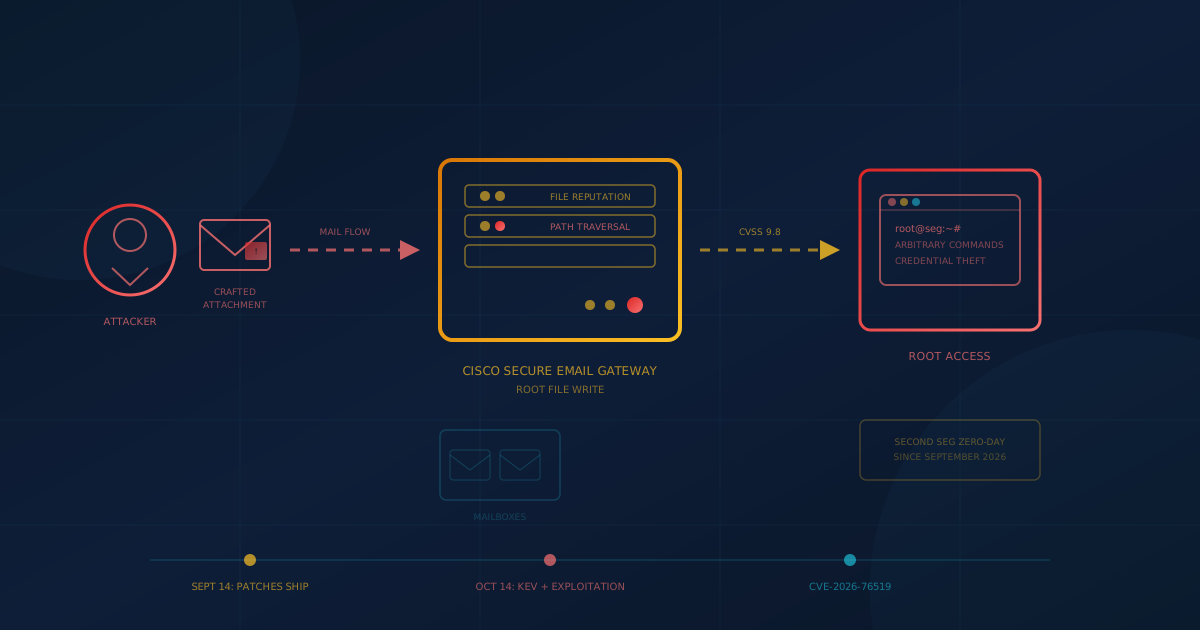
The security appliance that scans your email attachments for malware can now be compromised by one of those attachments. On October 14, 2026, Cisco confirmed that attackers are actively exploiting CVE-2026-76519, a critical vulnerability in Cisco Secure Email Gateway that it patched on September 14. The flaw lets unauthenticated attackers write files and execute commands with root privileges by sending a single crafted email. CISA added it to its Known Exploited Vulnerabilities (KEV) catalog the same day Cisco confirmed the attacks. If your organization relies on Cisco Secure Email Gateway to filter inbound mail, this post covers what happened, who is at risk, and what to ask your IT team.
For small and mid-sized businesses in Canada and the United States, the lesson is that security tools can themselves become attack surfaces. The device that protects you from malicious attachments is now the target of malicious attachments.
What Is CVE-2026-76519?
CVE-2026-76519 is a relative path traversal vulnerability in the Advanced Malware Protection (AMP) feature of Cisco Secure Email Gateway. The flaw stems from improper handling of email attachments when the File Reputation service is enabled. According to Cisco's advisory, updated October 14, 2026, an attacker can exploit the flaw by sending an email that contains a crafted attachment through an affected device. The vulnerability carries a CVSS score of 9.8, the Critical severity band.
Key facts from the advisory and CISA:
- Attack method: An attacker sends an email with a malicious attachment. No login is required.
- Impact: Arbitrary file write and command execution with root privileges on the appliance's operating system.
- Conditions: File Reputation (part of Cisco AMP) must be enabled and assigned to a mail policy. Content Scanner Tools must be older than version 25.3.0.5525.
- Severity: CVSS 9.8 (Critical). CWE-23: Relative Path Traversal.
- KEV listing: CISA added CVE-2026-76519 to its Known Exploited Vulnerabilities catalog on October 14, 2026.
The Canadian Centre for Cyber Security also issued advisory AV26-1042 on the same date, noting the active exploitation and urging administrators to apply updates.
How Are Attackers Exploiting This Flaw?
The attack arrives through normal mail flow. According to BleepingComputer, threat actors send an email containing a crafted attachment, and the appliance's File Reputation feature processes it. The vulnerability allows the attacker to control where a file write lands on the underlying operating system. Because the mail pipeline runs with elevated privileges, the write executes as root.
Cisco has not published detailed technical information about the exploit chain, but the mechanics are clear: the component that evaluates an attachment's reputation does not properly sanitize a path controlled by the attacker. That path manipulation gives the attacker file-system access at the highest privilege level.
SecurityWeek reports that Cisco grouped this vulnerability with others under a different CVE in its September security hardening release. On October 14, when exploitation was confirmed, Cisco updated the advisory to assign CVE-2026-76519 its own identifier and confirm the active attacks.
Which Devices Are Affected?
Cisco Secure Email Gateway, both physical and virtual, is affected if it meets two conditions: the File Reputation service is enabled and assigned to a mail policy, and the Content Scanner Tools version is older than 25.3.0.5525. Cisco's advisory explains how to check both settings.
Fixed releases are:
- AsyncOS 15.5: 15.5.5-014
- AsyncOS 16.0: No fix. Migrate to 16.5.0-780.
- AsyncOS 16.5: 16.5.0-780
Alternatively, updating Content Scanner Tools to version 25.3.0.5525 or later closes the vulnerability on any supported AsyncOS release without requiring an AsyncOS upgrade or reboot. The update can be applied manually with the contentscannerupdate CLI command or automatically if automatic updates are enabled.
Cisco Secure Email and Web Manager and Cisco Secure Web Appliance are not affected.
Is This the Only Recent Cisco Email Gateway Exploit?
No. CVE-2026-76519 is the second Cisco Secure Email Gateway zero-day exploited in the wild since September 2026. The previous flaw, CVE-2026-76461, was an SQL injection vulnerability that also allowed unauthenticated remote command execution with root privileges. CISA added CVE-2026-76461 to the KEV catalog on September 14, 2026.
Both vulnerabilities share a pattern: the attack arrives through normal email processing, requires no authentication, and achieves root-level access on the appliance. Back-to-back exploits in the same product within a month should prompt any organization using Cisco Secure Email Gateway to confirm both patches are applied.
The Shadowserver Foundation tracks nearly 300 Cisco Secure Email Gateway instances exposed to the internet, according to BleepingComputer. That count may include honeypots and already-patched devices, so it is not a precise vulnerability census, but it indicates significant exposure.
What About Cloud Customers?
Cisco says no action is required for Cisco Secure Email Cloud Gateway customers. According to the advisory, Cisco has already deployed mitigations to the cloud infrastructure. However, Cisco states it "directly contacted customers who own Cisco Secure Email Cloud devices where indicators of possible compromise were identified." If you received such a notice, treat it as a forensic trigger and follow Cisco's recovery guidance.
How Can You Tell If Your Appliance Was Compromised?
Cisco's advisory includes a procedure for checking indicators of compromise. Run the following command at the CLI and look for log messages marked "System Security":
esa-appliance> grep "System Security" system_logsIf the appliance is part of a cluster, check each member individually. A message reading "Suspected compromise indicator was found" means compromise was detected. If no indicators are found, upgrade to a fixed release if you have not already.
Critically, because the attacker gains root privileges, evidence of exploitation may be removed or hidden after the fact. Cisco recommends cross-checking network and firewall logs outside the appliance for unexpected uploads from the device to external IP addresses or downloads from suspicious addresses.
What Recovery Steps Does Cisco Recommend?
For on-premises virtual appliances where exploitation is suspected, Cisco recommends a full rebuild rather than an in-place upgrade:
- Record forensics information before continuing. Upgrading will destroy logs and forensic data.
- Deploy a new virtual machine running one of the fixed releases.
- Rebuild the configuration without importing previous configuration files.
- Renew credentials and cryptographic materials installed on the appliance.
- Monitor the system for anomalous behavior.
For physical appliances, contact Cisco TAC for support. The guidance emphasizes that SSH key pairs used for cluster authentication may have been accessed; if one cluster member was compromised, restore all cluster members to a secure configuration.
What Else Was Added to the KEV Catalog on October 14?
CISA added four vulnerabilities to the KEV catalog on October 14, 2026. Alongside CVE-2026-76519, the additions were:
- CVE-2026-0322: Palo Alto Networks PAN-OS Code Injection Vulnerability
- CVE-2026-105133: Ahsay AhsayCBS Improper Authentication Vulnerability
- CVE-2026-105134: Ahsay AhsayCBS Command Injection Vulnerability
The Ahsay vulnerabilities are the same ones we covered in our post on attackers hijacking AhsayCBS backup servers. Two security tools, a backup server and an email gateway, were added to the exploited list on the same day. That is a reminder that the tools meant to protect your infrastructure are themselves high-value targets.
What Should SMB Leaders Ask Their IT Provider?
If an MSP or IT provider manages your email infrastructure, these are the questions to ask this week:
- Do we use Cisco Secure Email Gateway for email filtering? If yes, is it on-premises, virtual, or cloud-hosted?
- Is File Reputation enabled on the appliance? The vulnerability only affects appliances where this AMP feature is turned on.
- What version of Content Scanner Tools is running? The CLI command
contentscannerstatusshows the version. Anything below 25.3.0.5525 is vulnerable. - Has the September 14 fix been applied? Either AsyncOS 15.5.5-014 or 16.5.0-780, or a Content Scanner Tools update to 25.3.0.5525, closes the flaw.
- Have you reviewed the logs for indicators of compromise? Even if you patched promptly, anyone exposed between September 14 (when patches for this flaw shipped and CVE-2026-76461 was added to KEV) and now should verify no compromise occurred.
For guidance on how fast patches should land and what evidence to request from your IT provider, see our guide on setting a patch SLA. The October 2026 Patch Tuesday, released one day before the Cisco disclosure, also included an actively exploited Windows flaw. When multiple exploited vulnerabilities drop in the same week, having a clear patching order matters.
The Bigger Pattern for Email Security Appliances
This is the irony of security appliances: the device that inspects every inbound message for malware can itself be owned by one of those messages. Cisco Secure Email Gateway joins a list of security products, including VPN appliances like Ivanti Connect Secure and backup tools like AhsayCBS, that have been actively exploited in 2026.
The common thread is that these products sit at trust boundaries. They handle untrusted input (emails, remote connections, backup data) and often run with high privileges. When a flaw is found, attackers move quickly. Our analysis of how fast CVEs are now exploited found that the window between disclosure and active attacks has shrunk to hours in some cases.
What Should You Take Away?
If your business uses Cisco Secure Email Gateway, confirm today that File Reputation is either disabled or that Content Scanner Tools is at version 25.3.0.5525 or later. Because exploitation was confirmed after the fixes shipped, review logs even if you patched promptly. If you are uncertain about any of these steps, escalate to your IT provider and ask for evidence of the patched version.
If you are not sure how your organization's overall security posture compares, start with our free quick security assessment. It takes about five minutes and covers 22 security areas, including email protection and patching practices.
This article is intended for general informational purposes only and does not constitute professional security, legal, or compliance advice. Details about CVE-2026-76519 are based on public disclosures from Cisco, CISA, the Canadian Centre for Cyber Security, and security researchers as of October 15, 2026. Information about exploitation and patching may evolve as the investigation continues. Organizations should consult qualified cybersecurity professionals before acting on specific indicators of compromise or making operational changes based on this article.