
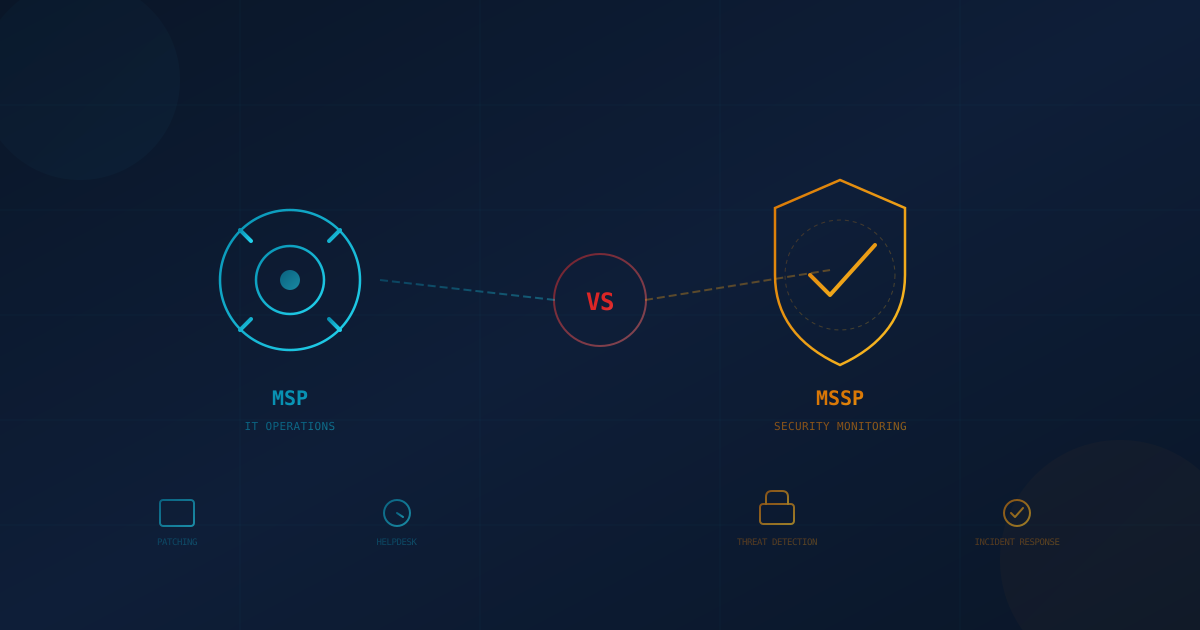
An MSP and an MSSP solve different problems, and confusing the two is one of the most common (and costly) mistakes growing businesses make when they outsource technology. A Managed Service Provider (MSP) keeps your computers, network, and cloud systems running. A Managed Security Service Provider (MSSP) is specifically built to detect and respond to attacks against those systems. Many vendors blur the line in their marketing, but the distinction determines whether you actually have someone watching for threats or just someone who answers the phone when a printer breaks.
According to Barracuda's MSP Customer Insight Report 2025 (a survey of 2,000 IT and security decision-makers conducted with Vanson Bourne), 73% of organizations with up to 2,000 employees already work with an MSP, and that figure rises to 96% once you include businesses actively considering one. Reliance climbs with scale: 85% of organizations with 1,000 to 2,000 employees now depend on an MSP for security support, compared with 61% of companies with 50 to 100 employees. Outsourcing IT and security has become the default, not the exception. What hasn't kept pace is clarity about what each type of provider is actually responsible for.
What's the actual difference between an MSP and an MSSP?
An MSP manages IT infrastructure and operations; an MSSP manages cybersecurity specifically. An MSP's core job is keeping the lights on: helpdesk tickets, patching, backups, cloud administration, device management. An MSSP's core job is watching for and responding to threats: 24/7 security monitoring, threat detection, vulnerability management, and incident response. Some MSPs bundle in baseline security tools, but that's different from having a team whose entire function is threat detection and response.
The clearest way to separate them is by what happens when something goes wrong. If your email server crashes, that's an MSP problem. If someone is actively exfiltrating data from your network at 2 a.m., that's an MSSP problem, and it requires a security operations center (SOC), documented incident response procedures, and analysts trained specifically for that scenario, not a helpdesk technician working through a general ticket queue.
- MSP (Managed Service Provider): Day-to-day IT operations: helpdesk, patching, backups, cloud administration, device management. May offer basic security add-ons.
- MSSP (Managed Security Service Provider): Dedicated cybersecurity: 24/7 SOC monitoring, threat detection, vulnerability management, incident response. May not handle general IT support.
- Integrated MSP/MSSP: Combines both under one contract and one team, so IT operations and security are managed as a single accountable function rather than two vendors pointing at each other during an incident.
Who actually needs an MSSP instead of just an MSP?
Businesses handling regulated data, processing significant payment volume, or operating in industries that are frequent attack targets need MSSP-level security monitoring, not just MSP support. Healthcare practices bound by HIPAA, law firms holding privileged client data, financial services firms, and any business processing card payments under PCI DSS all fall into this category: the cost of a breach and the compliance obligations around one exceed what basic patching and backups can address.
That said, size matters less than exposure. A 20-person accounting firm holding client tax data and financial records is a more attractive target than a 200-person business with little sensitive data on hand. As we've covered in why cybercriminals target small businesses, attackers increasingly favor smaller organizations precisely because they're less likely to have dedicated security monitoring in place. A business without an MSSP-level function isn't invisible to attackers. It's just unmonitored.
Businesses with straightforward IT needs, minimal regulatory exposure, and a low-value attack surface can often start with a strong MSP whose baseline offering already includes endpoint detection and response (EDR), email security, and automated patching (the essentials outlined in our small business cybersecurity checklist). The gap only becomes dangerous when a business assumes that baseline coverage is the same thing as active threat monitoring.
Why the MSP/MSSP line matters more in 2026 than it used to
The market data explains why this distinction has sharpened. The global managed security services market is projected to grow from roughly $42 billion in 2025 to more than $86 billion by 2033, according to Grand View Research, a growth rate that outpaces general managed IT services and reflects how many businesses are separately budgeting for security monitoring rather than treating it as a line item inside their IT contract. Vendors have noticed, and marketing language has gotten looser as a result: providers increasingly describe basic antivirus or a firewall subscription as "managed security" without operating anything resembling a 24/7 SOC.
There's also a supply-chain dimension. Providers with deep access into client environments are themselves high-value targets. The 2021 Kaseya VSA ransomware attack demonstrated the risk at scale: a single compromise of a widely used MSP tool impacted more than 50 MSPs and an estimated 800 to 1,500 downstream businesses, with the REvil ransomware group demanding $70 million. CISA has repeatedly warned that state-sponsored and criminal groups alike treat MSPs as a gateway into many client networks at once. Whichever model you choose, the provider's own security posture (not just yours) becomes part of your risk profile, a point we explore further in third-party vendor risk from an SMB perspective.
How to tell which model your business actually needs
Work through these questions before signing with either type of provider:
- Do you handle regulated or high-value data? Health records, financial data, payment card information, or privileged legal files push you toward MSSP-level monitoring, regardless of headcount.
- Could you tell if you were breached right now? If the honest answer is "not quickly," that's a monitoring gap, not an IT gap. An MSP without dedicated threat detection won't close it.
- What's your current provider actually watching? Ask directly whether they operate a 24/7 SOC with human analysts, or whether "security" means antivirus and a firewall. Vague answers are themselves informative.
- Do you need one vendor accountable for everything, or are you comfortable managing two contracts? Separate MSP and MSSP vendors can create gaps during an incident, when each may point to the other's scope. An integrated provider removes that ambiguity.
- What's your realistic budget? Dedicated MSSP monitoring costs more than baseline MSP support because it requires specialized staff working around the clock. Underfunding this line item is where businesses end up with monitoring in name only.
For most small and mid-sized businesses, the practical answer isn't choosing one label over the other. It's finding a provider who is transparent about which functions they actually perform in-house versus outsource, and who can point to a documented SOC, defined incident response procedures, and response-time commitments in writing. Our guide on how to evaluate a managed IT and cybersecurity provider walks through the evaluation process in more detail, our list of what IT security services a small business should get shows what to expect from a provider, and a free quick security assessment can help clarify where your current setup actually stands before you go shopping for a new one. If you are based in British Columbia, see our Vancouver managed IT support page for local service details.
What affects the monthly cost of an MSSP?
MSSP pricing varies widely because the underlying services differ substantially. Understanding what drives the cost helps you compare proposals and avoid paying for capabilities you do not need, or underpaying for coverage that turns out to be incomplete. The main factors are:
- Number of users and devices. Most MSSPs price by the endpoints they monitor: workstations, servers, and mobile devices. More devices means more agents to deploy, more alerts to triage, and more potential attack surface to watch.
- 24/7 SOC vs. business-hours monitoring. Around-the-clock security operations require shift coverage, which costs more than business-hours-only monitoring. Attacks do not follow a 9-to-5 schedule, so the decision here directly affects your exposure window.
- EDR/MDR scope. Basic endpoint detection and response (EDR) software is cheaper than fully managed detection and response (MDR), where human analysts investigate alerts and take action on your behalf. The difference is whether someone is watching the dashboard or just whether the dashboard exists.
- Email security. Advanced email filtering, anti-phishing, and business email compromise detection may be bundled or priced separately. Given that email is the most common initial access vector, this is rarely optional in practice.
- Compliance reporting. If your business needs reports aligned to specific frameworks (NIST, CIS Controls, PCI DSS, HIPAA), that reporting capability adds to the scope. Some MSSPs include it; others charge extra.
- Incident response retainer. Some contracts include a set number of incident response hours; others charge per incident or require a separate retainer. Understand what happens if you actually need the MSSP to respond to a breach.
- Onboarding complexity. Initial assessment, agent deployment, policy configuration, and integration with your existing tools all contribute to setup costs. A business with legacy systems or multiple office locations will have a larger onboarding effort than a single-office cloud-first company.
When comparing proposals, ask what is included in the base price versus what costs extra. A lower monthly fee that excludes incident response or compliance reporting may end up more expensive when you need those services. To understand how these factors apply to your business and build a custom plan, see our pricing page.
The label matters less than the accountability
Whether a provider calls itself an MSP, an MSSP, or something else on their homepage is ultimately less important than whether they can answer a direct question clearly: if something goes wrong on a Saturday night, who is watching, how fast do they respond, and what exactly have they committed to in writing? Businesses that ask that question before signing tend to avoid the expensive discovery, months into a contract, that "managed security" meant something much thinner than they assumed.
This article is intended for general informational purposes only and does not constitute professional security, legal, or compliance advice. Market figures and survey statistics cited are based on third-party research as of the date of publication and may change. Organizations should consult qualified cybersecurity professionals before selecting a provider or making operational changes based on this article.