
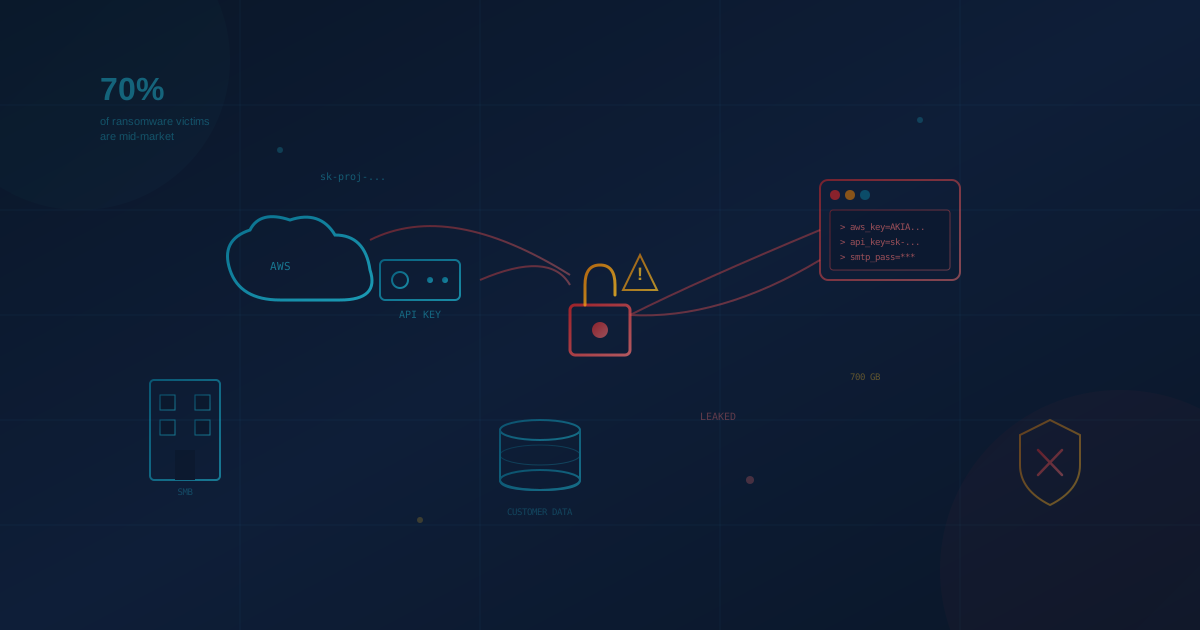
On October 5, 2026, a ransomware group calling itself BYOD listed Franklin Empire, a Canadian electrical distributor, on its extortion site. The group claimed to have exfiltrated over 700 GB of data, including AWS bucket keys, API credentials for an AI service, SMTP credentials, invoices, customer personally identifiable information, and inventory records. According to multiple ransomware tracking services, the group claims the attack occurred on October 4.
Whether this specific claim is accurate remains unverified. Ransomware groups routinely exaggerate or fabricate victim claims to pressure targets and attract attention. Franklin Empire has not publicly confirmed or denied the incident as of this writing. But the pattern the attackers describe, targeting cloud credentials, API keys, and business-critical data rather than just encrypting local files, reflects a broader shift in how ransomware operations work. That pattern matters for every small and mid-sized business in Canada and the United States, regardless of whether this particular claim proves accurate.
Why Are Ransomware Groups Targeting Credentials and API Keys?
Modern ransomware attacks have evolved well beyond simply encrypting files and demanding payment. Attackers now focus heavily on exfiltrating data first, then using the threat of publication as additional leverage. Within that exfiltrated data, credentials and API keys represent particularly high-value targets.
Cloud storage credentials (like AWS access keys) can unlock entire data repositories. API keys for third-party services can be resold, abused for fraud, or used to pivot into connected systems. SMTP credentials enable attackers to send phishing emails from legitimate business accounts. Each of these creates cascading risks that extend far beyond the initial breach.
The BYOD group's claimed haul from Franklin Empire, if accurate, reads like a checklist of exactly what a sophisticated attacker would want: cloud infrastructure access, AI service credentials, email system access, and enough business data to make the extortion threat credible. We have seen similar patterns in incidents like the stolen AI API key that generated a $600,000 bill, where a single compromised credential led to significant financial exposure.
Who Is BYOD, and Should Businesses Take Them Seriously?
BYOD is a newly emerged ransomware group. According to ransomware tracking services Breachsense, ervik.as, and ShellCodeX, the group first appeared in early October 2026, listing between three and five victims in its initial days of operation. The group operates a dark web leak site and uses the same double-extortion model that has become standard across ransomware operations: steal data first, encrypt systems, then threaten to publish stolen data if the ransom is not paid.
New ransomware groups should be treated with appropriate skepticism. Some emerge, make exaggerated claims, and disappear. Others prove to be rebrands of existing operations or affiliates of larger ransomware-as-a-service ecosystems. The ShellCodeX tracker explicitly notes that BYOD claims "should be treated with caution until independently verified."
That said, the credibility of any individual group matters less than the pattern of attack. Whether this specific claim proves accurate or not, the tactic of targeting cloud credentials and API keys alongside traditional business data is well-established and growing. The Canadian Centre for Cyber Security's Ransomware Threat Outlook 2025-2027 notes that ransomware incidents in Canada have increased an average of 26 percent year-over-year from 2021 to 2024.
Why Mid-Market Distributors and SMBs Are in the Crosshairs
Franklin Empire operates as an electrical distributor serving contractors and businesses. Distributors occupy a particular risk position: they handle significant volumes of business data, maintain relationships with numerous customers and suppliers, and often operate with leaner IT resources than enterprises of comparable revenue.
This profile makes distributors and similar mid-market businesses attractive targets. Research from Black Kite's 2026 Manufacturing and Distribution Ransomware Report found that 70 percent of manufacturing and distribution ransomware victims with known revenue earned between $10 million and $100 million annually. These organizations are large enough to potentially pay a ransom, yet often too small to have dedicated security operations centers or around-the-clock monitoring.
The pattern applies across both Canada and the United States. A December 2025 survey of 506 U.S. small business owners by Morning Consult found that 72 percent had experienced fraud, scams, or ransomware in the previous year, with affected businesses reporting average losses of approximately $92,000. Only 30 percent of respondents said they felt prepared for a ransomware attack.
As we explored in our article on why "too small to be a target" is a dangerous assumption, automated attack tools scan for vulnerabilities without regard to company size. A 50-person distributor with weak credential hygiene is often an easier target than a Fortune 500 company with layered defenses.
What the Claimed Data Tells Us About Attack Patterns
The specific items BYOD claims to have exfiltrated, if the claims are accurate, point to several common security gaps:
- Cloud storage credentials stored improperly. AWS keys should never be stored in plaintext files, embedded in code, or accessible to users who do not need them. Yet many organizations still store cloud credentials in ways that make them accessible to anyone who gains access to internal systems.
- API keys without rotation or monitoring. The claim of compromised AI service API keys suggests either long-lived credentials or insufficient monitoring of API usage. Many businesses treat API keys as set-and-forget configurations rather than credentials that require the same lifecycle management as passwords.
- Email credentials that enable further attacks. SMTP credentials allow attackers to send emails from legitimate business accounts. This capability enables highly convincing phishing and business email compromise attacks against customers and partners.
- Customer data that creates notification obligations. PII exposure can trigger breach notification requirements under Canadian privacy law (PIPEDA) and, for businesses with U.S. customers, various state breach notification statutes.
Each of these gaps can be addressed through practices that do not require enterprise-scale budgets. The issue is usually that nobody has systematically reviewed where credentials live and who can access them.
What Business Leaders Should Ask Their IT Teams or MSPs
Whether you work with an internal IT team, a managed service provider, or handle technology decisions yourself, the Franklin Empire claim highlights questions worth asking:
- Where are our cloud credentials stored, and who can access them? AWS keys, Azure credentials, and similar secrets should be stored in dedicated secrets management systems, not in spreadsheets, code repositories, or shared drives. Access should be limited to personnel who genuinely need it.
- Do we have an inventory of active API keys across our services? Many businesses accumulate API integrations over time without tracking which keys are active, what permissions they have, or when they were last rotated. An unknown key is an unmanaged risk.
- Is multi-factor authentication enabled on every account that matters? MFA remains one of the most effective defenses against credential theft. But as we discussed in our piece on why MFA alone may not be enough, the type of MFA matters. Hardware security keys or passkeys provide stronger protection than SMS codes.
- Could we detect if someone was using our cloud credentials from an unusual location? Monitoring for anomalous access patterns, such as API calls from unexpected IP addresses, can catch credential misuse before significant damage occurs.
- Are our backups truly isolated from our production environment? Ransomware operators specifically target backup systems to remove the victim's recovery option. Backups that are continuously connected to the network share the network's risks. Truly resilient backups require intentional isolation.
- When was the last time we reviewed who has access to what? As we covered in our article on access reviews, accounts accumulate over time. Former employees, expired contractor access, and overly broad permissions create risk that a periodic review can address.
Practical Steps That Reduce Exposure
The defensive measures that would have reduced risk in an attack like the one BYOD claims are not exotic or expensive:
- Rotate credentials on a schedule. Cloud access keys and API credentials should have defined lifespans. Regular rotation limits the window during which a stolen credential remains useful.
- Use secrets management. Tools like AWS Secrets Manager, HashiCorp Vault, or Azure Key Vault centralize credential storage, provide audit trails, and enable programmatic rotation. Even simpler approaches, like storing credentials in a password manager rather than a spreadsheet, represent improvement.
- Enable MFA everywhere possible. Every cloud console, email account, financial system, and administrative interface should require multi-factor authentication. Prioritize phishing-resistant methods like hardware keys or passkeys for high-risk accounts.
- Monitor for anomalous access. Cloud providers offer logging and alerting capabilities. An API call from an unexpected country or an unusual volume of data transfer can indicate compromise, but only if someone is watching.
- Segment backups from production. Backups stored on a different network, with different credentials, that are not continuously mounted to production systems are far harder for ransomware to reach. The goal is ensuring that if attackers compromise your production environment, they cannot also destroy your recovery path.
- Test your recovery. Backups that have never been tested are assumptions, not assurances. Periodically restore from backup to confirm the process actually works.
The Incident Response Question
If a ransomware group published your organization's name tomorrow, would you know what to do? Many businesses have never thought through basic questions: Who makes decisions? Who do we call? How do we communicate with customers? What are our notification obligations?
Having considered these questions in advance, even informally, significantly improves outcomes when an incident occurs. We covered the basics in our article on incident response planning before something happens. The time to think about incident response is not during the incident.
What We Do Not Know About the Franklin Empire Claim
It is important to be clear about the limits of available information. As of this writing:
- Franklin Empire has not publicly confirmed or denied any breach.
- No independent security researcher has verified the BYOD group's claims.
- The actual scope of any data exposure, if an incident occurred, remains unknown.
- Whether any systems were encrypted or only data was exfiltrated is unclear from public sources.
Ransomware groups have strong incentives to exaggerate. A dramatic claim attracts attention, pressures victims, and establishes the group's reputation. The specificity of the BYOD claim, naming particular credential types and data categories, could indicate genuine access or could reflect a standard template designed to sound credible.
The point of examining this case is not to draw conclusions about a specific organization, but to use the claimed attack pattern as a concrete prompt for examining your own security posture.
A Starting Point for Assessment
If reading about credential theft, API key exposure, and backup isolation has raised questions about your own organization's readiness, a structured assessment can help identify gaps. Our free cybersecurity assessment covers credential management, backup practices, and other fundamentals in a format designed for business leaders rather than security specialists.
The goal is not to achieve perfect security, which does not exist, but to close the gaps that attackers most commonly exploit. Credential hygiene, MFA, backup isolation, and access reviews represent high-impact, achievable improvements that meaningfully reduce risk.
The Durable Lesson
Whether the Franklin Empire claim proves accurate or fades as an unverified extortion attempt, the pattern it represents is real and growing. Ransomware operations have evolved from encrypting files to comprehensive data theft, with cloud credentials and API keys representing high-value targets. The defenses that matter, proper credential management, strong authentication, isolated backups, and practiced incident response, are the same regardless of which group happens to be in the headlines.
The organizations that fare best are not necessarily the largest or the best-funded. They are the ones that have asked the uncomfortable questions, reviewed who has access to what, and tested their recovery before they needed it. That work is not glamorous, but it is what separates a ransomware listing from a ransomware disaster.
This article is intended for general informational purposes only and does not constitute professional security, legal, or compliance advice. Details about the claimed incident involving Franklin Empire are based on public ransomware tracking sources as of the date of publication and have not been independently verified. Ransomware group claims should be treated with skepticism. Organizations should consult qualified cybersecurity professionals before acting on any specific indicator of compromise or making operational changes based on this article.