
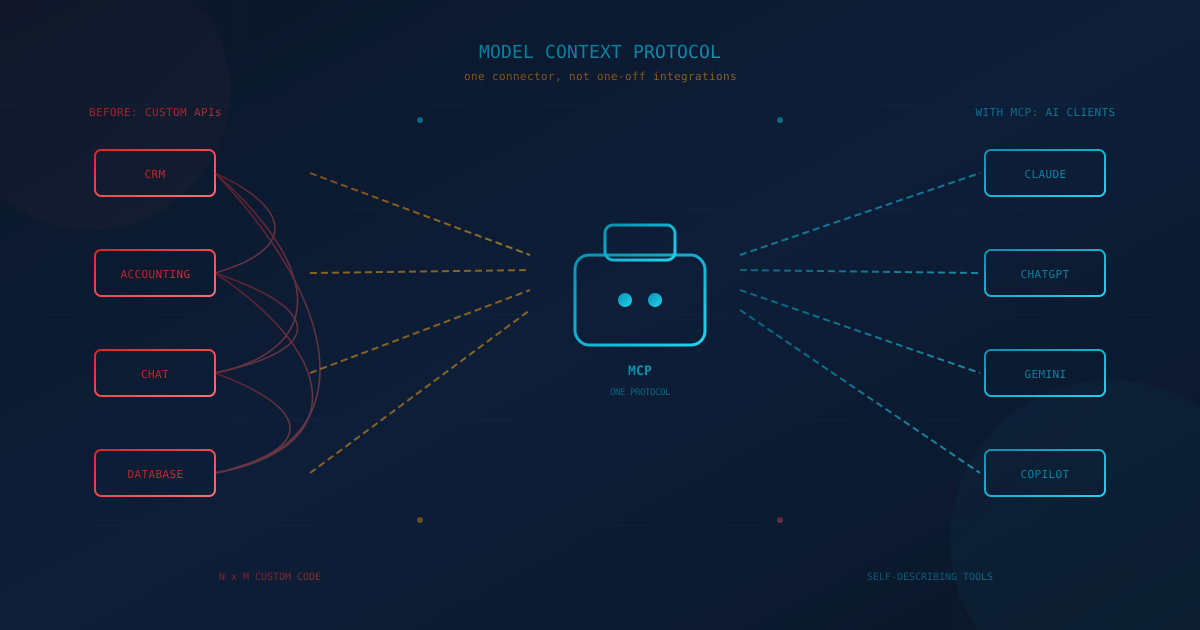
Model Context Protocol, or MCP, is the open standard Anthropic released on November 25, 2024, so that AI assistants like Claude, ChatGPT, and Gemini can connect directly to the software a business already runs — its CRM, its accounting system, its internal databases — without a developer hand-building a custom connector for every pairing.
Most business owners have heard the term without a plain answer to what it does. Within five months, OpenAI and Google DeepMind had both adopted MCP, and Microsoft, AWS, and Cloudflare joined as backers soon after — an unusually fast convergence around one standard. MCP is quietly becoming the plumbing behind the "connect your AI to your data" feature every software vendor now pitches.
This piece explains what MCP actually is, how it differs from the APIs your business already depends on, why vendors are racing to support it, whether it is secure, and what it takes to build one safely.
What Is MCP, Exactly?
MCP is a standard way for an AI assistant to discover what it is allowed to do and then do it, instead of requiring a developer to write bespoke code every time a new AI tool needs to talk to a new piece of software. Anthropic describes it with a simple comparison: MCP is meant to work like a USB-C port for AI. Before USB-C, every device needed its own cable and its own port. Once manufacturers agreed on one standard connector, any compliant device could plug into any compliant port.
Applied to software: imagine a business running QuickBooks, Salesforce, and Slack, and wanting an AI assistant that can answer questions across all three — "what did this customer buy, what's their support ticket status, and what's their outstanding invoice?" Before MCP, that meant three separate custom integrations, each maintained by a developer, each breaking separately when a vendor changed its interface. With MCP, if each of those three tools exposes an MCP server, one AI assistant can talk to all three through the same protocol, using the same request format, without three different pieces of custom glue code.
How Is MCP Different From a Traditional API?
An API is a contract between two specific systems, written and maintained by a developer who read that one system's documentation. MCP does not replace APIs — most MCP servers are thin wrappers built on top of a company's existing API. What MCP standardizes is the layer above that: how an AI model discovers what actions are available and calls them, using a consistent format regardless of which underlying system it is actually talking to.
- A traditional API requires a developer to read documentation, write integration code for that specific pairing, and update it whenever either side changes. There is no built-in way for an AI model to "ask" an API what it can do — a human has to already know and program it.
- An MCP server exposes a self-describing list of "tools" (for example,
search_customerorget_invoice_status) that any MCP-compatible AI assistant can read and use immediately, without custom integration code for that specific AI product. - The practical difference is that an API connects two systems that were built to know about each other. MCP lets a general-purpose AI assistant connect to a system it has never seen before, as long as both sides speak the same protocol.
Think of it this way: the API is still the road. MCP is the standard road sign that lets any AI-driven vehicle read the directions, instead of every vehicle needing its own custom map.
Why Should Software Vendors Offer MCP?
Vendors that build one MCP server can be reached by every MCP-compatible AI assistant on the market — Claude, ChatGPT, Microsoft Copilot, Gemini — without writing a separate connector for each one. That turns what used to be a multiplying integration problem (every AI product needing its own custom hook into every software product) into a single build that plugs into all of them.
The adoption curve backs this up. OpenAI integrated MCP across ChatGPT Desktop and its API in March 2025, four months after Anthropic's release; Google DeepMind confirmed support for Gemini the following month. In late 2025, Anthropic donated stewardship of the MCP specification to a newly formed, vendor-neutral Agentic AI Foundation, the same governance model that gave businesses confidence to build on standards like Linux or Kubernetes rather than a single company's roadmap.
For a vendor, the business case is distribution: customers increasingly expect to reach a product through whatever AI assistant they already use, and a vendor without an MCP server risks being invisible inside that workflow. MCP support has quickly moved from differentiator to baseline expectation — but as the next section shows, "supports MCP" and "supports MCP securely" are not the same claim.
Is MCP Secure?
MCP is a protocol, not a security guarantee, and 2026 security research on real-world MCP deployments has found significant gaps. Security researchers surveying 2,614 publicly available MCP implementations found that 82 percent of servers that handle file operations were vulnerable to path traversal attacks, and 43 percent of tested servers were vulnerable to command injection — meaning an attacker could potentially reach files or run commands the server was never meant to expose. Separate analysis of officially registered MCP servers found that roughly 38 to 41 percent shipped with no meaningful authentication at all.
Named vulnerabilities back up the statistics. CVE-2025-6514, a critical remote-code-execution flaw (CVSS 9.6) in the widely used mcp-remote package, was downloaded more than 437,000 times before it was disclosed and patched. CVE-2026-33032, nicknamed "MCPwn," was a CVSS 9.8 authentication bypass in an MCP integration that was actively exploited before a patch shipped on March 15, 2026. Even Anthropic's own official Git MCP server was not immune — it carried three separate CVEs (path traversal, argument injection, and a repository-scoping bypass), as we detailed in our earlier look at AI coding agent security risks.
Beyond individual bugs, researchers have documented attack patterns unique to MCP. A "rug pull" occurs when a server that was reviewed and approved later updates its own tool definitions to add hidden, malicious instructions — because those definitions can load dynamically, a server safe at approval time is not guaranteed to stay that way. "Tool poisoning" hides malicious instructions inside a tool's description text, which the AI model reads as an instruction even though a human reviewer would only see a plausible-looking label. Both exploit prompt injection, which OWASP's Top 10 for LLM Applications has ranked the number one risk since the list's creation, because there is still no reliable way to stop a language model from treating untrusted data as an instruction.
Can You Build Your Own MCP Server Securely?
Yes, but it needs to be treated like any other production integration that touches company data — not a quick internal script. Organizations building or commissioning an MCP server should apply the same controls used for any externally facing API:
- Require real authentication. The current MCP specification supports OAuth 2.1. Use it, rather than joining the roughly 40 percent of servers running with no meaningful authentication.
- Scope permissions narrowly. A tool built to look up an invoice should not also be able to delete records or read unrelated tables. Least-privilege access limits the damage if the server is compromised or tricked.
- Sanitize and validate every input the AI model passes to the server. This is the same input-handling discipline that prevents SQL injection in a traditional web application, and it directly closes the path-traversal and command-injection classes described above.
- Pin and review server versions before deployment. Because tool definitions can update dynamically, review any change to an already-approved MCP server the way you would review a new vendor, to guard against the "rug pull" pattern.
- Log every tool call. Treat the log the same way you would an audit trail for a privileged employee account, since the AI model is effectively acting with that server's level of access.
- If you don't have developers who can own this properly, don't build one. Use a vendor's already-hardened MCP server instead of a homegrown one maintained by whoever had time to write it.
What Business Owners Should Ask Before Adopting MCP
Whether MCP arrives through a vendor's product or a project your own team builds, a few direct questions separate a real security posture from a checkbox:
- What authentication does this MCP server use — OAuth, or an API key pasted into a config file?
- What tools and data does the server expose, and are permissions scoped per user or granted all at once?
- Are the server's tool definitions version-pinned, and who reviews changes before they reach production?
- Is this MCP connection included in the company's AI usage policy, inventoried the same way a new SaaS vendor would be?
- Has anyone actually looked for MCP servers already running inside the business, given how easily developers and power users can spin one up without IT's knowledge, a pattern we covered in our piece on shadow AI and MCP servers?
Businesses unsure of the answers can start with a free quick security assessment to establish what AI tools and integrations are already connected before adding more.
The Bottom Line
MCP does not make AI dangerous, and it does not make AI safe — it is plumbing that makes it faster to connect an AI assistant to the systems a business already runs. That speed is exactly why it deserves scrutiny: the same standard that lets a vendor ship an integration in days lets a poorly secured server expose customer data just as quickly. Adopt MCP with the same seriousness given to any other system with access to company data, and the underlying question stays a familiar one — not "is this AI tool impressive," but "who has access, to what, and how do we know."
This article is intended for general informational purposes only and does not constitute professional security, legal, or compliance advice. Statistics and vulnerability details referenced here are based on public security research and vendor disclosures as of the date of publication and may evolve as the MCP ecosystem matures. Organizations should consult qualified cybersecurity professionals before connecting any AI tool to systems containing sensitive or regulated data.