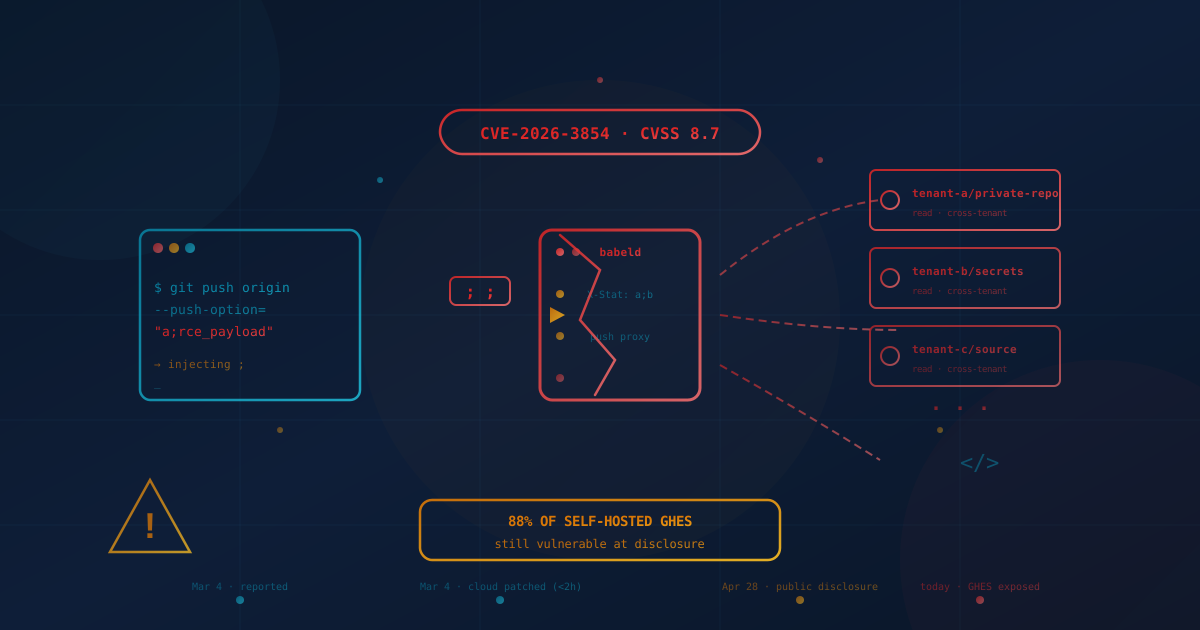
On April 28, 2026, GitHub publicly disclosed CVE-2026-3854 — a critical remote code execution (RCE) vulnerability in its internal git infrastructure that affected both GitHub.com and self-hosted GitHub Enterprise Server. Any authenticated user could have run arbitrary commands on GitHub's backend with a single git push command using nothing more than a standard git client.
The flaw carries a CVSS score of 8.7 (High). It was reported to GitHub on March 4, 2026, by researchers at Wiz, and a fix was rolled out to GitHub.com in under two hours. GitHub's investigation found no real-world exploitation. Self-hosted GitHub Enterprise Server (GHES) is a different story — Wiz reports that 88% of self-hosted GHES instances are still vulnerable as of public disclosure.
For the millions of Canadian and US businesses that store source code, infrastructure-as-code, and CI/CD pipelines on GitHub, this is the kind of incident worth paying attention to — even if you don't run the servers yourself.
What Is CVE-2026-3854?
CVE-2026-3854 is a command injection vulnerability in babeld, GitHub's internal git proxy. When a developer ran git push with custom push options, those user-supplied values were copied verbatim into a semicolon-delimited internal header (X-Stat) without sanitizing the semicolon — the same character used as a field delimiter. By injecting a semicolon, an attacker could append additional fields that downstream services trusted, ultimately leading to arbitrary command execution on GitHub's backend.
The vulnerability is classified under CWE-77 (Improper Neutralization of Special Elements). The exploitation prerequisites were minimal: an attacker needed a GitHub account and push access to any repository — including a free, attacker-controlled public repo on github.com.
According to Wiz, the consequences differ by deployment:
- GitHub.com (cloud): RCE on shared storage nodes that hold many tenants' repositories. In the worst case, an attacker could read millions of public and private repositories belonging to other organizations on the same node.
- GitHub Enterprise Server (self-hosted): Full server compromise, including access to every hosted repository, internal secrets, and any credentials stored in the instance.
Who Was Actually at Risk?
The good news: if your organization uses GitHub.com (the cloud-hosted service used by most Canadian and US small and mid-sized businesses), no action is required. GitHub mitigated the vulnerability on its own infrastructure within hours of receiving the report. The forensic investigation concluded there was no exploitation in the wild before the patch.
The bad news: if your organization, your developers, or any of your third-party vendors run GitHub Enterprise Server on their own infrastructure, the risk has not gone away. GHES is the on-premises version of GitHub used by larger enterprises, regulated industries, government contractors, and software vendors that need to keep code inside their own network.
The flaw was fixed in the following GHES releases:
- GHES 3.14.24
- GHES 3.15.19
- GHES 3.16.15
- GHES 3.17.12
- GHES 3.18.6
- GHES 3.19.3
Any GHES instance running an earlier version is exploitable. Wiz's scanning data, published with the disclosure, indicates that roughly 88% of internet-reachable GHES instances had not yet been upgraded at the time of public disclosure. For Canadian and US businesses, the practical question is not just "do we run GHES?" but also "does our software supplier, our outsourced development partner, or our managed service provider run it?"
Why This Vulnerability Is Different
Most critical vulnerabilities in 2026 follow a familiar pattern: a researcher finds a flaw, the vendor patches it, the public learns the technical details, and attackers race to exploit unpatched systems. CVE-2026-3854 follows that pattern — but two details make it stand out.
First, the attack surface is unusually broad. A single semicolon in a push option, sent through a standard git client, was enough to cross the line from "regular user" to "code execution on GitHub's servers." There was no need for an exploit kit, no social engineering, no supply chain interdiction. The trust boundary between authenticated git users and the platform itself was thinner than most defenders assumed.
Second, the vulnerability was discovered using AI-assisted reverse engineering. Wiz publicly described this as one of the first critical bugs found in closed-source binaries with the help of AI tooling — using IDA MCP to automate analysis of GitHub's compiled internal protocols. The researchers reportedly went from idea to working exploit in under 48 hours. This is consistent with the pattern we have been tracking in our coverage of AI-powered vulnerability discovery and recent Chrome zero-days: AI is compressing the time between "vulnerability exists" and "vulnerability is being exploited."
For SMBs that depend on third-party platforms, the implication is uncomfortable. A flaw your IT team has no visibility into can be discovered, weaponized, and patched faster than your patch cycle can react — and the only safe assumption is that your vendors will hit a CVE-2026-3854-shaped problem at some point.
What Canadian and US Business Leaders Should Take From This
The technical details of CVE-2026-3854 matter less to most business owners than the operational questions it surfaces. A practical executive read of this incident looks like this:
- You probably depend on GitHub more than you realise. Even if your business doesn't write software, your accounting platform, your point-of-sale vendor, your website provider, and your managed IT firm almost certainly do — and their code likely lives on GitHub.
- Cloud SaaS is not magic, but it is faster to patch. GitHub.com customers were protected within two hours. Self-hosted GHES customers had to apply the patch themselves, and most have not. This is the recurring trade-off between control (self-hosted) and speed-of-response (SaaS).
- Vendor risk is a board-level question now. Bill C-26 in Canada and the FTC Safeguards Rule, NIST SP 800-171, and CIS Controls in the United States all expect organizations to know who their critical vendors are and how those vendors handle vulnerabilities. CVE-2026-3854 is a textbook case for testing that program.
- Patch latency is the actual risk. The vulnerability was fixed. Eighty-eight percent of self-hosted instances were still exposed at disclosure. The same dynamic plays out in nearly every software update and patch management conversation we have with clients.
If your business has been treating "we use GitHub" as a synonym for "GitHub is somebody else's problem," this is a useful moment to revisit that assumption.
What Your Business Should Do Right Now
Treat the next two weeks as a structured response window, not a fire drill. The actions below are ordered roughly by who they apply to.
1. If You Use GitHub.com (Cloud)
- Confirm with your developers or IT lead that all code lives on GitHub.com (not a self-hosted GHES instance). No patch is required for the cloud service itself.
- Review the GitHub audit log for any unfamiliar push activity between early March and late April 2026, especially from accounts that should not have write access.
- Rotate any long-lived personal access tokens, SSH keys, and GitHub App credentials that have been in use for more than 12 months. This is good hygiene regardless of CVE-2026-3854.
- Enforce two-factor authentication on every GitHub account in your organization, and require single sign-on (SSO) where you have it.
2. If You Run GitHub Enterprise Server (Self-Hosted)
- Upgrade immediately to GHES 3.14.24, 3.15.19, 3.16.15, 3.17.12, 3.18.6, or 3.19.3 — or any later release on your version line.
- If your GHES instance has been internet-reachable, assume credentials and any secrets stored on the server may have been accessible, and rotate them as a precaution.
- Review push and audit logs for suspicious activity from authenticated users, particularly malformed push options or unexpected processes spawned from the git pipeline.
- If you cannot patch within 48 hours, restrict GHES access to a known IP range or behind a VPN until you can.
3. If You Rely on Vendors That Use GitHub
- Send a short written question to your critical software, MSP, and development vendors: "Do you use GitHub Enterprise Server, and if so, have you applied the patches for CVE-2026-3854?" Document the answers.
- For vendors that handle regulated data (health, financial, personal), ask for written confirmation in writing — not a verbal "yes."
- Add CVE-2026-3854-style scenarios to your incident response plan: what do you do if a critical platform vendor announces an authenticated-user RCE on a Friday afternoon?
The Bigger Pattern
CVE-2026-3854 is the third significant vulnerability in widely used developer infrastructure that we have covered this year, after the axios npm supply chain attack and the Bitwarden npm compromise. The targets are different, but the underlying pattern is the same: the code, identity, and tooling layers that almost every modern business sits on top of are the most attractive places for sophisticated attackers to spend their time.
Crucially, none of the businesses affected by these flaws did anything wrong. They used a popular package, a popular password manager, or a popular code-hosting service — exactly as their vendors and the broader market expected. The risk is not that any of these tools are unsafe; it is that any tool used by millions becomes a high-value target, and your operational resilience depends on how quickly you can react when something in that stack breaks.
Closing Reflection
The durable lesson of CVE-2026-3854 is not that GitHub had a bug — every platform of that size eventually does. It is that the speed of response, on both the vendor's side and your own, is now the deciding factor between "interesting story we read about" and "Monday morning incident." If your organization is not yet sure how it would learn about, evaluate, and act on a vulnerability like this within 48 hours, the time to fix that is before the next disclosure, not after.
If you would like a quick read on where your business stands on patch management, vendor risk, and identity hygiene, our free 5-minute security assessment is a useful starting point for both Canadian and US small and mid-sized businesses.
This article is intended for general informational purposes only and does not constitute professional security, legal, or compliance advice. Details about CVE-2026-3854 are based on public reporting from Wiz Research, the GitHub Security Blog, and major security outlets as of the date of publication, and may evolve as the investigation continues. Organizations should consult qualified cybersecurity professionals before acting on any specific indicator of compromise or making operational changes based on this article.