
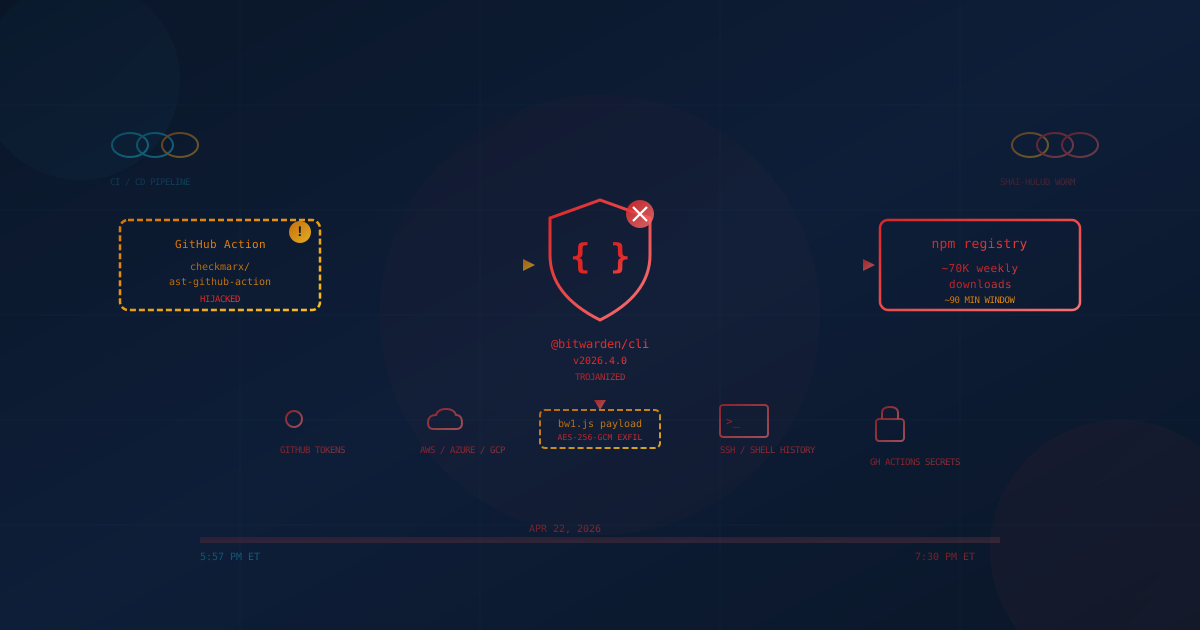
On April 22, 2026, between roughly 5:57 PM and 7:30 PM Eastern, a malicious version of Bitwarden's command-line tool — @bitwarden/cli version 2026.4.0 — was published to the npm public package registry. For about 90 minutes, anyone who installed or auto-updated the CLI received a backdoored package that quietly harvested developer credentials, cloud secrets, and GitHub tokens before exfiltrating them through an attacker-controlled domain. The incident was first reported by SecurityWeek and confirmed by Bitwarden the same day.
End-user vaults were not affected. But the bigger story isn't what was stolen during a 90-minute window — it's what the incident reveals about how supply chain attacks are evolving, and why even the security tools we trust now require a different kind of scrutiny.
For Canadian and US small and mid-sized businesses, the practical question is the same on both sides of the border: do we even know whether one of our tools touched that package? Most companies, today, do not.
What Actually Happened
The attack did not exploit a flaw in Bitwarden's password manager, the vault, the browser extension, or the mobile app. It exploited the distribution channel for one specific developer-facing tool: the Bitwarden CLI, distributed as an npm package.
Researchers at Socket, JFrog, OX Security, and StepSecurity traced the compromise back to a hijacked GitHub Action — specifically checkmarx/ast-github-action, a third-party action used in Bitwarden's CI/CD pipeline. The attackers had earlier compromised Checkmarx's GitHub Actions infrastructure, giving them a foothold in the build pipelines of every project that referenced the affected action. From there, they were able to publish a tampered release of @bitwarden/cli to npm under Bitwarden's own publishing identity.
The malicious version preserved Bitwarden's metadata so the package looked legitimate. The payload sat in a file named bw1.js, which executed on install and:
- Harvested GitHub and npm authentication tokens
- Collected SSH keys, shell history, and environment variables
- Searched for AWS, Azure, and Google Cloud credentials
- Looked for GitHub Actions secrets and AI tooling configuration files
- Encrypted the haul with AES-256-GCM
- Exfiltrated the encrypted blob to
audit.checkmarx[.]cx— a domain impersonating Checkmarx — and, in some configurations, dropped it into a public GitHub repository on the victim's own account
OX Security found the string "Shai-Hulud: The Third Coming" in the payload, tying the campaign to the Shai-Hulud npm worm that had hit the JavaScript ecosystem twice before. Bitwarden deprecated the malicious version, rotated affected build credentials, and confirmed that no end-user data, vault data, or production systems were impacted. A CVE for @bitwarden/cli@2026.4.0 is being assigned.
@bitwarden/cli averages around 70,000 weekly downloads, so the practical blast radius — even in a 90-minute window — is non-trivial.
Who Was Actually At Risk
This is the first thing executives need to internalize: the people in danger were not Bitwarden's password manager users. They were:
- Developers who installed or upgraded
@bitwarden/cliduring the 90-minute window - CI/CD pipelines that ran
npm installof@bitwarden/cli@2026.4.0in that window - Any automation that picked up the latest version through a non-pinned dependency
If your business uses Bitwarden as a password manager — through the browser extension, mobile app, or desktop app — you were not exposed by this incident. Your vault data is encrypted client-side, never touches the npm CLI, and is protected by the kind of zero-knowledge architecture we covered earlier this year.
But if your developers, your IT team, your contractors, or your managed service provider use the Bitwarden CLI in scripts or CI pipelines, that's a different conversation. The credentials that were at risk — GitHub tokens, cloud keys, SSH material — are precisely the credentials an attacker would use to pivot deeper into your infrastructure. For most SMBs, those tokens are also the keys to customer data, payroll systems, and production hosting.
Why This One Is Different
The cybersecurity industry is used to supply chain attacks. The SolarWinds compromise trojanized enterprise monitoring software. The Notepad++ update infrastructure compromise hijacked an open-source editor's update channel. The axios npm attack in March 2026 introduced a malicious transitive dependency under one of the world's most depended-on packages. What makes the Bitwarden incident notable isn't the technique — it's the target.
When a password manager's own developer tool becomes the vehicle for credential theft, it short-circuits a piece of security folklore: that picking trustworthy tools is enough. Bitwarden is well-regarded. It is open source. It is recommended in mainstream password-manager guidance and across our own coverage of what businesses get wrong about passwords. And it was still, briefly, a delivery mechanism for malware — through no fault of the company's product itself, but through a transitive trust relationship with a third party's GitHub Action.
The 2026 lesson is not "stop using Bitwarden." Bitwarden's response was fast, transparent, and by-the-book. The lesson is: trust in a vendor's product does not transfer automatically to trust in every channel that vendor ships through. Your password manager's vault and your password manager's npm CLI are different attack surfaces, with different threat models, defended by different controls.
The "Shai-Hulud" Pattern: Worms Inside Your Build Pipeline
The most worrying detail in the analysis is buried in the payload behaviour. The Bitwarden CLI compromise was not just credential theft — it was self-propagating. Once the malware ran on a developer's machine, it would try to use the harvested npm token to publish trojanized versions of every other npm package that token could publish to. That is a worm, executing inside the global software supply chain.
Two earlier waves of Shai-Hulud, in 2025, hit dozens of npm packages by the same mechanism. The Bitwarden incident — the so-called "Third Coming" — adds a new wrinkle: rather than hijacking a maintainer's leaked credentials, the attackers hijacked a GitHub Action used by the maintainer's CI. That makes the attack reachable for any project that pulls in third-party actions without pinning them by commit hash.
For a Canadian or US business that relies on software developed in-house, by an outsourced developer, or by any vendor that ships JavaScript or container images, the practical implication is uncomfortable: you are exposed not only to the security of your direct vendors, but to the security of every GitHub Action, every npm package, and every transitive dependency that touches your vendors' build pipelines. This is the modern face of third-party vendor risk, and it is no longer a problem you can manage by reading a vendor's marketing site.
What Canadian and US Business Leaders Should Take From This
The Bitwarden incident is a clean case study in modern dependency-graph risk. For non-technical leadership, a few questions are worth raising — and the answers should come back from your IT lead or managed service provider in plain English, in writing.
- Do we know which of our internal tools or vendor products use the Bitwarden CLI in automation? Not the Bitwarden vault — the CLI specifically. If the answer is "we don't know," that's the gap.
- Did anything install or upgrade
@bitwarden/clibetween 5:57 PM and 7:30 PM ET on April 22, 2026? Build logs and CI history will tell you. If yes, the affected build credentials and any tokens accessible to that pipeline should be rotated. - Are our CI pipelines pinning their GitHub Actions and npm dependencies by version, or are they pulling
@latest? Floating dependencies are how a 90-minute attack window becomes a real exposure for your business. - If a developer workstation in our company harvested cloud credentials yesterday, would we know today? This is the incident response question, and most SMBs cannot answer it confidently.
These questions are not technical trivia. They map directly onto the controls every modern security framework expects — Secure Configuration, Authentication, Vulnerability Management, and Incident Response — whether you are benchmarking against the Canadian Centre for Cyber Security's Baseline Cyber Security Controls, NIST SP 800-171 or the CIS Critical Security Controls in the US, or the FTC's Safeguards Rule for financial-sector small businesses.
The Practical Asks For Your Team
If you do nothing else this week, ask your IT lead or managed service provider for short, written answers to four things:
- Is
@bitwarden/cliused anywhere in our environment — desktops, servers, CI/CD, contractor tooling? - If yes, was version
2026.4.0ever installed? The window is narrow but the exposure is meaningful for any system caught in it. - What is our policy for pinning third-party dependencies and GitHub Actions? The answer should not be "we use the latest version" without compensating controls.
- If a developer's GitHub or cloud token were stolen tomorrow, what's our detection and rotation plan? Token theft is the modern initial access vector. The right answer is not "we'd notice eventually."
For the Bitwarden CLI specifically, Bitwarden recommends upgrading to the latest clean release, rotating any tokens that were accessible to systems that ran the malicious version, and reviewing CI logs for installs in the affected window. Where rotation is not feasible immediately, treat the affected systems as if their tokens were already in attacker hands — because for any account that ran @bitwarden/cli@2026.4.0, they may well be.
The Bigger Insight
The single most useful frame for incidents like this is to stop thinking about cybersecurity as a property of your vendors and start thinking about it as a property of your dependency graph. Your business does not just use Bitwarden. It uses Bitwarden, which uses GitHub Actions, which uses Checkmarx's action, which uses npm, which uses thousands of transitive packages. Every link in that chain is a place where trust can be borrowed — and abused.
This is the same lesson SolarWinds taught in 2020, the same lesson the Notepad++ update compromise repeated earlier in 2026, the same lesson the axios npm attack reinforced in March, and the same lesson the Bitwarden npm incident is teaching now. Each time, the affected vendor was not negligent. Each time, the businesses downstream — including a long tail of small and mid-sized companies in Canada and the US — had no good way to see the compromise coming.
What separates organizations that absorb these incidents from organizations that get devastated by them is not better luck. It is a small set of unsexy practices: a known software inventory, dependency pinning, fast credential rotation, phishing-resistant multi-factor authentication on every developer and admin account, and a working incident response plan that does not depend on the breach being on the front page. The principles are the same whether you are an Ottawa-based manufacturer, a Toronto professional services firm, a Chicago contractor, or a Miami brokerage — and the consequences of skipping them are the same too, as we've explored in why cybercriminals target small businesses and the 2026 threat landscape for US small businesses.
If you are not sure where your business stands, our free cybersecurity assessment walks you through 22 critical security areas - including the controls most relevant to a supply chain incident like this one. It takes under five minutes and your answers never leave your browser.
The Bitwarden incident lasted 90 minutes. The lesson is permanent: in 2026, the security of your business is the security of every tool, action, and package your tools depend on. Treat it accordingly.
This article is intended for general informational purposes only and does not constitute professional security, legal, or compliance advice. Details about the Bitwarden npm incident are based on public reporting, vendor disclosures, and analysis from Socket, JFrog, OX Security, and StepSecurity as of the date of publication and may evolve as the investigation continues. Organizations should consult qualified cybersecurity professionals before acting on any specific indicator of compromise or making operational changes based on this article.