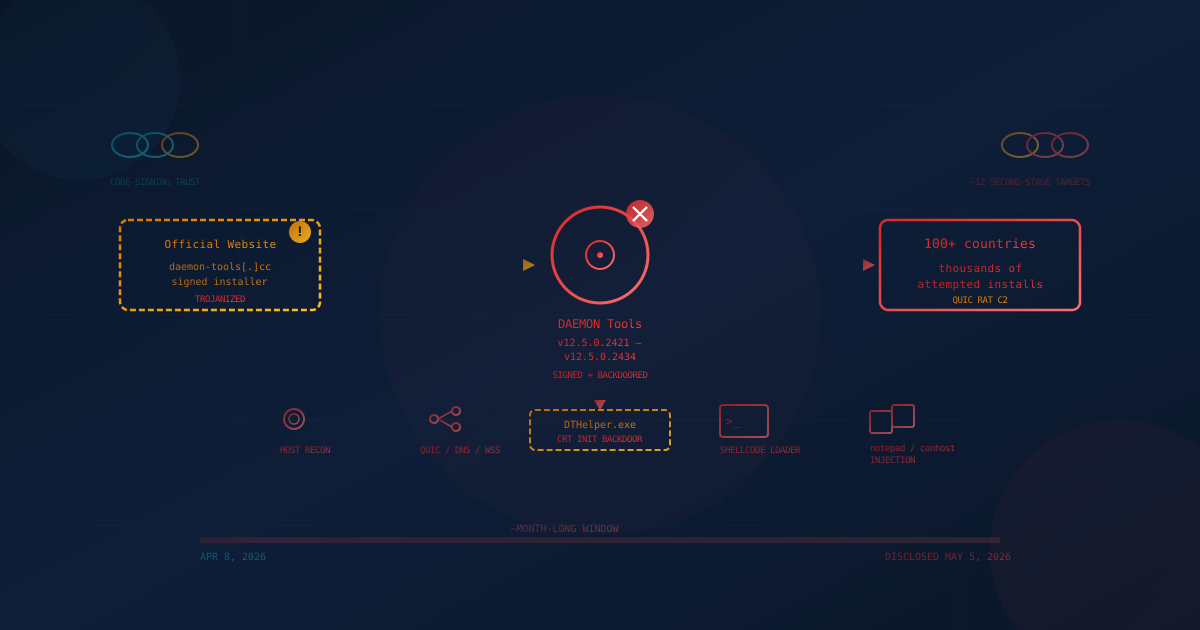
On May 5, 2026, Kaspersky's Securelist team disclosed an active supply chain attack against DAEMON Tools, the popular Windows utility for mounting disc images. The official, code-signed installer hosted on the legitimate DAEMON Tools website was trojanized starting April 8, 2026, and according to Kaspersky telemetry the campaign is still ongoing as of disclosure. Versions 12.5.0.2421 through 12.5.0.2434 are affected.
The compromised installers are signed with valid digital certificates belonging to the DAEMON Tools developer (AVB Disc Soft / Disc Soft Ltd), so Windows SmartScreen, most antivirus suites, and standard signature checks treated them as legitimate. Kaspersky has observed thousands of attempted infections in more than 100 countries, with the heaviest clusters in Russia, Brazil, Türkiye, Spain, Germany, France, Italy, and China. TechCrunch reports that artifacts inside the implants suggest a Chinese-speaking threat actor.
For Canadian and US small and mid-sized businesses, the practical question is the same one every supply chain incident now forces: did any machine in our environment install or update DAEMON Tools after April 8, 2026 — and if so, what do we do about it?
What Actually Happened
Between roughly April 8, 2026 and the public disclosure on May 5, 2026, the official DAEMON Tools website distributed a tampered installer. The malicious code was injected into three legitimate program binaries shipped inside the package — DTHelper.exe, DiscSoftBusServiceLite.exe, and DTShellHlp.exe — which are placed in the main DAEMON Tools install directory and configured to launch at Windows startup.
According to Kaspersky's analysis, the malicious code was hidden inside the C runtime (CRT) initialization routines of those binaries, so the backdoor activates the moment any of the three processes start. From there, the attack proceeds in stages:
- A first-stage information gatherer collects the MAC address, hostname, DNS domain name, list of running processes, list of installed software, and Windows language settings, then sends them to an attacker-controlled command-and-control (C2) server.
- If the operator decides the host is interesting, a shellcode loader (observed as
cdg.exewith an encrypted payload incdg.tmp) decrypts and runs a second-stage backdoor entirely in memory. - For high-value targets, the operators deploy a sophisticated remote access trojan that researchers have dubbed QUIC RAT — a C++ implant, obfuscated with control-flow flattening, that supports HTTP, HTTP/3, QUIC, UDP, TCP, WSS and DNS for C2 traffic and injects malicious code into
notepad.exeandconhost.exeto blend in with normal Windows activity.
Kaspersky reports thousands of first-stage infections, but only roughly a dozen confirmed second-stage QUIC RAT deployments — squarely consistent with an espionage operation that uses a noisy supply chain compromise to find a small number of targeted victims rather than to mass-distribute commodity malware.
Who Was Actually At Risk
This is the part SMB executives most need to internalize: this is a Windows endpoint compromise, not a server-side breach of DAEMON Tools' user accounts. The people exposed are:
- Anyone who downloaded DAEMON Tools (any edition — Lite, Pro, Ultra) from the official website on or after April 8, 2026.
- Anyone whose existing DAEMON Tools install auto-updated to a version between
12.5.0.2421and12.5.0.2434in that same window. - Any third-party software bundle, internal IT script, or imaging template that pulled the installer from the official site during that window and pushed it to multiple machines.
If your organization does not use DAEMON Tools at all, you are not exposed to this incident. But there is no comfortable way to confirm the absence of a tool like this without actually checking, because DAEMON Tools is exactly the kind of utility that an individual employee installs on their own laptop — sometimes years ago, sometimes on a contractor-owned device, sometimes on a shared machine in a back office — without the IT team being aware. The most quietly dangerous case is the workstation where DAEMON Tools was installed legitimately in 2022, ignored for three years, and then auto-updated through the bad window in April.
Kaspersky's public telemetry indicates the second-stage payloads have so far hit organizations in retail, scientific research, government, and manufacturing in Russia, Belarus, and Thailand. That target profile is consistent with an espionage operation, not a financially motivated crew — but it does not mean Canadian or US businesses are safely outside the blast radius. The first-stage backdoor is on every machine that installed an affected version, regardless of geography. Whether an operator chooses to escalate against a given host is a decision made later, on the C2 side.
Why This One Is Different
The cybersecurity industry has been here many times. The SolarWinds compromise trojanized enterprise monitoring software through a tampered build pipeline. The Notepad++ supply chain incident hijacked an open-source editor's update channel. The axios npm attack in March 2026 buried malicious code inside a transitive dependency. The Bitwarden CLI npm incident in April 2026 used a hijacked GitHub Action to push a backdoored security tool. Now it is DAEMON Tools' turn.
The common thread is not the technique. It is the distribution channel of trust — the moment when a vendor's legitimate website, signing certificate, or update infrastructure is borrowed by an attacker. In the DAEMON Tools case the malicious binaries were signed with the developer's own valid certificate, which means:
- Windows showed no SmartScreen warning on install.
- Endpoint protection that whitelists by code signature would have allowed the binary by default.
- An IT team auditing "is this software signed and from the vendor's official site?" would have answered yes — and still been wrong.
That is the defining shift of the 2026 supply chain era. Code signing is necessary, but it is no longer sufficient evidence of safety on its own. The signal that mattered in this incident is behavioural: a disc-mounting utility making outbound connections to an unknown domain at startup, injecting code into notepad.exe, or running a hidden shellcode loader from its own install folder. That is what endpoint detection and response (EDR) tooling looks for, and it is one of the reasons modest investments in EDR consistently outperform purely signature-based antivirus on incidents like this.
How To Tell If Your Business Is Affected
You do not need a malware analyst to answer the first-pass question. A non-technical owner or operations leader can ask their IT lead or managed service provider for the four checks below, and any competent provider should be able to confirm in writing within a day or two.
- Inventory. Is DAEMON Tools (Lite, Pro, or Ultra) installed on any company-managed Windows machine, contractor device, or shared workstation? Most modern endpoint management or RMM platforms can answer this with a single query against the installed software list.
- Version check. On any machine where it is installed, is the version between
12.5.0.2421and12.5.0.2434? You can read the installed version from Settings → Apps on Windows, or from the DAEMON Tools application itself (Help → About). - Install or update timestamp. When was DAEMON Tools first installed, or most recently updated, on each affected machine? An install or update timestamp on or after April 8, 2026 is the trigger condition for this advisory.
- Behavioural signals. On any affected machine, has there been unusual outbound network traffic from
DTHelper.exe,DiscSoftBusServiceLite.exe, orDTShellHlp.exesince April 8, 2026? Hasnotepad.exeorconhost.exemade unexpected outbound connections? Are there unfamiliar files (for examplecdg.exeorcdg.tmp) in the DAEMON Tools install directory or in user temp folders? An EDR or modern antivirus product with telemetry retention can answer these questions far more quickly than a manual sweep.
If any one of those four answers points the wrong way, treat the machine as presumed compromised until proven otherwise. The cost of treating a clean machine as compromised is a few hours of investigation. The cost of treating a compromised machine as clean is months of attacker dwell time on your network, which is exactly the scenario every incident response plan exists to prevent.
What Canadian and US Business Leaders Should Do This Week
The DAEMON Tools incident maps cleanly onto the controls every modern security framework expects, whether you benchmark against the Canadian Centre for Cyber Security's Baseline Cyber Security Controls, NIST SP 800-171, the CIS Critical Security Controls, or the FTC's Safeguards Rule for US financial-sector small businesses. None of the practical asks below are exotic; they are the controls that exist precisely because incidents like this happen.
- Uninstall the affected versions immediately. On any machine running DAEMON Tools
12.5.0.2421through12.5.0.2434, remove the application using Windows' standard uninstaller, then manually verify that the install directory is empty and no scheduled tasks or startup entries reference the old binaries. If you genuinely need DAEMON Tools, wait for the vendor to publish a clean release and a clear advisory before reinstalling. - Isolate, then investigate. Disconnect the affected machine from the corporate network during the review, especially before running cleanup tools. The first-stage backdoor was designed to enable lateral movement; assuming it is "just one laptop" is the wrong default.
- Rotate credentials used on the affected device. Browser-saved passwords, single sign-on tokens, VPN credentials, cloud console sessions, SSH keys, and any local administrator accounts on that machine should be treated as exposed. A good password manager makes this a 30-minute task instead of a week of guesswork.
- Hunt for the second stage. Even if a first-stage infection was largely automated, the QUIC RAT operator activity is human-driven. Look for unusual outbound connections from
notepad.exeandconhost.exe, persistence entries you do not recognise, and any new local admin accounts created since April 8, 2026. - Tighten software install policy going forward. Most SMBs do not need every employee to be a local administrator on their laptop. Reducing the number of people who can install arbitrary software is one of the highest-return controls available, and it directly reduces exposure to the next DAEMON Tools-style incident — whatever utility happens to host it.
For organizations without internal security staff, this is a textbook scenario for engaging a trusted managed security partner. The technical work is straightforward, but it does need someone whose day job is doing it.
The Bigger Pattern
Step back from DAEMON Tools specifically and the underlying issue is depressingly familiar: the legitimacy signals businesses have learned to rely on — downloading from the vendor's official site, checking that an installer is digitally signed, sticking to popular and well-reviewed software — can all be true at the moment a machine is compromised. SolarWinds was bought from SolarWinds. The Bitwarden CLI was published by Bitwarden. DAEMON Tools was downloaded from the DAEMON Tools website and signed by the DAEMON Tools developer. Each time, the vendor itself was the unwitting carrier.
What separates organizations that absorb these incidents from organizations devastated by them is rarely better luck. It is a small set of unsexy, durable practices: a known software inventory, restricted local admin rights, modern endpoint detection rather than signature-only antivirus, fast credential rotation, phishing-resistant multi-factor authentication on every administrative account, and a working incident response plan that does not depend on the breach being on the front page. Those practices look the same whether you are an Ottawa manufacturer, a Toronto professional services firm, a Chicago contractor, or a Denver brokerage — and so do the consequences of skipping them, as we have explored in why cybercriminals target small businesses.
If you are not sure where your business stands against this kind of incident, our free cybersecurity assessment walks you through 22 critical security areas in under five minutes - including the controls most relevant to a software supply chain attack like this one. Your answers never leave your browser.
Closing Reflection
The DAEMON Tools backdoor will probably not become a headline ransomware story. It is too quiet, too targeted, and too geographically scattered to make front pages outside the security press. That is precisely why it is worth taking seriously. The campaigns that quietly sit on a handful of mid-sized businesses for months — reading email, harvesting credentials, mapping networks — are the ones that hand attackers their next big payday. In 2026, the security of your business is the security of every signed installer, every auto-update, and every utility a well-meaning employee downloaded years ago and forgot. Treat it accordingly.
This article is intended for general informational purposes only and does not constitute professional security, legal, or compliance advice. Details about the DAEMON Tools supply chain incident are based on public reporting and analysis from Kaspersky's Securelist, The Hacker News, BleepingComputer, and TechCrunch as of the date of publication and may evolve as the investigation continues. Organizations should consult qualified cybersecurity professionals before acting on any specific indicator of compromise or making operational changes based on this article.