
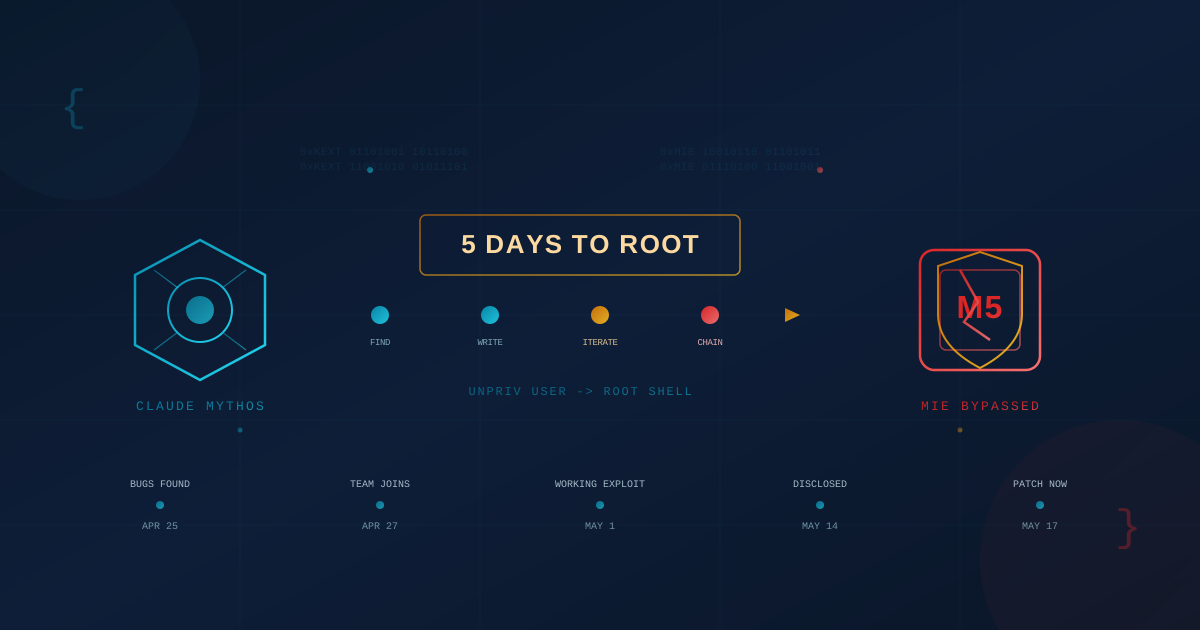
On May 14, 2026, security firm Calif disclosed the first public macOS kernel exploit on Apple M5 silicon. Researchers Bruce Dang, Dion Blazakis, and Josh Maine chained two macOS bugs into a working local privilege escalation on macOS 26.4.1 (25E253), bypassing the brand-new Memory Integrity Enforcement (MIE) hardware mitigation Apple spent roughly five years building. They went from "no bugs in hand" to a full root shell in five days, with substantial help from Claude Mythos Preview, Anthropic's restricted frontier model for vulnerability research.
The timeline, per Calif's own writeup: Bruce Dang found the bugs on April 25, Dion Blazakis joined the team on April 27, Josh Maine built the tooling, and a working exploit was running by May 1. The exploit starts from an ordinary, unprivileged local account, uses only normal system calls, and ends with root — all while Apple's newest memory-protection layer is fully enabled. Calif delivered the findings to Apple in person at Apple Park to avoid getting lost in the submission queue, and will publish its 55-page technical report once Apple ships a fix.
For Canadian and US small and mid-sized business leaders, this is not an Apple story. It is the clearest signal yet that the patching cadence most businesses still operate on — monthly, quarterly, "whenever the MSP gets to it" — is now a real source of business risk. We covered the underlying trend last week when the CVE-to-exploit window collapsed to roughly 10 hours. The Apple M5 case is the same story applied to one of the hardest targets in the industry.
What Calif's Five-Day macOS Kernel Exploit Actually Did
Calif's exploit is a data-only kernel local privilege escalation chain targeting macOS 26.4.1 (25E253) on Apple M5 hardware. Translated for executives: a person with a normal user account on a Mac — or anyone who lands code on that account through phishing, a malicious download, or a compromised browser session — can walk that access up to root, the highest level of control on the machine. From root, an attacker can read any file, disable security tooling, install persistent malware, and pivot to whatever the device can reach.
Three details matter for non-technical readers:
- The target was Apple's newest, most hardened platform. M5 silicon ships with Memory Integrity Enforcement (MIE), a hardware-backed protection Apple has marketed as raising the bar against the entire class of memory-corruption attacks. MIE is supposed to make exploits like this dramatically harder. Calif's chain ran with MIE active.
- The attack used only standard system calls. Nothing exotic, no kernel driver loaded by the attacker, no rare hardware feature. From a defensive monitoring perspective, the activity looks like normal application behavior.
- Five days is the relevant number. Kernel exploits on Apple silicon have historically taken senior researchers weeks or months. Apple invested years and considerable engineering capital in MIE specifically to push that number up, not down.
Calif has been deliberate about what Mythos Preview did and did not do. Per the team's own framing, the model did not magically invent new attack primitives. It recognized bug classes the team had generalized from prior work, helped write and iterate exploit code, and moved the team much faster. The hardest part — bypassing MIE itself — was still human work. The lesson is not "AI hacked Apple." The lesson is that elite offensive researchers now have a second brain, a faster loop, and far more attempts per week.
This is the same dynamic we documented when Mozilla shipped 423 Firefox security fixes in April 2026, 271 of them found by Mythos Preview, and earlier when Claude Opus 4.6 surfaced 500+ unknown vulnerabilities in open-source libraries. The Apple M5 case extends the curve from "found bugs" to "weaponized exploit on the hardest target available."
What "Patching" Actually Means — and Why Tight Patching Policy Is Now Non-Negotiable
"Patching" is the unglamorous practice of installing the fixes that vendors release for the software and devices you already own. A patch is a small software update that closes a specific bug, usually a security vulnerability. Operating systems (macOS, Windows, iOS, Android, Linux), browsers (Chrome, Edge, Firefox, Safari), business apps (Microsoft 365, Adobe, accounting and CRM platforms), firewalls, printers, phones, point-of-sale terminals, and Wi-Fi routers all ship patches throughout the year. Keeping every device and piece of software current is what defenders mean when they say "patch."
For roughly two decades, "patch promptly" was good hygiene. In May 2026, it is operational risk management. The reason is the gap between two clocks:
- The vendor clock: how fast Apple, Microsoft, Google, Mozilla, and your business-software vendors can ship a fix after a flaw is reported. For high-severity issues this is now measured in days to a few weeks.
- The attacker clock: how fast someone with AI assistance can turn a public advisory into a working exploit. As of early 2026, the median is approximately 10 hours. The Apple M5 case shows the same compression applied to bugs that are not yet public at all.
If the attacker clock is hours and your patch clock is "the second Tuesday of the month," the math is not favourable. That is why a tight, written patching policy — and the automation to enforce it — has moved from "nice to have" to a baseline requirement under both the CCCS Baseline Cyber Security Controls in Canada and the NIST SP 800-171 and CIS Controls v8 frameworks in the United States. The CISA Known Exploited Vulnerabilities (KEV) catalog has become the operational benchmark: when something hits KEV, US federal contractors must patch on a fixed clock, and increasingly, cyber insurers are referencing the same standard.
Automation matters because humans cannot keep up. A typical SMB endpoint fleet — laptops, phones, browsers, a handful of SaaS desktop clients — receives hundreds of patches a year. Manually approving each one is the bottleneck most internal IT teams and smaller MSPs have not yet engineered out. We covered the mechanics in our guides to software updates and patch management and managing general software updates. The short version: turn auto-update on by default for every category that does not actively break your business, then build a fast exception path for the few that do.
Why Even Microsoft and Apple Will Struggle to Ship Fixes Fast Enough
The honest framing is that the patching squeeze is not only an SMB problem. The biggest vendors in the industry are about to feel it harder than they have in twenty years.
Three pressures are stacking up at once:
- AI-scale discovery on the defensive side. Mozilla just shipped a single-month patch volume roughly 20 times its 2025 baseline because Mythos Preview surfaced 271 real bugs. Microsoft, Apple, Google, and every major open-source project are running similar pipelines or will be within the next year. Patch volume is going up, not down.
- AI-scale weaponization on the offensive side. The Apple M5 exploit shows that the same capability, in capable hands, compresses the time from "bug exists" to "working exploit" against even hardware-backed mitigations. The traditional 90-day responsible-disclosure window — designed when only a handful of researchers could weaponize a kernel bug — was already strained. Anthropic and several major vendors are openly discussing shortening it.
- QA and rollout are still bounded by physical reality. Patches have to be written, regression-tested across thousands of device configurations, signed, staged, and shipped without breaking customers' production environments. Apple in particular has historically been measured (and criticized) for the time it takes to validate kernel changes. None of that engineering discipline goes away because the bug count went up.
Expect more frequent, larger security releases from Apple, Microsoft, Google, and Mozilla through the rest of 2026 and into 2027. Expect tighter disclosure windows. Expect more cases — like the Apple M5 chain — where a fix is in progress but no patch is yet available, and the defender's job is to manage exposure with compensating controls. We saw a smaller-scale version of this with the Chrome zero-days earlier this year and the Windows BitLocker bypass disclosed last week. The Apple M5 case is the same pattern at the highest difficulty setting.
Who Is Actually at Risk Right Now?
Apple's MIE bypass is, today, a research result. Calif has not released the technical report, and the chain still requires local code execution to start. That is the comforting framing. The accurate framing is that knowledge spreads, similar capabilities will appear in other research groups and threat actors, and Apple's Macs are now firmly inside the same patching reality as everything else in your environment.
Three SMB populations should be paying particular attention:
- Mac-heavy businesses. Design, legal, finance, executive, healthcare, and increasingly software-development teams skew heavily Mac. The reflexive belief that Macs are inherently safer has always been overstated, and it is now demonstrably wrong at the kernel level. Macs need the same patching, MDM, EDR, and asset-inventory rigor as Windows.
- BYOD environments. If contractors, executives, or remote staff use personal Macs to access company SaaS, file shares, or banking, your visibility into those devices' patch state is typically poor. See our note on BYOD risk for SMBs. A local-privilege-escalation chain is precisely the kind of bug that turns an opportunistic browser compromise into a full device takeover.
- Businesses where "the IT person handles updates" is still the policy. Manual patching cannot keep up with AI-scale disclosure. If your patch cadence depends on one human's attention each month, you do not have a patching policy; you have a patching aspiration.
For context, the most recent Verizon Data Breach Investigations Report continues to show that businesses with fewer than 1,000 employees absorb a disproportionate share of confirmed breaches. The gap between attacker speed and SMB defender response is widening fastest at the small end of the market — which is exactly where automated patching, baseline MFA, and basic endpoint detection have the largest marginal return.
What Canadian and US Business Leaders Should Take From This
The right questions to put to your internal IT lead, your MSP, or your vCISO this quarter are concrete and measurable. Vague answers are themselves a finding.
- What is our written patching policy, and where is it documented? If the answer is "we just keep things updated," that is not a policy.
- How much of our patching is automated versus manually approved? Auto-update should be the default for browsers, operating systems, mobile devices, and most SaaS clients. Manual approval should be the exception, not the rule.
- What is our time-to-patch for a critical CVE on a device that touches the internet? Hours, days, or weeks? Get a number, and confirm it is measured against the data, not estimated.
- How current is our Mac fleet specifically? Including contractors and executives. Ask for a report showing macOS versions across every device that touches company data.
- If a high-severity bug ships and no patch is yet available, what do we do? Network segmentation, conditional access, EDR, disabling unused features, and tightening admin permissions all buy time. A policy that only knows how to "wait for the patch" has a single point of failure.
- Are our key vendors part of programs like Anthropic's Project Glasswing? Most SMBs will not be direct participants, but your operating system, browser, identity provider, and core SaaS vendors should be on early-disclosure tracks. Ask.
- Where is patching written into our cyber insurance application? Misrepresenting patch cadence in an insurance form is becoming a denial vector for claims. Make sure the answer on the form matches the reality on the ground.
None of these questions require a technical background to ask. The answers reveal whether your patching program is engineered or improvised.
Practical Asks for the Next 30 Days
For Canadian and US SMB leaders who want a short, defensible action list in response to the Apple M5 / Mythos disclosure:
- Confirm every Mac in the business is on macOS 26.4.1 or later and that auto-update is enabled. Include contractor devices and BYOD where you can. When Apple ships the MIE fix, the lag between "available" and "installed in your fleet" is your exposure window.
- Turn on automatic updates for every category that does not actively break your business. Browsers, operating systems, mobile devices, Microsoft 365 apps, and most SaaS desktop clients should be auto-updating. Document exceptions.
- Write down a critical-CVE patch SLA. Many SMBs we work with target 24–72 hours for internet-facing systems, seven days for end-user devices, and 14 days for back-office systems. Pick numbers, commit to them, and measure against them.
- Subscribe to the CISA KEV feed and your top vendors' security advisories. KEV is free and is the closest thing to a "patch this now" signal that exists.
- Pair patching with phishing-resistant MFA on every remote-access surface. Local privilege escalation chains like the Apple M5 case typically need code execution to start. Strong identity controls are the most common thing that stops the chain before it begins.
- Add or validate EDR/MDR coverage on Macs specifically. A surprising number of SMB endpoint-detection deployments still treat Macs as an afterthought.
- Run a 5-minute risk check. Our free quick security assessment covers the patching, identity, backup, and training basics that most Mythos-class exploit chains would still need to chain through to do real damage.
The Durable Lesson
The headline — "AI cracked Apple's M5 in five days" — is the part that travels. The durable lesson is the unglamorous one. Patching is the single most leveraged thing most SMBs are still under-doing, and the cost of being late just rose sharply. Even the biggest vendors in the industry — Microsoft, Apple, Google, Mozilla — are going to be visibly struggling to keep up with the new disclosure cadence over the next 12 to 24 months. The businesses that fare best will be the ones that quietly automated their patching long before they had to.
You do not need a security team to act on this. You need a written policy, automated enforcement, a measurable SLA, and someone other than the people who built the environment looking at it periodically. The Apple M5 / Mythos case is a useful prompt to confirm those four things actually exist in your business — in writing, with numbers, and not just as something the IT person "usually does."
This article is intended for general informational purposes only and does not constitute professional security, legal, or compliance advice. Details about the Calif macOS kernel exploit, Claude Mythos Preview, and Apple's Memory Integrity Enforcement are based on Calif's public disclosure and independent reporting available as of the date of publication and may evolve as Apple ships a fix and additional technical detail is released. Organizations should consult qualified cybersecurity professionals before making operational changes based on this article.