
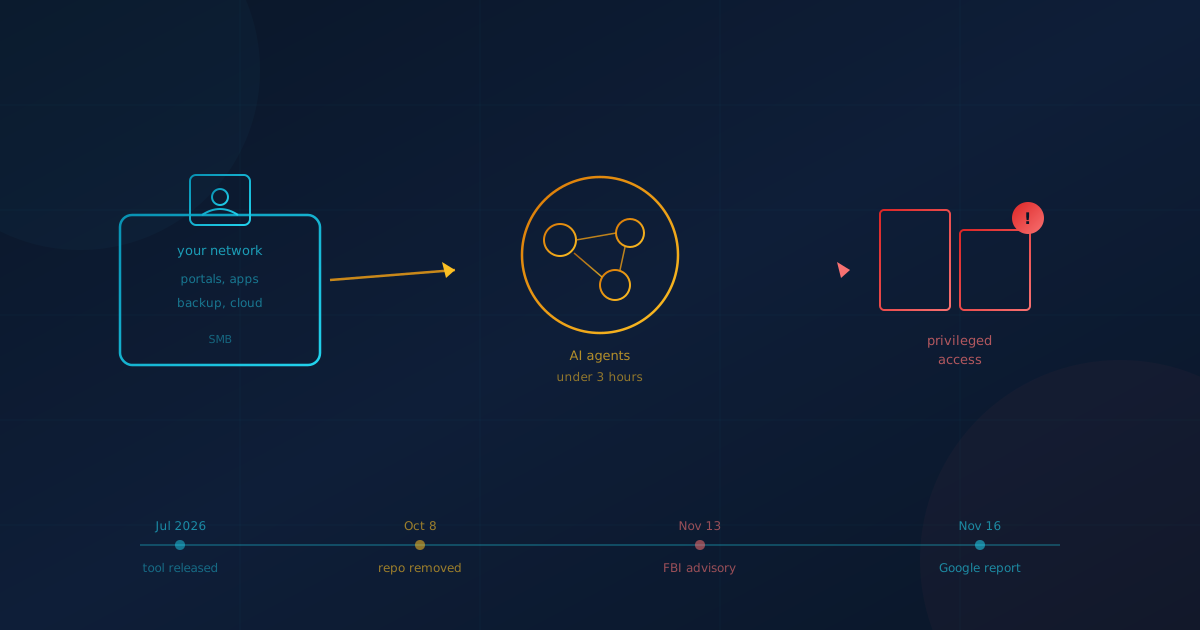
On November 13, 2026, the FBI said AI hacking tools built on an open-source framework called ARTEX have carried some intrusions from initial targeting to privileged access in under three hours. Privileged access means the attacker can administer systems, not only use an ordinary login. The advisory is FLASH-20261113-001. TechCrunch reported the warning on November 16.
The FBI said actors have used ARTEX since at least August 2026 against organizations in financial services, government, technology, defense, semiconductor, energy, healthcare, manufacturing, telecommunications, and legal. The Bureau's point for a smaller firm in Canada or the United States is that the tool lowers the technical bar. Someone with limited skill can aim it at many targets at once, and the systems it favors are often the ones a busy owner does not think of as "production": a partner portal, an old employee app, a backup product, a login left over from a vendor who is no longer on contract.
On November 16, 2026, the same day TechCrunch published, Google's Threat Intelligence Group described a separate system that it says researched flaws and attacked with no person in the loop. The two reports pose one question for an owner: whether anyone can act while an automated run is still in progress.
What did the FBI say about AI hacking tools on November 13?
On November 13, 2026, the FBI published a public advisory on AI hacking tools built around ARTEX, an open-source platform that plugs into outside AI models and turns a plain-language goal into machine commands. The Bureau said actors have used it since at least August 2026 to automate steps from reconnaissance through data theft. Some of those intrusions progressed from initial targeting to privileged access in under three hours.
ARTEX does not contain its own AI model. The FBI said it connects to outside providers, including commercial models and open models, and that a person sets an objective and then the software does much of the rest. In the advisory's words, it requires "minimal human interaction beyond initial objective setting." The original developer published it on GitHub in July 2026. Censys dates that publication to July 26, 2026. After public reports of abuse, the developer removed the repository on October 8, 2026. The FBI says copies, forks, and a commercial version it calls ARTEX PRO are still in circulation, and that the earlier code "remains widely accessible."
The FBI also describes the traffic as noisy. ARTEX "generates high volumes of forensically noisy traffic that may trigger alerts," and the speed "provides limited time for coordinated defender response before objective completion." Noise helps when someone is looking during the run, including overnight.
How fast can an automated attack reach privileged access?
The FBI said on November 13, 2026 that some ARTEX intrusions reached privileged access in under three hours from initial targeting. Microsoft reported the same interval on October 21, 2026: multiple attacks reached privileged cloud access in less than three hours. Microsoft attributes that activity to Storm-0940, which it describes as a China-aligned actor, and the FBI cites Microsoft for the figure. Three hours is inside a single afternoon, including evenings, when many small firms have no one watching alerts.
Microsoft added two qualifications that matter before anyone treats "three hours" as "every attempt succeeds." It said the majority of that actor's targeting was not successful. It also said the actor still achieved privileged cloud persistence at many organizations in a brief time. When the activity did land, Microsoft saw follow-on work through Microsoft's cloud programming interfaces: reconnaissance, changes to application credentials, and attempts to modify privileges. Microsoft was explicit that a successful sign-in, or the mere presence of an affected application, does not by itself prove customer data was copied.
On November 16, 2026, Google said language models are shrinking the time between a vendor publishing a fix and attackers using what that fix reveals. Citing the security firm Greynoise, Google described a late August 2026 campaign in which a foothold was expanded to a domain administrator account within minutes. A domain administrator can control the accounts and computers in a typical Windows network. The slow research phase is what the software is compressing.
Which organizations were actually affected?
The FBI's November 13 advisory names two campaigns with public counts. Attacks on South Korean financial institutions stole personal information on approximately 67,000 people. TechCrunch's November 16 account said at least 68,000, so the published figures sit in that range. Separately, the FBI said a ConnectWise Cloud Backup compromise led to attempted sign-ins to more than 2,250 downstream Microsoft 365 tenants. Microsoft's October 21 post uses that same figure of more than 2,250.
The FBI's phrase is "attempted sign-ins." Microsoft says a successful sign-in, or the mere presence of an affected application, does not by itself prove customer data was copied. TechCrunch reported that Microsoft says the operators are likely Chinese, and that they stole data from affected ConnectWise customers. TechCrunch also reported that a ConnectWise spokesperson said the company does not have the visibility to confirm the number of affected environments the FBI cited. A firm that authorized that backup application can be in the review set, including one that has stopped using the product. The FBI tells administrators to review every Microsoft 365 tenant where the affected applications are or were installed.
The FBI says ARTEX is effective against peripheral systems that get less attention than the main website or the main finance app: partner and supplier portals, mobile backends, employee applications, sales-support systems, legacy services, third-party integrations, and applications built by different teams. It also says the agents can map trust between organizations and move from a weaker supplier into a more valuable network. A 40-person firm in Calgary or Dallas is in that picture when it is the supplier, the customer of a managed backup product, or the owner of an old portal.
Exposed copies are widespread, and the counts differ by method. The FBI said that as of early November 2026, researchers had identified over 1,600 publicly exposed ARTEX consoles, and that the true number is higher once systems behind firewalls are included. Check Point Research, which the FBI cites, reported 1,608 live public instances on November 5, while a summary line in the same piece said more than 1,800. Censys reported 1,465 hosts as of November 4, 2026, and said deployment is likely higher because a console does not have to be public. TechCrunch described hundreds of consoles left online without a password, including one tied to the South Korea activity. Censys notes that some public consoles are likely authorized testing left open by mistake. Taking the original repository down did not take the tool out of circulation.
What did Google report about a fully automated AI attack?
On November 16, 2026, Google's Threat Intelligence Group said it had, for the first time, seen threat actors fully automate vulnerability discovery and exploitation with no human in the loop. The system, which Google calls exploit_agent, sat on an exposed server and was built to compare web software before and after a patch, draft an exploit, and run it. CyberScoop reported the finding the same day. Google's report does not name a group or a state.
Google's sentence, from its November 16 report, is that it identified threat actors using language-model frameworks "to fully automate vulnerability discovery and exploitation without a human in the loop for the first time." A large language model is the type of AI system behind a chatbot. CyberScoop wrote that Google said Russian-speaking hackers carried out what its analysts believe is the first cyberattack run end to end by AI, with no human at any stage. The published report is narrower than that headline. It shows Russian-language comments in a configuration file. Google's English rendering of one line is "LLM API keys for auto-exploitation (exploit_agent pilot)." Another tells the operator to enter the keys in that file, not in a chat. Victim data on the server, Google said, pointed to French websites in media and entertainment, and in education. Treat "Russian-speaking" as CyberScoop's description of those comments, and treat the no-human-in-the-loop claim as Google's.
Google's report also puts numbers on the wider pace. It said overall vulnerability disclosures and exploits nearly doubled between January and August 2026, while exploited zero-days (flaws the vendor did not yet know about) rose from a 2025 average of 8 per month to 11 per month in 2026, then spiked to 22 in August. After official patches for two PHP vulnerabilities on October 21, 2026, Google said hundreds of claimed proof-of-concept exploits appeared within days, most of them non-functional and likely produced with language models. PHP is a programming language many websites run.
Google said the tools it is seeing trade stealth for speed. They leave forensic traffic, recognizable identifiers, and code-level traces, and they can still finish the job. The company wrote that, given the low barrier, the ease of adding exploits, and the scaling potential, "we believe it is highly likely that threat actors will continue to use these frameworks in campaigns targeting organizations globally." Google also said it observed the open-source framework CAIRN in activity that included an aerospace organization in the United States, and PentAGI in reconnaissance against organizations in Asia. It said a PRC-nexus group was developing its own automated attack framework for likely espionage use. Those are Google's assessments. They show automated tooling is no longer a single product or a single incident.
What does the FBI tell a small business to fix first?
The FBI's November 13, 2026 advisory puts the first fixes on exposure and identity. It tells organizations to inventory every internet-facing application, including partner portals, employee apps, legacy services, and third-party integrations, and to keep cloud administration, backup platforms, and publishing interfaces off the open internet. It also says to limit each connected app to the access it needs, and to watch for new credentials on highly privileged applications.
The same ideas already sit in public baselines on both sides of the border. CIS Critical Security Control 1 says to inventory and track enterprise assets, including servers and cloud systems, so you know what must be monitored. The Canadian Centre for Cyber Security baseline for small and medium organizations tells those organizations to enable automatic patching or run full vulnerability and patch management (control BC.2.1), and to use two-factor authentication wherever possible, including for cloud administration and privileged users (BC.5.1). Two-factor authentication is a form of multi-factor authentication: a second proof on top of the password. The FBI list is more specific about connected cloud apps. The baselines are the standing version of the same homework.
A vulnerability scan is an automated sweep for known weaknesses such as missing patches. Run one, and also keep the FBI inventory, because a scanner only tests systems someone included. The advisory's examples are the portals and old apps people forget. Google's patch-to-exploit timeline is why the Canadian baseline's instruction to patch automatically, or to run a real patching program, applies to internet-facing software.
Logging still matters, with a shorter fuse. The FBI asks defenders to notice compressed bursts of activity, high volumes of failed attempts that change a little each time, and duplicate automated requests. It also lists unexpected connections to AI model services as something to investigate beside other suspicious activity, not as proof on their own. Ordinary businesses call those services for legitimate reasons. The signal is the combination: odd outbound AI traffic, plus failed or unusual sign-ins, plus new credentials on an application. Endpoint detection and response (EDR) is software on each laptop and server that records activity and spots behaviour that looks like an attack. Managed detection and response (MDR) is a service in which a provider's analysts watch those alerts, investigate them, and respond. Software that records an event at 2 a.m. does not contain it unless a person is authorized to act.
If that person does not exist on your staff after hours, a managed service is the usual way smaller firms cover the gap. Cyber Unit's cybersecurity page describes endpoint detection and response (EDR) and managed detection and response (MDR) on each device, watched 24/7 by its Security Operations Center, alongside vulnerability management that patches operating systems and third-party applications. That is the shape of coverage the FBI's timeline is pressing on: detection that is on when the office is not, and patching that does not wait for a monthly visit.
What should owners in Canada and the US check this week?
If ConnectWise Cloud Backup was ever authorized, start with Microsoft's October 21, 2026 guidance and the FBI's November 13 advisory. Review every Microsoft 365 tenant where those applications are or were installed, and search by application ID rather than the display name. Keep the connections disabled until ConnectWise gives formal restoration instructions. Do not delete the enterprise applications as a first step.
The FBI also says to review logs from at least October 1, 2026, including failed sign-ins, and to include tenants where the integration is no longer used. Work through the steps below with whoever administers Microsoft 365 and the public website. They are the advisory's recommendations, translated for an owner who will not run them personally:
- Write down every internet-facing application. Include partner and supplier portals, mobile backends, employee apps, sales tools, old services, third-party integrations, and apps built by different teams. If it has a login and a public address, it is on the list.
- Take cloud administration, network-device management, application publishing, hypervisors, and backup platforms off the open internet. Limit them to a trusted network or a dedicated admin path. Turn off basic publishing logins you do not need.
- Require a review before a workload or a management screen is given a public address. Where you can, put business applications behind an access check so they are not exposed to the whole internet. The FBI points to zero trust access for this: each request is checked on identity and device, instead of being trusted because it came from "inside."
- Give every connected cloud application the smallest permission that still lets it work. Review consent grants. Alert when a new credential, a new owner, or a privileged role appears on an application, especially one that signs in on its own without a person at the keyboard. That kind of identity is called a service principal.
- If ConnectWise Cloud Backup, or a related ConnectWise cloud app, was ever authorized, review each tenant as Microsoft describes. Look at successful and failed application sign-ins separately. Do not stop at a vendor's published list of IP addresses. The FBI says unfamiliar sources outside the vendor's expected infrastructure still need a look.
- In the audit log, look for new applications, new credentials, consent grants, privileged role assignments, and changes to users, groups, sign-in methods, or conditional access. Conditional access is the set of rules that decides when a login is allowed. If you confirm something unauthorized, preserve the logs, then revoke the extra rights and rotate credentials.
- Put rate limits and volume alerts on high-impact functions: mass email, mass record lookups, large transfers. On partner and employee portals, alert when one session reads an unusual number of records, and enforce the limit on the server, not only in the browser.
- Stop showing detailed error messages, database errors, and internal file paths to people who are not signed in. The FBI says that detail helps an automated tool learn how the application is built. Keep the detail in internal logs.
- Search configuration files, deployment scripts, build pipelines, and databases for stored passwords and keys. The FBI says to rotate exposed credentials promptly.
- Keep sign-in logs, audit logs, and security monitoring data long enough to review back to October 1, 2026 for the ConnectWise question, and long enough in general to reconstruct a three-hour burst. If you must contain an incident, the FBI says not to wait for a perfect export before urgent containment. Save what you can, then remove confirmed unauthorized credentials and grants.
- Ask the person who watches alerts whether they would notice a short burst of failures, repeated small changes, and duplicate automated requests. Agree in advance what they may do without a phone call, such as disabling an application sign-in or isolating a computer.
The first hours of an incident are often chaotic, which is why the last item belongs on paper before anyone needs it. Knowing who to call, and what they may shut off, is the part a tool cannot do for you. United States organizations that see activity matching the advisory can report it to a local FBI field office or to the Internet Crime Complaint Center, as the FLASH requests. Reporting paths in Canada are different. Ask your provider which channel applies where you operate, and do not wait on a cross-border argument before you contain a live sign-in.
What should you ask your IT lead before the weekend?
Given the FBI's under-three-hour timeline, published November 13, 2026, the question to ask your IT lead or provider is this: if an automated tool reached a privileged account on a Saturday afternoon, who would see the alert, and how long until someone could contain it? Put the answer in hours, with a name attached. Then take the free 5-minute cybersecurity assessment. It covers 22 security areas, runs in the browser, and does not require a signup.
This article is intended for general informational purposes only and does not constitute professional security, legal, or compliance advice. Details about the FBI's November 13, 2026 ARTEX advisory, Microsoft's October 21, 2026 findings, and Google's November 16, 2026 threat report are based on those public documents and on reporting by TechCrunch and CyberScoop as of the date of publication, and may change as investigations continue. Organizations should consult qualified cybersecurity professionals before acting on any specific indicator of compromise or making operational changes based on this article.