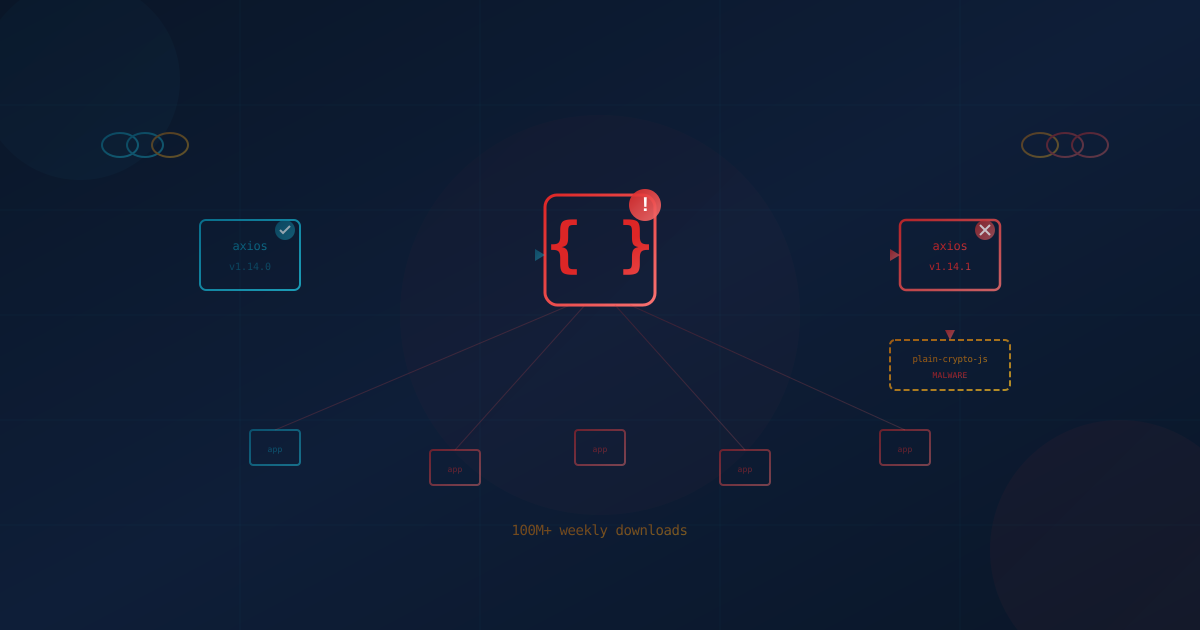
On March 30, 2026, security researchers confirmed an active supply chain attack on axios—one of the most widely used JavaScript libraries in the world. With over 100 million weekly downloads, axios is a foundational dependency in countless web applications, backend services, and developer toolchains. The latest version, axios@1.14.1, had been compromised to pull in a brand-new malicious package called plain-crypto-js@4.2.1.
The package didn't exist before the day of the attack. Socket AI analysis confirmed it was an obfuscated dropper/loader—a piece of malware designed to establish a foothold and deliver additional payloads. Every npm install pulling the latest version of axios was potentially pulling in malware.
This is what a modern software supply chain attack looks like. And it's a pattern every business that depends on software—which is to say, every business—needs to understand.
What Happened With Axios
Axios is a promise-based HTTP client used across JavaScript and Node.js projects. It's the kind of package developers install without a second thought—trusted, well-maintained, and ubiquitous. If your business has a web application, there's a strong chance axios is somewhere in the dependency tree.
The attack worked by introducing a new dependency into the latest axios release: plain-crypto-js@4.2.1. The name bears a resemblance to the widely-used crypto-js library—a naming pattern consistent with dependency confusion and typosquatting tactics—but the package was brand new and had never existed before the day of the compromise.
Security analysis revealed that plain-crypto-js was a sophisticated piece of malware that:
- Deobfuscated embedded payloads at runtime — hiding its true purpose from static analysis tools
- Dynamically loaded sensitive modules like
fs,os, andexecSyncto evade detection - Executed decoded shell commands on the host system
- Staged and copied payload files into OS temp directories and Windows ProgramData folders
- Deleted and renamed artifacts post-execution to destroy forensic evidence
This is textbook installer malware. The dropper establishes initial access, and once running on a developer's machine or build server, it can exfiltrate credentials, deploy backdoors, or pivot into production environments.
Why Supply Chain Attacks Are So Dangerous
Traditional cyberattacks target organizations directly—phishing emails, brute-force login attempts, exploiting known vulnerabilities. Supply chain attacks take a fundamentally different approach: instead of attacking you, they attack something you trust.
When an attacker compromises a widely-used software library, every organization that depends on that library becomes a potential victim. The trust relationship between developer and dependency becomes the attack vector. This is exactly the dynamic we explored in our coverage of the SolarWinds breach, where compromised update infrastructure affected over 18,000 organizations.
The economics are compelling for attackers. Instead of targeting one organization at a time, compromising a single package with 100 million weekly downloads gives potential access to thousands of organizations simultaneously. It's why supply chain attacks have become the preferred vector for both state-sponsored groups and financially motivated cybercriminals.
And the trend is accelerating. As we documented in our analysis of the Notepad++ supply chain compromise, software supply chain attacks more than doubled globally during 2025. Roughly 30% of all data breaches are now linked to third-party or supply chain issues. Global losses are projected to reach $60 billion by the end of 2026.
The npm Ecosystem: Scale Creates Risk
The JavaScript ecosystem deserves special attention because of its sheer scale. npm (Node Package Manager) hosts over 2 million packages with billions of downloads per week. A typical web application can have hundreds or even thousands of dependencies when you include transitive dependencies—packages that your packages depend on.
This creates a massive attack surface that most organizations don't fully understand. Your development team may explicitly install 50 packages, but those 50 packages might pull in 500 more. A malicious package introduced at any point in that dependency tree can compromise the entire application.
The axios incident illustrates this perfectly. Most developers never explicitly installed plain-crypto-js. It was pulled in automatically as a dependency of axios—a package they already trusted. This is the supply chain problem in its purest form: the thing you trust vouches for something you've never heard of, and you install it without question.
This dynamic isn't limited to npm. We've seen similar patterns in WordPress plugin ecosystems, where the open nature of the platform creates vulnerabilities that cascade to hundreds of thousands of sites. The pattern repeats wherever software ecosystems prioritize convenience and composability over verification.
How This Connects to Your Business
If your reaction is "we're not a software company, this doesn't affect us"—it almost certainly does. Modern businesses run on software that depends on open-source libraries. Your website, your customer portal, your internal tools, your SaaS applications—all of them are built on dependency trees that include packages like axios.
Even if your organization doesn't write code directly, you're affected through:
- SaaS applications you use: Your CRM, project management tools, and cloud platforms all depend on open-source libraries. If a vendor's build pipeline pulls in a compromised package, their product—and your data—could be affected.
- Custom applications: If you've hired developers or agencies to build tools for your business, those applications have dependencies that need ongoing management.
- Internal tools and automations: Scripts, integrations, and automations often pull libraries from public registries without formal review.
This is fundamentally a third-party vendor risk issue. Your security posture is only as strong as the weakest link in your software supply chain—and in many cases, you don't even know what that chain looks like.
The Bigger Picture: Why Supply Chain Attacks Keep Winning
The axios attack is not an isolated incident. It's part of a structural problem with how modern software is built and distributed. Several factors make supply chain attacks increasingly effective:
Trust Is the Default
Package managers are designed around trust. When you run npm install, you're trusting that every package in your dependency tree is legitimate. There's no verification step, no approval workflow, no security review. The system assumes everything is safe until proven otherwise.
Scale Defeats Manual Review
No human can review the thousands of dependencies in a modern application. Even if your security team reviews direct dependencies, transitive dependencies—the packages your packages depend on—are effectively invisible. Attackers exploit this gap by targeting packages deep in the dependency tree.
Speed Creates Exposure
Modern development practices emphasize speed. Continuous integration pipelines run npm install automatically on every build. Auto-update policies pull the latest versions without human review. The gap between "compromise published" and "compromise installed in production" can be measured in minutes.
Identity Verification Is Weak
Package registries have limited mechanisms for verifying that updates come from legitimate maintainers. Account takeovers, social engineering, and credential theft can give attackers the ability to publish malicious versions of legitimate packages. Once published, the malicious version inherits all the trust of its predecessors.
AI Is Accelerating the Threat
As we covered in our analysis of AI-powered cyber threats, artificial intelligence is making it easier for attackers to generate convincing package names, craft obfuscated payloads, and identify high-value targets in the dependency graph. The same AI capabilities that help developers write code faster are helping attackers compromise code faster.
What Your Business Should Do
1. Audit Your Dependency Exposure
Start with visibility. If you run software—whether built in-house or by a vendor—understand what dependencies it relies on. For custom applications, generate a Software Bill of Materials (SBOM) that catalogs every package in use. For vendor software, ask your providers what their dependency management practices look like.
2. Pin Your Dependencies
If your organization builds or maintains software, stop using floating version ranges (like ^1.14.0) that automatically pull the latest minor or patch versions. Pin exact versions and use lockfiles (package-lock.json, yarn.lock) to ensure builds are reproducible. This won't prevent all supply chain attacks, but it prevents your systems from automatically pulling in compromised versions the moment they're published.
3. Implement Dependency Scanning
Automated tools can flag suspicious packages, known vulnerabilities, and unexpected dependency changes. Socket, Snyk, and GitHub's Dependabot are examples of tools that monitor dependencies for security issues. This should be integrated into your CI/CD pipeline so compromised packages are caught before they reach production.
4. Delay Automatic Updates
For critical dependencies, consider implementing a delay before adopting new versions. A 24-48 hour buffer gives the security community time to identify and flag compromised releases before they reach your build pipeline. The axios compromise was flagged within hours—organizations with even a short delay would have been protected.
5. Evaluate Your Vendor's Practices
For SaaS applications and third-party software, include software supply chain security in your vendor evaluation process. Ask vendors:
- Do they maintain a Software Bill of Materials?
- How do they manage open-source dependencies?
- Do they use automated vulnerability scanning?
- What is their response process when a dependency is compromised?
As we discussed in our guide on choosing a managed IT and cybersecurity provider, the right partner should be proactive about these risks, not reactive.
6. Keep Everything Updated—But Thoughtfully
This may seem contradictory to the "delay updates" advice above, but the nuance matters. Known vulnerabilities should be patched quickly—as we covered in our guide on software updates and patch management. But "latest" shouldn't mean "automatic and unreviewed." The goal is rapid, informed updates—not blind auto-updates.
7. Plan for Compromise
No defense is perfect. Your incident response plan should account for the possibility that trusted software becomes the attack vector. This means having processes to quickly identify affected systems, isolate compromised components, and roll back to known-good versions. As we explored in our article on what happens when systems aren't updated, the cost of delayed response compounds quickly.
Supply Chain Attacks Will Define the Next Era of Cybersecurity
We're witnessing a fundamental shift in how cyberattacks work. The perimeter is no longer the network firewall—it's the software supply chain. Attackers have recognized that the most efficient way to compromise thousands of organizations is to compromise something those organizations already trust.
The SolarWinds breach in 2020 was a wake-up call. The Notepad++ compromise in 2025 showed the pattern was accelerating. The axios attack in 2026 demonstrates that even the most ubiquitous, well-maintained packages are targets.
For businesses, the lesson is clear: your security posture extends far beyond your own systems. Every piece of software you run, every vendor you trust, and every dependency in your stack is part of your attack surface. Managing that surface requires visibility, process, and the assumption that compromise is a matter of when, not if.
This is the same principle we've discussed across our coverage of reducing your attack surface and understanding why small businesses are targeted. The organizations that weather supply chain attacks won't be the ones with the biggest budgets—they'll be the ones with the best processes.
If you're unsure about your organization's exposure to supply chain risks—whether through your own software dependencies, your vendors' practices, or your development team's workflows—that uncertainty is itself worth acting on.
This article is intended for informational purposes only and does not constitute professional security, legal, or compliance advice. Organizations should consult with qualified cybersecurity professionals to assess their specific circumstances and develop appropriate protective measures.