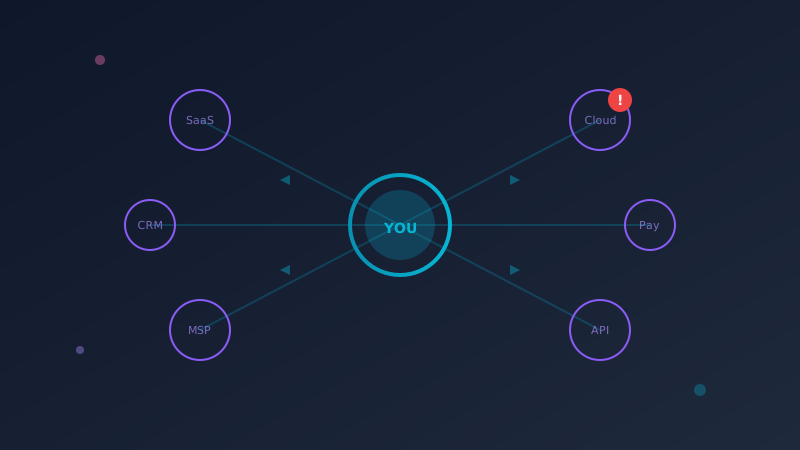
Modern businesses don't operate in isolation. From cloud services to payment processors, HR platforms to marketing tools, small and medium-sized businesses depend on a web of third-party vendors. Each of these relationships introduces both value and potential risk.
Why Third-Party Risk Matters
When you share data with a vendor or grant them access to your systems, their security posture becomes relevant to yours. A breach at a vendor can cascade to their customers. A vulnerability in widely-used software can affect thousands of businesses simultaneously.
This isn't theoretical—supply chain attacks have been responsible for some of the most significant security incidents in recent years. Attackers have recognized that compromising a single vendor can provide access to many downstream targets.
The SMB Challenge
Enterprise organizations often have dedicated teams to assess vendor security, negotiate contractual protections, and monitor ongoing risk. Small and medium-sized businesses typically lack these resources, yet face many of the same risks.
This creates a challenging dynamic: SMBs may rely heavily on third-party services (often more than larger organizations, as a way to access capabilities they couldn't build internally), while having limited ability to evaluate or influence vendor security practices.
Common Risk Scenarios
Data Sharing
Many business applications require access to sensitive data to function. Customer information, financial records, employee data—all may reside in systems operated by third parties. If those systems are compromised, your data may be exposed regardless of your own security measures.
We explored some data handling considerations in our article on the hidden data trail.
Integration Access
Modern software often connects to other systems through APIs and integrations. These connections can provide attackers with lateral movement opportunities if not properly secured. A compromise of one integrated service can potentially affect others.
Software Supply Chain
The software your business runs is itself built from components, libraries, and dependencies. A vulnerability or malicious code introduced anywhere in that supply chain can affect the final product. This risk exists whether you're using commercial software or custom-developed applications.
Managed Service Providers
Many SMBs rely on managed service providers (MSPs) for IT support and security. While this can provide access to expertise, it also means granting significant access to your systems. MSPs have become attractive targets precisely because compromising one can provide access to many client organizations.
The Visibility Problem
One of the core challenges with third-party risk is limited visibility. You may not know:
- What security practices your vendors actually follow
- Whether they've experienced breaches that weren't publicly disclosed
- What subcontractors or fourth parties they rely on
- How they would respond to a security incident affecting your data
This information asymmetry is difficult to overcome, particularly for smaller organizations with limited leverage.
Contractual Considerations
Contracts with vendors often include terms related to security and data handling, but the practical value varies. Small businesses typically accept standard terms without negotiation power. Even favorable contract terms may be difficult to enforce or may not prevent harm—only potentially provide recourse after the fact.
The Concentration Question
Many businesses rely heavily on a small number of critical vendors. If your operations depend entirely on one cloud platform, one software suite, or one service provider, a disruption to that vendor becomes a disruption to your business.
This concentration isn't necessarily wrong—there can be good reasons to standardize on particular platforms. But understanding the dependency helps clarify what's at stake.
We discussed related considerations in our article on the real cost of downtime.
An Evolving Landscape
Regulatory requirements around third-party risk management are expanding. Privacy laws increasingly hold organizations responsible for how their vendors handle personal data. Industry-specific regulations may impose particular requirements around vendor security.
For Canadian businesses, the evolving privacy landscape adds additional considerations. We covered some of this in our piece on Canada's privacy landscape.
Questions Worth Asking
Understanding your third-party risk doesn't require becoming a security expert. But asking some basic questions can illuminate your exposure:
- Which vendors have access to your most sensitive data?
- What would happen to your operations if a key vendor experienced a prolonged outage?
- Do you know what happens to your data when a vendor relationship ends?
- How would you learn if a vendor experienced a security incident?
There are no universal right answers to these questions—appropriate risk tolerance varies by business. But awareness of the landscape helps inform decision-making.
This article is intended for informational purposes only and does not constitute professional security or legal advice. Organizations should consult with qualified professionals to assess their specific situation.