
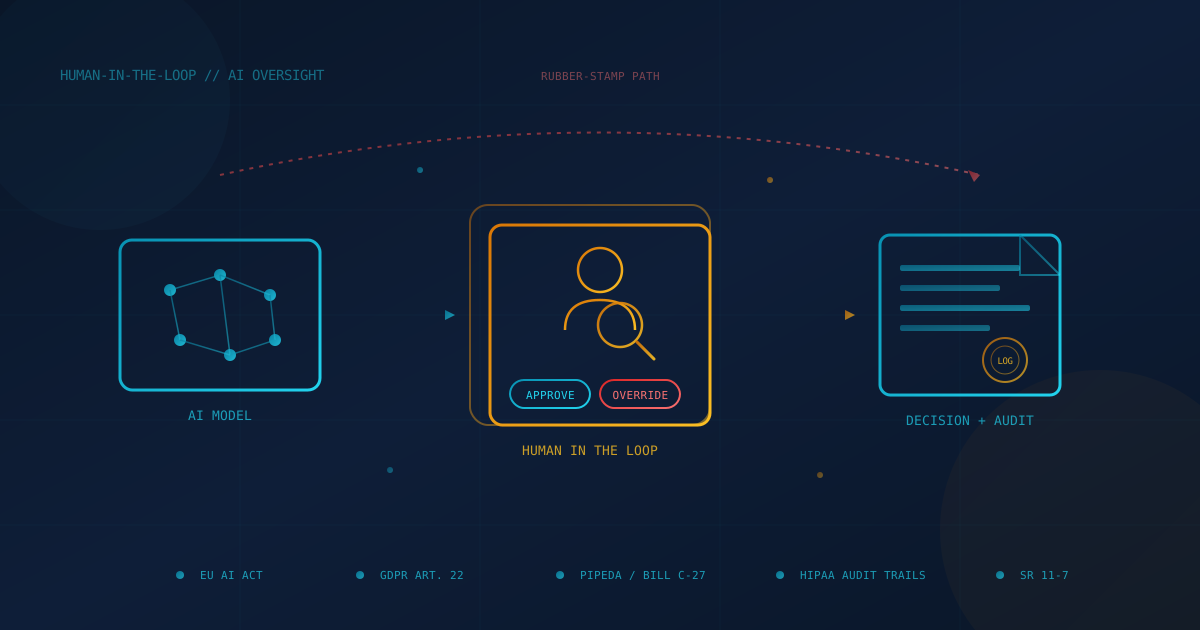
AI is now sitting somewhere in nearly every small business workflow — drafting customer replies, screening résumés, summarizing meetings, scoring leads, suggesting prices, writing marketing copy, and increasingly helping with code. The standard safeguard, when anyone asks, is the same almost everywhere: a person reviews the output before it ships. That single sentence — what compliance specialists call human in the loop AI, often shortened to HITL — used to be enough on its own.
It isn't anymore. Regulators on both sides of the Canadian and US border — and in the EU markets a lot of small businesses sell into — are starting to ask harder questions about exactly what that human is doing, how long they have to do it, and whether anyone can prove it happened.
A recent Kiteworks article on AI compliance makes the case that what counts as meaningful human review is much narrower than most businesses assume — and that a great deal of what gets labelled "human oversight" today is closer to a rubber stamp. This post translates that into what it means for a small business that does not have a compliance department.
What "Human in the Loop" Actually Means
Human in the loop is the practice of having a person check, approve, or override what an AI tool produces before that output is used to make a decision or sent into the world. In regulatory language, the review has to be real — meaning the reviewer has the information, the time, and the authority to change the answer. If the only realistic option is to click "approve," it is not human-in-the-loop oversight in the way regulators mean it.
In plain English, the phrase covers three very different levels of involvement:
- Watching: a person looks at AI behaviour in bulk — overall accuracy, patterns of error, complaint trends — and steps in when something looks off. No single output is reviewed before it goes out.
- Sampling: a person reviews some AI outputs but not all of them. Common where decisions are routine and the harm of any one mistake is low.
- Approving: nothing leaves the system without a human signing off on it. The AI is a draft; the person is the decision-maker.
The size and reversibility of the decision is what determines which level applies. A typo in a draft email is not the same kind of mistake as wrongly denying someone a job interview, a loan, or a medical referral.
When Small Businesses Actually Need It
Most everyday AI use in a small business sits comfortably in the watching or sampling zones — drafting emails, brainstorming copy, transcribing meetings, suggesting outlines. The cases where you need real, per-output human review are narrower, but they are precisely the ones where regulators are paying attention.
Plan on a genuine human-in-the-loop review when the AI is involved in any of the following:
- Screening applicants, scoring résumés, or recommending who to interview or hire
- Making or influencing credit, insurance, pricing, or eligibility decisions for customers
- Supporting medical, mental-health, or other care-related decisions
- Approving, denying, or escalating refunds, complaints, or account actions in customer support
- Acting on personal information — names, health, finances, location, identity documents
- Producing content that goes out under your business's name to customers, regulators, or the public
If you are not sure where a particular tool lands, our AI security checklist for small businesses walks through how to inventory what you are actually using.
The Rules That Already Apply to You
You do not need to be a Fortune 500 to be in scope. Several rules already on the books — or arriving in 2026 — apply to small businesses without anyone having to send you a letter first.
If You Sell into the European Union
The EU AI Act begins enforcing its rules for "high-risk" AI systems on August 2, 2026. High-risk categories include hiring and workforce-management tools, credit scoring and access to essential public or private services, education and exam systems, parts of law enforcement and migration, and certain critical infrastructure. A small Canadian or US business whose AI tool processes data about people in the EU can be on the hook the same way a large enterprise can. Article 14 of the Act explicitly requires that high-risk systems be designed so a competent human can understand the output, intervene, override, or stop using the system entirely.
If You Handle European Customer Data
The EU's General Data Protection Regulation, which already applies today, gives any person the right not to be subject to a decision made solely by automated processing where that decision significantly affects them — for example, a rejected application or a denied service — and the right to ask for a human to review it. That right is not waiting for new legislation. It is in force now.
In Canada
Canada's federal privacy law, PIPEDA, requires you to be transparent about how personal information is used and to give individuals meaningful access to that information. There is currently no enacted federal AI statute in Canada. The proposed Artificial Intelligence and Data Act (AIDA), introduced as part of Bill C-27, died on the Order Paper in January 2025 when Parliament was prorogued, and as of 2026 the federal government is operating under a Voluntary Code of Conduct on Generative AI rather than binding legislation. Provincial regulators have moved faster — most notably Quebec under Law 25, which already requires organizations to inform people when a decision about them is made exclusively by automated processing and to let them submit observations to a qualified person who can review or override that decision. Our overview of the Canadian privacy landscape for small businesses covers the rest of the picture.
In US Healthcare
HIPAA does not use the words "human in the loop," but the Security Rule requires audit trails detailed enough to reconstruct who made which decision about protected health information and when. An AI tool that touches patient data without a documented, named human reviewer is a difficult story to tell during an audit or a breach investigation.
In US Financial Services
Federal banking regulators have, for more than a decade, told institutions that any model influencing customer outcomes — pricing, credit, fraud, underwriting — needs ongoing human monitoring, defined override procedures, and validated controls. The guidance is older than the current generation of AI tools, but it applies to them. Small banks, credit unions, and the fintechs that serve them are inside that perimeter.
The common thread across all five: if your AI is helping decide something that materially affects a person, regulators expect a real human to be able to step in — and to be able to prove they did.
Why "We Have Someone Check It" Isn't Enough
The most common failure flagged by AI compliance specialists is not that businesses skipped human review entirely. It is that the review was theatrical. A queue too long to read carefully, a reviewer with two minutes per case, an override rate near zero, and no record of who looked at what. From the outside — and from a regulator's perspective — that is hard to distinguish from no review at all.
If a regulator, an insurer, a customer's lawyer, or your own board ever asks how your human-in-the-loop control is working, four numbers tend to come up:
- Volume: how many AI outputs each reviewer is responsible for in a given day or shift
- Time: how long the reviewer actually spends on each case
- Override rate: how often the human disagrees with the AI and changes the outcome
- Evidence: whether you can produce a tamper-evident log of what the AI proposed, who reviewed it, when, and what the final decision was
An override rate close to zero is rarely a sign that the AI is flawless. More often it is a sign that the human is not really reviewing — they are confirming. That distinction matters, both for the people on the receiving end of the decision and for the people who eventually have to answer questions about it.
What Canadian and US Business Leaders Should Ask Their Teams
You do not need to read the AI Act to find out where the gaps are in your own business. A short list of plain questions to your IT lead, MSP, or operations manager will surface most of them:
- Which AI tools are we using to make or shape decisions about specific people — customers, applicants, patients, employees?
- For each one, who is the named human reviewer, and how much time do they actually have per case?
- How often does that reviewer override the AI? Are we tracking it at all?
- If a customer asked for a human to redo a decision, could we do that within a reasonable window?
- Where are the review logs kept, and could we produce them in an audit, breach, or complaint?
- For tools we did not build ourselves, what does the vendor's documentation say about human oversight controls?
If the answers come back as shrugs or "we trust the model," that is the gap. It is also the same gap that shadow AI tends to widen, because tools nobody officially adopted rarely have a named reviewer behind them.
Practical Next Steps
You do not need a compliance department to get this right. A named list of AI use cases and a one-page oversight matrix is enough to put most small businesses ahead of where regulators expect them to be. A reasonable starting sequence:
- Inventory the AI in use. Include obvious tools (ChatGPT, Claude, Copilot, Gemini) and AI features quietly baked into software you already pay for — CRMs, helpdesks, hiring platforms, accounting tools. Our SaaS security guide for the AI era covers how to find them.
- Classify each tool by what it influences. Informational only, customer-facing, employee-facing, or regulated. Most fall into the first; a handful do not, and those are the ones that need real oversight.
- Pick the level of oversight that matches the decision: watching, sampling, or approving. Do not default everything to "approving" — that is how reviewer fatigue and rubber-stamping start.
- Name the human in the loop. A control without a named owner does not get exercised. For very small teams, the owner can be the same person for several tools — but they need to be named.
- Decide what you will log. At minimum: what the AI suggested, who reviewed it, when, and what the final decision was. Keep it somewhere a non-technical person could retrieve.
- Write it into your AI usage policy. If you do not have one yet, our guide to what an AI usage policy should include covers the structure.
- Revisit quarterly. AI capabilities are changing faster than most policies are. So are the rules around them.
If you want a starting point that does not require building any of this from scratch, our free quick security assessment flags AI governance and oversight gaps as part of a 22-question review you can complete in about five minutes.
The Bigger Pattern Worth Noticing
Human in the loop is moving from a slogan to a measurable control. The businesses that treat it as the latter — even at small scale — are the ones that will keep using AI confidently as the rules tighten through 2026 and into 2027.
The instinct, especially for small businesses, is to assume regulatory expectations only apply to large enterprises. That has not been true for privacy obligations for years, and it is not going to be true for AI ones either. The good news is that the bar is not perfection. It is evidence: a named reviewer, a defined process, a kept log, and an honest sense of where the AI is really driving the decision and where the human is.
If you have never measured your own human-in-the-loop control, the question is worth bringing to your next leadership meeting before someone outside the business asks it first.
This article is intended for general informational purposes only and does not constitute professional legal, compliance, or security advice. References to the EU AI Act, GDPR, PIPEDA, Bill C-27, HIPAA, and US financial-services guidance summarize publicly available information as of the date of publication and may evolve as enforcement and legislation develop. Organizations should consult qualified legal, privacy, and cybersecurity professionals before relying on this article to make compliance decisions.