
In early June 2026, a team of academic researchers published a preprint describing something the cybersecurity industry has feared for years: an AI-powered worm — self-spreading software that, instead of running a fixed list of pre-written exploits, decides how to attack each machine it meets, in real time, with no human at the keyboard.
A worm is malware that copies itself from device to device across a network without anyone clicking anything. Historically, worms were limited by their authors' imagination: they could only do what they were programmed to do. The researchers' prototype removes that ceiling. It carries a free, publicly available AI model, and when it lands on a new machine it reasons about what it is looking at and composes a tailored attack on the spot.
The findings come from CleverHans Lab at the University of Toronto, working with the Vector Institute and the University of Cambridge. To be clear up front: this was a controlled laboratory demonstration, not an attack found in the wild. But the reason it made headlines — including a Fortune piece calling it "the stuff of cybersecurity nightmares" — is that the researchers showed it can be built today, with off-the-shelf tools, at low cost. Here is what business leaders in Canada and the United States should take from it, without the hype.
What did the researchers actually build?
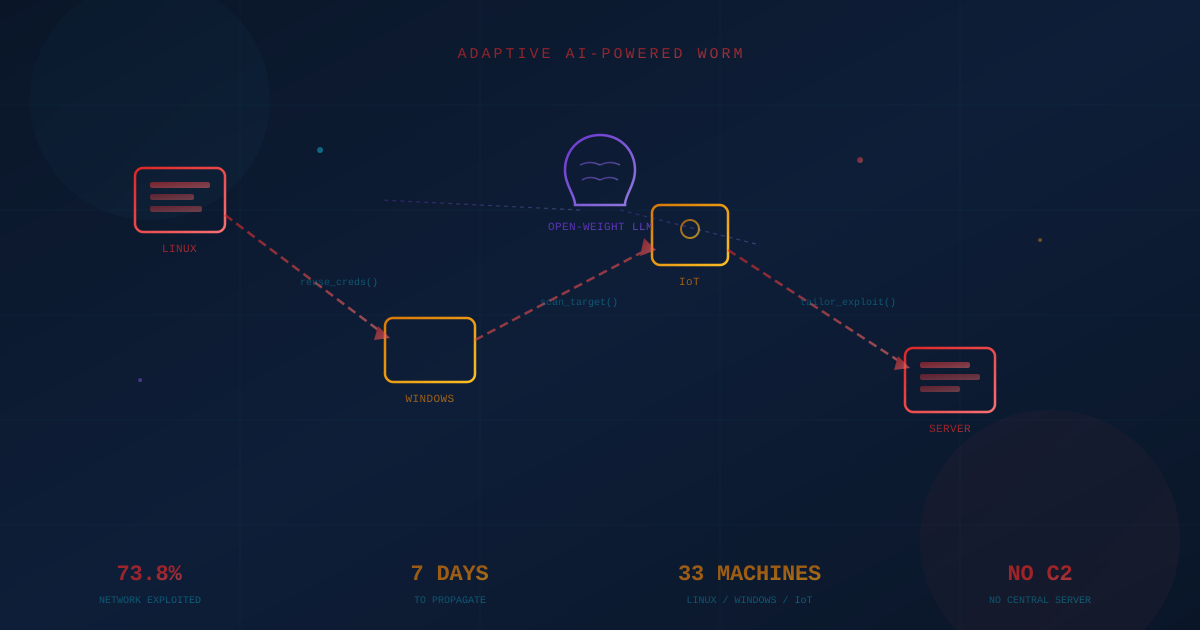
They built a proof-of-concept worm that uses a free, open-weight AI model to generate its own attack strategy for every machine it encounters. In a controlled simulation of a 33-machine corporate network — a mix of Linux, Windows, and Internet-of-Things (IoT) devices — the worm exploited 73.8% of the network and spread to 61.8% of hosts over seven days, identifying an average of 31.3 vulnerabilities per run.
The mechanics matter, so here they are in plain terms:
- It reasons, it doesn't recite. Traditional malware follows a script. This worm analyzes each target, weighs the weaknesses it finds, and picks the most promising way in — different decisions for a Windows server than for an IoT camera.
- It runs the AI on machines it has already taken. Once it compromises a device, it uses that device's own computing power to run the AI model. There is no central command-and-control server phoning home — which is exactly what most security tools watch for.
- It used a free, open-weight model. Not a frontier system behind a corporate API with safety guardrails, but a publicly available model — released in 2025 — that runs locally on a single high-end graphics card, the kind available outside data centres. The researchers deliberately did not name the specific model.
- It handled brand-new vulnerabilities. The worm exploited weaknesses disclosed after the AI model's training cut-off, by reading public security advisories on the fly — so it was not limited to a playbook baked in during training. Notably, it stuck to publicly known, unpatched flaws and misconfigurations, not secret "zero-day" bugs — which is how most real-world attacks work anyway.
One of the most common footholds it used will sound familiar to any business owner: reused passwords. The same password working on more than one system let the worm walk from device to device — the digital equivalent of one key opening every door in the building.
Is this happening in the wild right now?
No. This is a research prototype tested in an isolated, controlled environment, not a live campaign hitting real companies. That distinction is important, and it is the part most alarming headlines skip. No business was attacked, and the researchers built this specifically to demonstrate a risk before criminals do — a long-standing practice in security research.
The honest framing is that this is a warning shot, not a fire alarm. But it is a credible one, because the building blocks are already public. We have been tracking the same trajectory in our coverage of malware that rewrites itself using AI and the shrinking window between a vulnerability going public and attackers exploiting it. What this research adds is autonomy: a threat that doesn't need an operator to make decisions as it moves.
Why is this one different from ordinary malware?
The difference is autonomy plus invisibility. An AI-powered worm makes its own decisions and carries its brain with it, which breaks several assumptions that today's defenses quietly rely on. Most security products are tuned to catch known bad files and suspicious traffic to outside servers — and this design sidesteps both.
Four things make it a genuine departure from the worms of the past:
- No two attacks look the same. Because the worm tailors itself to each target, the "fingerprint" defenders normally match against keeps changing. Signature-based antivirus — the "book of mugshots" approach — has little to grab onto.
- No central server to block. Many defenses and investigations start by cutting off the attacker's command-and-control channel. A worm that thinks locally, on the machines it already owns, removes that choke point.
- The economics collapse. Sophisticated, adaptive attacks used to require skilled operators and real infrastructure. A free model running on hijacked hardware means the cost per target drops toward zero — and cheap attacks reach everyone, not just large enterprises.
- IoT is fair game. The simulation deliberately included IoT devices — cameras, sensors, smart hardware — which most organizations treat as harmless accessories. To an adaptive worm, an unmanaged smart device is just another door.
What should Canadian and US business leaders take from this?
The takeaway is not "buy an AI defense product." It is that the fundamentals you may have deprioritized — password hygiene, network segmentation, behavioral monitoring, and IoT inventory — are exactly the controls this kind of threat is designed to exploit. The researchers themselves pointed to defensive basics, not exotic countermeasures.
Notably, the weaknesses the worm leaned on are the same ones that anchor both Canadian and US security baselines — the Canadian Centre for Cyber Security's Baseline Cyber Security Controls and the US CIS Controls and NIST Cybersecurity Framework. None of them are new. All of them work against an adaptive attacker for the same reason they work against a human one.
Here are the questions worth raising with your IT lead or managed provider this quarter:
- Are passwords reused across our systems? If one stolen credential opens several doors, segmentation and multi-factor authentication are what stop a single foothold from becoming a full breach.
- Do we actually know everything on our network? Including printers, cameras, and smart devices. You cannot defend what you have not counted.
- Are we watching for behavior, or just known threats? Detection that flags unusual activity — a workstation suddenly scanning its neighbors — is what catches an attack that has no fixed signature.
- If something got in tonight, would anyone notice before Monday? Centralized logging and someone (or something) watching it around the clock is the difference between a contained incident and a company-wide one.
Practical next steps
None of the following requires becoming a security expert, and most of it you may already have started. The goal is to close the specific gaps an adaptive worm is built to find:
- Kill reused and weak passwords. Deploy a password manager, enforce unique credentials, and turn on multi-factor authentication everywhere it is offered. Our guide on why password audits fail covers where most businesses slip.
- Segment your network. Keep IoT devices, guest Wi-Fi, and critical systems on separate segments so a compromise in one place cannot freely spread to the rest.
- Inventory every connected device. Build and maintain a list of what is actually on your network, and retire or isolate anything unmanaged.
- Move beyond signature-only antivirus. Behavioral detection (often sold as EDR — Endpoint Detection and Response) watches for suspicious actions, not just known files. We walk through the options in our guide to defending against AI-powered attacks.
- Centralize logging and monitoring. Make sure activity across your systems is recorded in one place and reviewed — ideally continuously.
- Have a response plan. Decide in advance how you would isolate an affected device and who makes the call. A written incident response plan turns panic into procedure.
If you are not sure where your organization stands on these, our free quick security assessment is a 5-minute, 22-question starting point that maps directly to the gaps described above.
The durable lesson
The unsettling part of this research is not that AI invented new ways to break in. It is that AI makes old ways to break in — reused passwords, forgotten devices, flat networks — far more dangerous, because an autonomous attacker can find and chain them faster and cheaper than any human team. The threat is genuinely new; the openings it exploits are not.
That is also the encouraging part. The same fundamentals that have always mattered — strong unique passwords, segmentation, behavioral monitoring, knowing what is on your network — are what blunt this. Businesses that keep those sharp are not defenseless against an AI-powered worm. They are doing precisely what the researchers say works. The organizations at real risk are the ones still treating these basics as optional.
This article is intended for general informational purposes only and does not constitute professional security, legal, or compliance advice. Details about the University of Toronto, Vector Institute, and University of Cambridge AI-powered worm research are based on a preprint and public reporting as of the date of publication and may evolve as the work is reviewed. Organizations should consult qualified cybersecurity professionals before making operational changes based on this article.