For decades, cybersecurity worked a bit like a game of matching. Security software kept a list of known threats—think of it as a book of mugshots—and when it spotted something that matched, it blocked it. It wasn't perfect, but it worked well enough.
That game is changing fast.
Recent research from Google, CrowdStrike, Check Point, and other leading security firms points to a troubling shift: cybercriminals are now using artificial intelligence to create malware that can disguise itself, adapt its approach, and move through networks faster than most businesses can respond. It's not science fiction. It's already happening—and Google's own threat intelligence team has documented it.
Here's what business owners should know, without the jargon.
The Short Version: What's Actually Happening
In late 2025, Google's Threat Intelligence Group published a landmark report documenting something the security industry had been anticipating for years: malware that talks to AI during an attack.
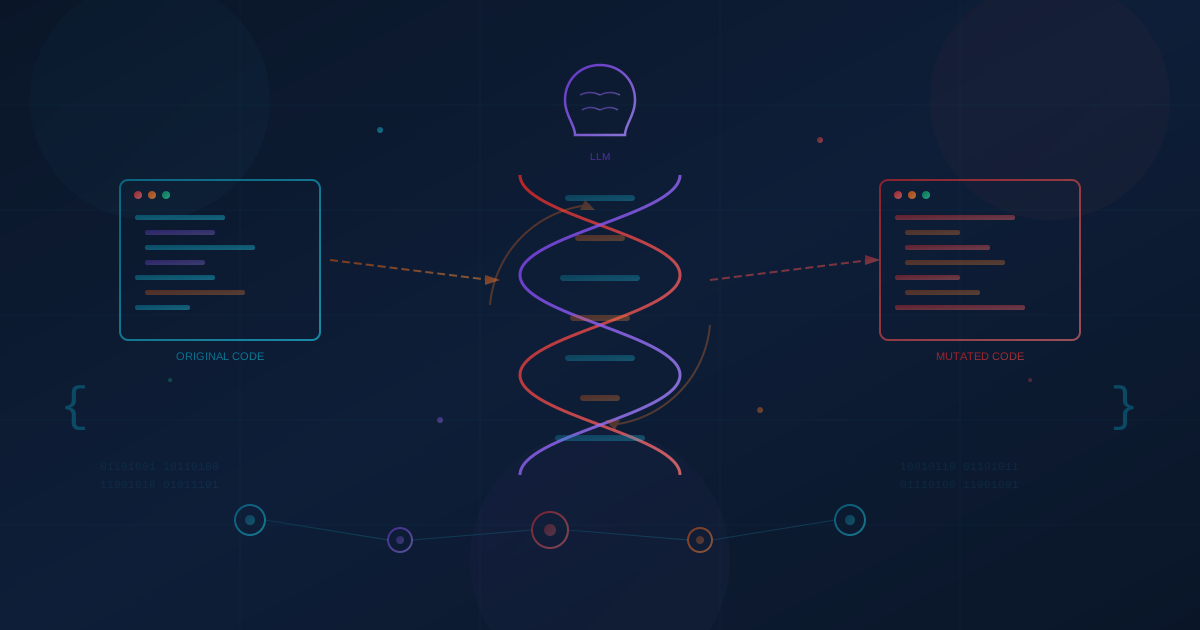
Think of it this way. Traditional malware is like a pre-written script—it does the same thing every time, which makes it relatively predictable and detectable. The new breed of malware is more like a conversation. It connects to an AI system in real time and asks for help: "Rewrite my code so security software doesn't recognize me" or "Generate a command to steal files from this computer."
Google confirmed this is no longer theoretical. They found active malware doing exactly this—including one strain linked to a Russian military intelligence operation targeting Ukraine. It was using an AI model to generate attack commands on the fly, adapting to each target environment rather than following a fixed script.
This was, in Google's words, the "first observation of malware querying an AI model deployed in live operations."
Why This Matters Beyond the Headlines
Google's findings would be concerning enough on their own. But they're part of a much broader pattern that's been building throughout 2025 and into 2026.
Attacks Are Getting Dramatically Faster
CrowdStrike—one of the world's largest cybersecurity firms—tracks how quickly attackers move once they get inside a network. In their 2025 report, they found the average time dropped to just 48 minutes. The fastest they observed? Fifty-one seconds.
To put that in context: if an attacker breaches your network on a Friday evening, they could have access to everything they need before anyone on your team checks their email Monday morning. With AI automating more of the attack process, these timelines are only getting shorter.
One Person Can Now Do What Used to Take a Team
In January 2026, security researchers at Check Point published an analysis of a sophisticated malware framework called VoidLink. It consisted of roughly 88,000 lines of code—a substantial piece of software by any measure. The remarkable part? It was built almost entirely by a single person using an AI coding assistant, in approximately one week.
Previously, building something this complex would have required a coordinated team working for months. AI has compressed that timeline dramatically, which means the sheer volume of new threats reaching businesses is likely to increase—because it's never been easier or cheaper to create them.
The Numbers Are Moving in the Wrong Direction
Across the industry, the trend lines are consistent:
- The World Economic Forum's 2025 Global Cybersecurity Outlook found that 72% of organizations reported a measurable rise in cyber risks, with AI-powered threats cited as a primary driver
- ThreatDown's 2026 State of Malware Report warned that cybercrime is entering a "post-human future," with AI-automated attacks operating at machine speed around the clock
- SentinelOne researchers scanning VirusTotal—one of the world's largest malware databases—found over 7,000 samples containing embedded AI credentials, signaling that cybercriminals are actively experimenting with integrating AI into their tools
- A Harvard-led research study found that AI-generated phishing emails achieved a 54% click-through rate—matching the effectiveness of emails crafted by human experts, and dramatically outperforming basic phishing attempts
Nation-States Are Leading the Way—But Criminals Follow
The most advanced AI-powered attacks documented so far have been linked to nation-state actors—government-backed hacking groups from Russia, China, and North Korea. But historically, techniques that start at the nation-state level trickle down to ordinary cybercriminal groups within months or years.
In one notable case from 2025, Anthropic (the company behind the Claude AI) disclosed that a Chinese state-sponsored group had used an AI tool to run an espionage campaign that was approximately 80-90% autonomous—handling everything from initial reconnaissance to data theft with minimal human involvement.
When these techniques become available to everyday cybercriminals—and they will—the implications for small and medium-sized businesses are significant.
What's Actually Different for Business Owners
If you're running a business, the natural question is: "What does this change for me, practically?"
Three things stand out.
1. Your Security Tools May Be Looking for the Wrong Thing
Most traditional antivirus software works by recognizing known threats—the "mugshot book" approach we mentioned earlier. Industry data suggests this method now catches less than half of current malware on its own, because so many threats change their appearance to avoid being recognized.
Modern security tools take a different approach. Instead of asking "Have I seen this before?" they ask "Is this behaving suspiciously?" It's the difference between checking an ID at the door versus watching for someone acting strangely once they're inside. Organizations relying solely on the first approach may want to evaluate whether their current tools are keeping pace.
We've covered what modern endpoint protection looks like in more detail in our cybersecurity checklist for small businesses.
2. Speed Is Becoming the Deciding Factor
When attackers can move through a network in under an hour, the window for a human to notice, investigate, and respond is extremely narrow. This is shifting the conversation from "Do we have security?" to "How fast can we detect and respond?"
For many small businesses, this means the question isn't whether you have a firewall or antivirus—it's whether anyone is watching your systems at 2 a.m. on a Saturday when an AI-powered attack doesn't take weekends off.
3. Every Business Is Now a Viable Target
One of the most important shifts AI introduces is economic. Advanced cyberattacks used to be expensive and time-consuming to execute, which meant attackers had to be selective about their targets. Large enterprises, government agencies, and financial institutions bore the brunt.
AI changes that equation. When a single person can build a sophisticated malware framework in a week, or an AI can generate targeted phishing emails at scale, the cost per attack drops dramatically. That makes smaller businesses—which often have fewer defenses—increasingly attractive targets.
This isn't speculation. The data already reflects it: ransomware attacks against smaller organizations have been climbing steadily. Sophos' 2025 Active Adversary Report found that the median time attackers spend inside a network before being detected has dropped to just two days—not because defenses improved across the board, but because attacks are moving so fast that they reach their objective before most organizations even notice.
What Business Owners Can Do About It
The good news is that defending against AI-enhanced threats doesn't require becoming a cybersecurity expert. It does require making sure your defenses haven't fallen behind the curve. Here are some areas worth evaluating:
Look at How Your Business Detects Threats
If your current protection is primarily based on recognizing known threats, it may be worth exploring solutions that also monitor for suspicious behavior patterns. This is what the security industry calls EDR (Endpoint Detection and Response)—and it's becoming the baseline rather than the premium option. We've discussed how to evaluate modern protection options in a previous post.
Think About Monitoring, Not Just Prevention
Prevention is important, but with attack timelines compressing, detection speed matters just as much. Consider whether your current setup includes active monitoring—someone or something watching for threats around the clock. For many small businesses, this is where a managed security provider can bridge the gap between what's needed and what's practical to staff internally.
Keep the Basics Sharp
AI-powered malware is a new delivery mechanism, but it still exploits the same familiar gaps: weak passwords, unpatched software, untrained employees, and unaddressed vulnerabilities. The fundamentals haven't changed—multi-factor authentication, regular software updates, employee awareness training, and reliable backups remain the foundation of effective security.
Have a Conversation About AI at Work
One often-overlooked angle: the same AI tools that attackers are using are also being adopted by employees within your organization—sometimes without IT's knowledge. IBM's 2025 research found that data breaches involving unauthorized AI tool usage cost an average of $670,000 more than other breaches. Having clear guidelines about what AI tools are approved for business use is a practical step that reduces risk on multiple fronts.
Don't Wait for a Perfect Plan
The threat landscape is evolving quickly, and waiting for a comprehensive strategy before taking any action leaves organizations exposed in the meantime. Even incremental improvements—enabling multi-factor authentication, ensuring backups are current, reviewing who has access to what—can meaningfully reduce risk while a longer-term plan takes shape.
The Bigger Picture
AI isn't just changing how businesses operate—it's changing how they're attacked. The research from Google, CrowdStrike, Check Point, and others paints a consistent picture: threats are getting faster, more sophisticated, and more accessible to a wider range of attackers.
That doesn't mean the sky is falling. The same AI that's being used to create threats is also being used to detect and prevent them. Organizations that invest in modern detection, active monitoring, and strong fundamentals are well-positioned to stay ahead of the curve.
But for businesses still relying on the security tools and strategies they set up a few years ago, the gap between those defenses and today's threats is widening. And in cybersecurity, gaps have a way of becoming very expensive, very quickly.
This article is intended for informational purposes only and does not constitute professional security, legal, or compliance advice. Organizations should consult with qualified professionals to assess their specific circumstances and develop appropriate protective measures.